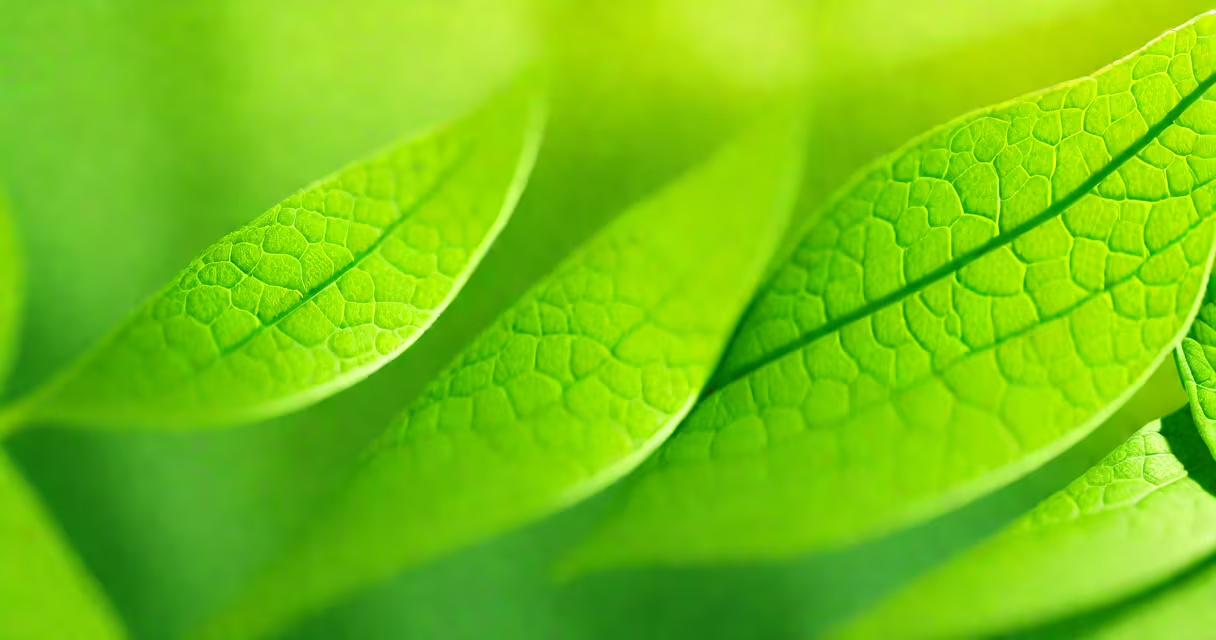
Green is the color produced when chlorophyll in plant cells reflects green wavelengths of visible light while absorbing red and blue wavelengths. This selective reflection is central to photosynthesis and determines the visual appearance of most leaves.
Chlorophyll is a complex molecule containing a magnesium ion at its center. It exists in several forms, with chlorophyll a and chlorophyll b being the most common in higher plants. These pigments absorb light primarily in the blue-violet (around 430 nm) and red (around 662 nm) regions of the spectrum. Green light, which falls between 500 and 570 nm, is not absorbed efficiently and is instead reflected or transmitted through the leaf tissue.
When sunlight hits a leaf, photons in the red and blue ranges excite electrons in chlorophyll molecules. This energy drives chemical reactions that split water into oxygen and hydrogen, and fix carbon dioxide into sugars. The unabsorbed green light exits the leaf and reaches our eyes, creating the perception of green. Without chlorophyll's absorption pattern, leaves would appear dark or black under sunlight, as they would absorb nearly all incident light.
Visible light spans wavelengths from approximately 380 nm (violet) to 750 nm (red). Within this range, green occupies the middle band. Human eyes have cone cells sensitive to red, green, and blue light. When green wavelengths dominate the reflected signal from a surface, the brain interprets the signal as green.
Plants evolved to use chlorophyll because the sun's peak emission is in the visible spectrum, particularly around 500 nm. By absorbing strongly in the blue and red ends, chlorophyll maximizes energy capture while minimizing thermal damage from high-energy photons. Reflecting green light reduces heat buildup in leaves, which helps maintain optimal enzyme function during photosynthesis.
A single leaf can reflect up to 40% of incident green light, depending on thickness, water content, and cellular structure. Thicker leaves with more layers of mesophyll cells tend to scatter green light more effectively, enhancing the perceived brightness of green. This is why some tropical plants have deeper green hues than desert species.
While chlorophyll dominates green coloration in living plants, other pigments contribute to green appearances in different contexts:
| Pigment Type | Color Reflected | Primary Location | Function |
|---|---|---|---|
| Chlorophyll a | Blue-green | Photosystem II reaction centers | Primary photochemical reaction |
| Chlorophyll b | Yellow-green | Light-harvesting antennae | Expands light absorption range |
| Carotenoids (e.g., lutein) | Yellow-orange | Protective layer in chloroplasts | Shield chlorophyll from excess light |
| Anthocyanins (in some young leaves) | Red-purple | Cell vacuoles | UV protection, signaling |
Carotenoids do not produce green themselves but can mask or modify the green hue. For example, in autumn, carotenoids become visible as chlorophyll breaks down, revealing yellow and orange tones. In spring, young leaves may appear reddish due to anthocyanins, which fade as chlorophyll levels rise.
Some algae and cyanobacteria use chlorophyll d, which absorbs far-red light and reflects green. This adaptation allows them to thrive in shaded underwater environments where red light is filtered out. Their green appearance is less intense than terrestrial plants because their pigments are tuned to different parts of the spectrum.
Many assume green is the default or most efficient color for photosynthesis. This is incorrect. Green light is actually the least effective for driving photosynthesis. Studies show that photosynthetic rates drop by 30-50% when only green light is supplied compared to red or blue.
Another misconception is that all green plants rely solely on chlorophyll. Some ferns and mosses contain additional pigments like phycobiliproteins, which absorb green light and transfer energy to chlorophyll. These organisms grow in low-light conditions where green light penetrates deeper than red or blue.
Even the term "green" varies across cultures and contexts. In art and design, "green" often refers to a specific shade defined by RGB values (e.g., #00FF00). In botany, green is a broad category encompassing shades from lime to forest green. A single leaf can display multiple green tones due to differences in pigment concentration and cell arrangement.
Consider a maple leaf under three lighting conditions:
This demonstrates that green light is inefficient for photosynthesis despite being the dominant color we see. The evolutionary trade-off favors energy capture over visual appeal.
I once measured leaf reflectance using a handheld spectroradiometer while studying urban tree health. A sycamore leaf in direct sunlight showed a 38% reflectance peak at 550 nm. Under artificial streetlights (mostly yellow-white), the same leaf appeared darker and less vibrant. The difference wasn't just aesthetic-it affected photosynthetic efficiency and long-term growth.
Green is not a single property. It results from the interaction of light, molecular structure, and biological function. Chlorophyll's ability to reflect green light is incidental to its primary role: capturing solar energy. The green color is a side effect of energy optimization, not a goal.
Understanding this explains why some plants turn yellow or red in fall-they degrade chlorophyll to recycle nutrients. The green fades not because the color disappears, but because the pigment responsible for reflecting green is broken down.
What makes green is a combination of physics, chemistry, and evolution. It's not a choice, but a consequence of how life captures energy from sunlight.