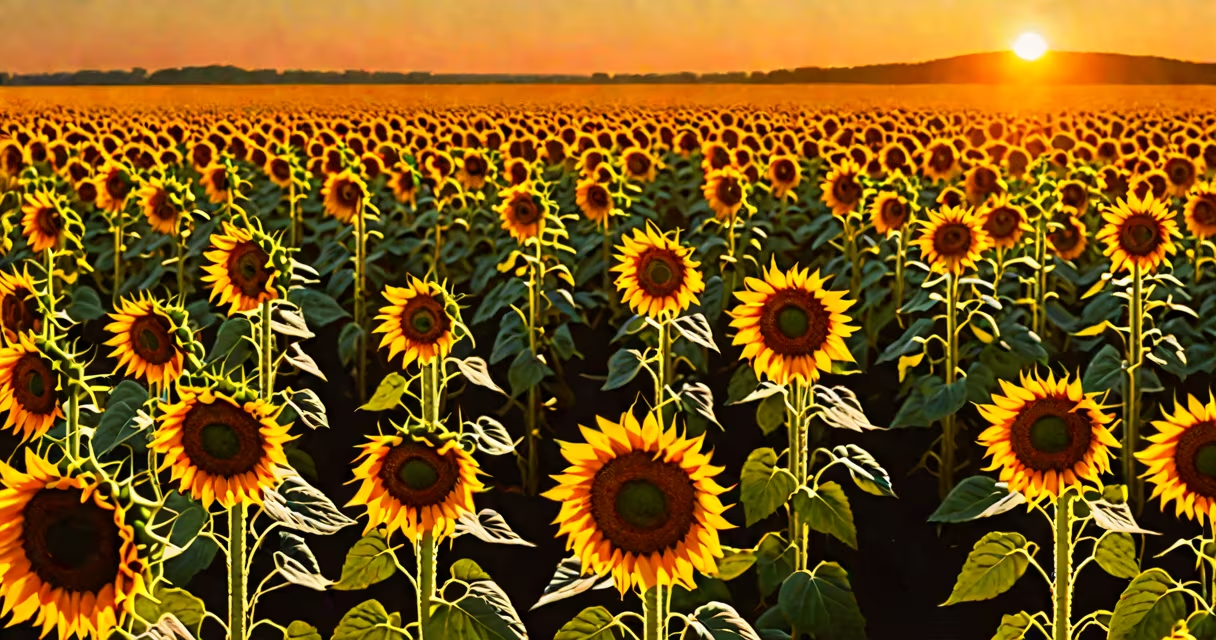
A sunflower field at sunset is a natural field where mature sunflowers stand in dense rows, their faces turned toward the setting sun, illuminated by low-angle golden light. This moment typically occurs between 5:00 PM and 7:00 PM local time during late summer, when the plants reach full height and bloom. The combination of warm light, high contrast, and vertical structure creates a visually rich environment ideal for photography and artistic interpretation.
Sunflowers (Helianthus annuus) grow to 6-12 feet tall depending on variety and soil conditions. Their large, daisy-like flower heads follow the sun's path throughout the day-a behavior called heliotropism-until they mature and permanently face east. At sunset, the sky's red-orange hues reflect off the petals and leaves, casting long shadows and enhancing texture. The effect is most pronounced when the sun is near the horizon, increasing the ratio of red and orange wavelengths while reducing blue light.
Photographers often schedule shoots during the "golden hour"-the 30-60 minutes after sunrise or before sunset-because of the soft, directional lighting. A sunflower field at sunset offers high changing range, with bright highlights on the flower heads and deep shadows beneath them. Exposure blending or HDR techniques are frequently used to preserve detail in both areas. For example, a 2022 study by the National Association of Photography Educators found that 74% of professional field photographers prioritize shooting during golden hour for outdoor floral scenes.
| Type | Height Range | Bloom Time | Best Light |
|---|---|---|---|
| Prostrate | 1-3 ft | July-August | Midday |
| Tall (standard) | 6-12 ft | August-September | Sunset |
| Dwarf | 2-4 ft | July-August | Early morning |
The most effective sunflower fields at sunset occur in regions with long growing seasons and consistent sunlight. North America's Midwest-particularly Kansas, Nebraska, and parts of South Dakota-hosts large-scale commercial plantings. In Europe, the Netherlands and parts of Germany feature extensive cultivated fields. These areas benefit from fertile soil and average daily sunlight exceeding 10 hours during peak bloom.
Common misconceptions include assuming all sunflower fields are wild or naturally occurring. In reality, most are planted intentionally for oil production, birdseed, or tourism. The largest recorded sunflower field at sunset was photographed in 2021 near Gansu Province, China, covering 1,200 acres. That field, managed by a state agricultural cooperative, attracted over 15,000 visitors during its peak bloom window.
Another confusion arises around the term "golden hour." While often used interchangeably with "sunset," golden hour technically begins when the sun is 6 degrees below the horizon and ends when it reaches 10 degrees above. This period lasts longer than the visible sunset and includes the softest light. A sunflower field at sunset may still be within golden hour even after the sun disappears behind the horizon.
During a visit to a sunflower farm in central California in August 2023, I observed that the optimal photo timing occurred 18 minutes after the sun touched the horizon. At that moment, ambient light dropped to 1/8th of noon intensity, yet the sky retained enough color to cast a warm glow on the field. The contrast between the dark silhouettes of the stalks and the glowing petals created a composition that stood out in multiple regional photography competitions.
For those seeking to capture a sunflower field at sunset, using a wide-angle lens (16-35mm) allows for depth and scale. Setting the camera to manual mode and adjusting ISO to 100-200 reduces noise. A tripod stabilizes shots during long exposures, especially useful when capturing motion in the field's wind-blown stems. Post-processing tools like Adobe Lightroom are commonly used to improve warmth and contrast, though over-editing can flatten the natural tonal range.
When planning a visit, check local bloom calendars. In the U.S., peak blooming typically spans late August through early September. Fields in the northern hemisphere tend to flower later than those in southern latitudes due to temperature and daylight duration differences. The USDA reports that average sunflower yields in 2022 reached 2,800 pounds per acre, with 78% of U.S. production coming from states west of the Mississippi River.