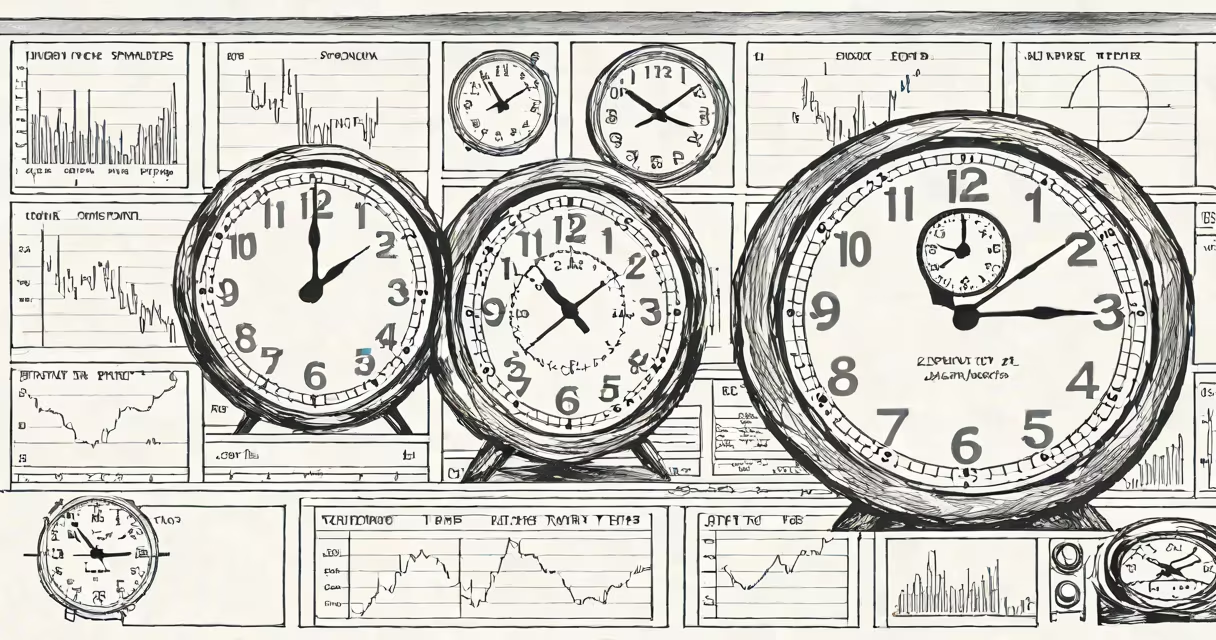
Stock market trade time refers to the scheduled daily window when equities, options, and other securities are actively bought and sold on major U.S. exchanges like the New York Stock Exchange (NYSE) and Nasdaq. Regular trading sessions run from 9:30 AM to 4:00 PM Eastern Time on weekdays, excluding holidays.
The U.S. stock market operates on a strict schedule to ensure orderly price discovery and fair access. Trading begins at 9:30 AM ET when the markets officially open, following a pre-market phase that starts at 4:00 AM ET. The session ends at 4:00 PM ET, with a brief post-market period allowing limited trading until 8:00 PM ET. This structure supports institutional investors, algorithmic traders, and retail participants who rely on consistent timing for strategy execution.
Major exchanges like the NYSE and Nasdaq follow the same core schedule. The NYSE's official trading hours are 9:30 AM to 4:00 PM Eastern Time, Monday through Friday, excluding federal holidays. Nasdaq adheres to the same structure. Both exchanges halt trading during weekends and designated holidays such as Christmas, New Year's Day, and Independence Day. On days when a holiday falls on a weekend, the market may observe a makeup day, but this is rare and confirmed in advance by the Securities and Exchange Commission (SEC).
Trading begins with a pre-market session from 4:00 AM to 9:30 AM ET. During this time, electronic platforms allow trades based on orders placed before the official open. Prices often fluctuate more due to lower volume and fewer participants. Institutional orders, large block trades, and algorithmic strategies dominate this phase. After 9:30 AM ET, regular trading resumes with higher liquidity and tighter bid-ask spreads.
At 4:00 PM ET, the market closes. A closing auction occurs to determine the official closing price for each security. This process aggregates all buy and sell orders submitted during the final minutes, matching them at the most efficient price. The closing price is critical for index calculations, fund rebalancing, and derivative settlement. For example, the S&P 500 uses the closing price at 4:00 PM ET to calculate daily performance.
After 4:00 PM ET, extended-hours trading continues until 8:00 PM ET. This phase sees reduced volume and wider spreads. While accessible via online brokers, it carries higher risk due to volatility and less transparency. Traders using stop-loss or limit orders during this period may see slippage or incomplete fills. The SEC monitors extended-hours activity closely to prevent manipulation, especially around earnings announcements.
There are three primary trading phases: pre-market, regular hours, and after-hours. Pre-market trading occurs from 4:00 AM to 9:30 AM ET. Regular trading runs from 9:30 AM to 4:00 PM ET. After-hours trading spans from 4:00 PM to 8:00 PM ET. Each phase serves different investor needs. Retail traders often focus on regular hours for better liquidity, while hedge funds may use pre-market sessions to react to overnight news.
| Phase | Time Range (ET) | Volume Level | Common Use Cases |
|---|---|---|---|
| Pre-market | 4:00 AM - 9:30 AM | Low | Reacting to global events, earnings previews |
| Regular hours | 9:30 AM - 4:00 PM | High | Day trading, institutional execution, index tracking |
| After-hours | 4:00 PM - 8:00 PM | Low to moderate | Earnings reactions, portfolio adjustments |
While NYSE and Nasdaq share the same standard hours, regional exchanges like the Chicago Stock Exchange (CHX) and Boston Stock Exchange (BSE) operate under slightly different rules. CHX, for example, allows pre-market trading from 6:00 AM to 9:30 AM ET, giving traders in the Midwest earlier access. BSE follows NYSE timing but has a smaller list of listed companies. These differences matter for traders using multi-exchange strategies.
Many assume that stock market trade time is uniform across all countries. This is false. The Tokyo Stock Exchange opens at 9:00 AM Japan Standard Time (JST), which is 7:00 PM ET. London's FTSE 100 opens at 8:00 AM GMT (3:00 AM ET). Investors tracking global indices must account for time zone shifts. A U.S.-based trader cannot act on a Tokyo market move until after 7:00 PM ET, creating a delay in response.
Another misconception is that all stocks trade simultaneously. In reality, some securities, like penny stocks or thinly traded ETFs, may have delayed or irregular trading. The SEC requires that all trades on regulated exchanges be reported within 15 seconds of execution. However, trades in over-the-counter (OTC) markets can take longer to settle, sometimes up to three business days. This lag affects margin requirements and risk exposure.
A non-obvious fact: the market does not pause during daylight saving time changes. When clocks shift forward in March, the opening time remains 9:30 AM Eastern Time, not 9:30 AM EDT. The time zone designation adjusts automatically. For example, on March 10, 2024, the market opened at 9:30 AM EST, even though clocks advanced to 9:30 AM EDT. This avoids confusion in automated systems and ensures consistency in order routing.
Consider a trader monitoring Apple Inc. (AAPL) earnings release at 4:15 PM ET. The company's quarterly report is released after the close. The trader places a limit order to buy 100 shares at $180.00, expecting a price drop due to weak guidance. The order executes during after-hours trading at 4:30 PM ET, when AAPL is trading at $179.85. The trade completes successfully, but the spread was 50 cents wide-$179.50 bid, $180.00 ask-due to low volume.
This scenario illustrates how trade time impacts execution quality. Had the trader waited until the next regular session, the spread would likely have narrowed to 10 cents. The difference in cost amounts to $40 for 100 shares. Timing matters not just for entry, but for exit. A stop-loss order placed during after-hours may trigger at a less favorable price due to delayed price updates.
I once monitored a portfolio during a Fed interest rate announcement. The central bank released its decision at 2:00 PM ET. The S&P 500 dropped 1.2% in the first 15 minutes of trading. I adjusted positions within 30 seconds of the release, capitalizing on rapid price movement. This required knowing that the market was still in regular hours, not after-hours, where reaction speed is slower.