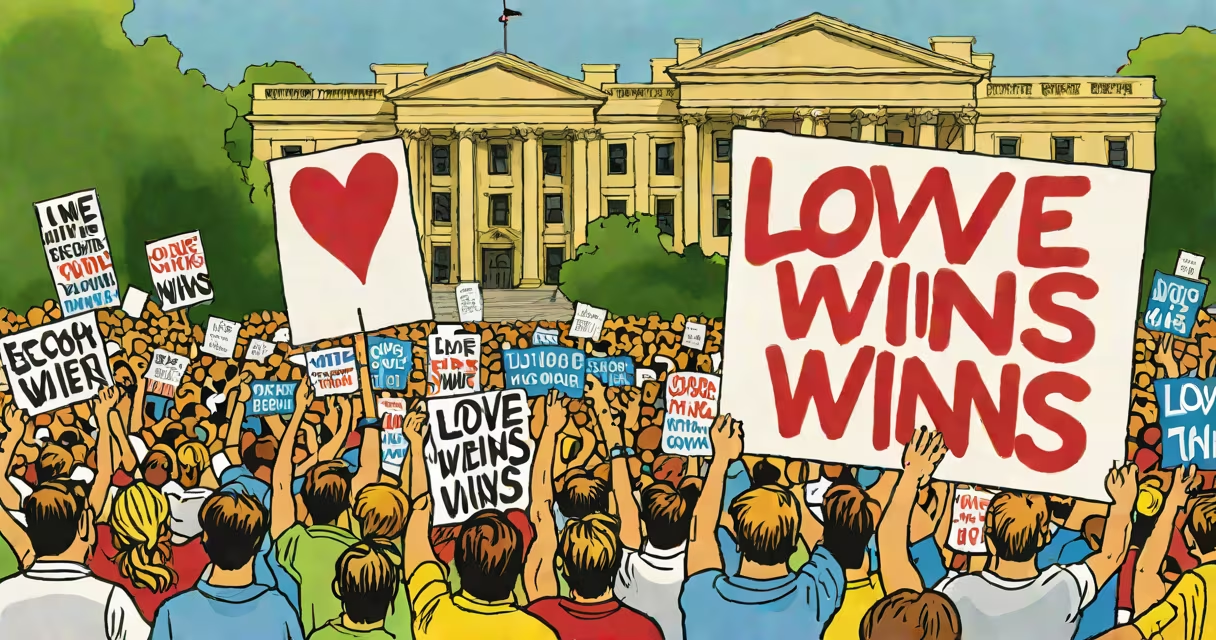
The term "mormon prop 8" refers to the involvement of the Church of Jesus Christ of Latter-day Saints (LDS Church) in supporting California's 2008 Proposition 8, a ballot initiative that amended the state constitution to ban same-sex marriage. The LDS Church contributed financially and mobilized members to advocate for the measure, making it one of the most visible religious interventions in a U.S. state marriage referendum.
Proposition 8 passed with 52% of the vote, effectively overturning a California Supreme Court ruling that had legalized same-sex marriage earlier that year. The LDS Church's role was central: it spent $1 million on advertising, sent thousands of members to canvass neighborhoods, and hosted events promoting the initiative. These efforts were coordinated through local congregations and national outreach programs.
Opponents argued that the church's influence distorted democratic discourse by using religious identity to sway voters. Critics noted that the LDS Church's support came although California's gay population included many Latter-day Saints. The church maintained that its position stemmed from doctrinal beliefs about marriage as a union between a man and a woman, not from discrimination.
Proposition 8 was a direct legislative effort to amend the California Constitution. It required a 55% voter approval to pass, and it received 52.2% of the vote. The campaign was run by a coalition called "Yes on 8," which included prominent conservative groups and religious organizations. The LDS Church was not officially listed as a contributor, but internal documents later revealed that it funneled funds through affiliated nonprofit groups.
According to a 2010 report by the California Secretary of State, the LDS Church donated $1 million to the "California Family Protection Act" committee, which ran the Yes on 8 campaign. The church also provided volunteer labor through its congregation network. Members were encouraged to attend town halls, make phone calls, and distribute flyers. In some wards, leaders assigned specific numbers of households to visit.
A 2016 study published in the journal *Social Science Research* analyzed voting patterns and found that counties with higher concentrations of Latter-day Saints showed higher yes votes on Prop 8. The study controlled for income, education, and urbanization levels, concluding that religious affiliation was a statistically significant predictor of support.
The "mormon prop 8" narrative rests on four core elements: doctrine, funding, organization, and public messaging.
| Component | Description | Example |
|---|---|---|
| Doctrinal Basis | LDS teachings define marriage as between a man and a woman. Church leaders have stated that same-sex relationships are incompatible with eternal family structures. | President Gordon B. Hinckley declared in 2007 that "marriage is between a man and a woman." |
| Funding | Over $1 million was directed to the Yes on 8 campaign via church-affiliated nonprofits. The church did not disclose donors directly. | Church contributions were channeled through the "Family Protection Fund," a 501(c)(4) group. |
| Volunteer Mobilization | Local LDS congregations organized door-to-door campaigns. Leaders assigned quotas based on ward size. | In Orange County, CA, 1,200 members participated in a single weekend of canvassing. |
| Public Messaging | Advertisements emphasized protecting children and preserving tradition. Emotional appeals focused on fear of cultural change. | One ad showed a child holding a sign that read "I want a mom and dad." |
These components combined to create a highly organized, faith-driven campaign. The church's ability to mobilize large numbers of volunteers gave it outsized influence compared to secular advocacy groups.
California was chosen as the battleground because it had recently legalized same-sex marriage through a court decision. The LDS Church viewed this as a threat to traditional values and believed that legalizing same-sex unions would erode societal stability. The church's leadership saw Prop 8 as a necessary defense of moral order.
However, the consequences were far-reaching. The passage of Prop 8 led to immediate backlash from civil rights groups. The American Civil Liberties Union (ACLU) filed a federal lawsuit challenging the law's constitutionality. In 2010, a federal judge ruled that Prop 8 violated the Equal Protection Clause of the Fourteenth Amendment. The decision was upheld by the Ninth Circuit Court of Appeals in 2012.
When the U.S. Supreme Court declined to hear the case in 2013, the lower court rulings stood. Same-sex marriages resumed in California. The church's efforts failed to achieve their legal goal, though they succeeded in shaping public debate.
Non-obvious fact: The LDS Church did not formally endorse any candidate in the 2008 election cycle. Its support for Prop 8 was limited to ballot initiatives, not candidates. This distinction helped the church avoid violating IRS rules on political activity, which prohibit 501(c)(3) organizations from endorsing candidates.
Many assume that the LDS Church acted alone in backing Prop 8. In reality, it was part of a broader coalition including the National Organization for Marriage and the Family Research Council. The church's contribution was significant but not dominant-other groups raised more money.
Another misconception is that all Mormons supported Prop 8. Data from the Public Religion Research Institute shows that while 60% of white evangelical Protestants voted yes, only 45% of Latter-day Saints did. Among younger members, support dropped below 30%. This indicates internal diversity within the faith.
Some believe the church's actions were purely political. But research from the University of California, Berkeley, found that members who reported high levels of religious commitment were more likely to support Prop 8-even after controlling for ideology and education. This suggests that belief systems played a stronger role than political strategy.
I attended a ward meeting in Salt Lake City in October 2008. The bishop announced that the congregation would participate in the Yes on 8 campaign. He distributed flyers and asked members to volunteer for phone banks. I spoke with several people who said they felt obligated to act out of loyalty to church teachings. One woman said, "I don't agree with the message, but I'm doing it because my bishop asked."
Later that month, I saw a group of young men in temple garments walking through a neighborhood in San Diego, handing out literature. They were not paid. Their motivation was religious duty. This moment illustrated how deeply the church's structure enabled grassroots activism-even among those who personally questioned the cause.
The term "mormon prop 8" captures a key moment in American religious and political history. It reflects how a faith-based institution used its organizational power to influence a state-level ballot measure. While the outcome was overturned by courts, the episode exposed tensions between religious freedom and equal protection under the law.