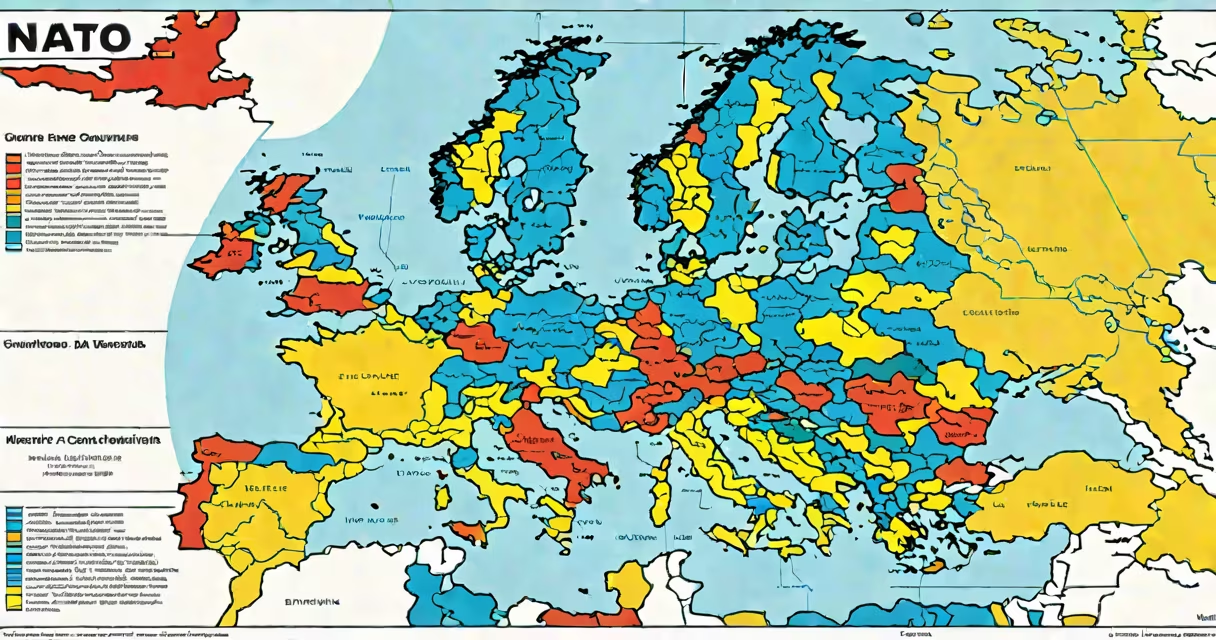
NATO, the North Atlantic Treaty Organization, is a military alliance of 32 sovereign nations committed to collective defense under Article 5. Member states span Europe and North America and agree to mutual security cooperation, joint exercises, and coordinated responses to threats.
NATO was formed in 1949 by 12 founding members, including the United States, the United Kingdom, France, Canada, and several Western European nations. Since then, it has expanded through four major waves, most recently adding Finland in 2023 and Sweden in 2024. The alliance operates under a consensus-based decision-making model, requiring unanimous agreement on all major actions.
The following 32 countries are full members of NATO as of 2024:
| Country | Year Joined | Region |
|---|---|---|
| United States | 1949 | North America |
| Canada | 1949 | North America |
| United Kingdom | 1949 | Europe |
| France | 1949 | Europe |
| Germany | 1955 | Europe |
| Italy | 1949 | Europe |
| Greece | 1952 | Europe |
| Turkey | 1952 | Europe/Asia |
| Belgium | 1949 | Europe |
| Netherlands | 1949 | Europe |
| Denmark | 1949 | Europe |
| Iceland | 1949 | Europe |
| Portugal | 1949 | Europe |
| Spain | 1982 | Europe |
| Poland | 1999 | Europe |
| Hungary | 1999 | Europe |
| Czech Republic | 1999 | Europe |
| Slovakia | 2004 | Europe |
| Slovenia | 2004 | Europe |
| Albania | 2009 | Europe |
| Macedonia (now North Macedonia) | 2019 | Europe |
| Montenegro | 2017 | Europe |
| Latvia | 2004 | Europe |
| Lithuania | 2004 | Europe |
| Estonia | 2004 | Europe |
| Romania | 2004 | Europe |
| Bulgaria | 2004 | Europe |
| Austria | 1955 | Europe |
| Finland | 2023 | Europe |
| Sweden | 2024 | Europe |
Membership requires ratification by all existing members. For example, Sweden's accession took 16 months from application to ratification due to concerns from Turkey and Hungary. Finland joined after a rapid process triggered by Russia's invasion of Ukraine in 2022, reflecting shifts in regional security priorities.
Any country may apply for NATO membership. The process begins with a formal request submitted to the North Atlantic Council. The council then evaluates the applicant's political stability, democratic institutions, rule of law, and commitment to collective defense. A country must demonstrate alignment with NATO values, including human rights, civil liberties, and free markets.
Once approved, the applicant undergoes a series of consultations and bilateral meetings with existing members. The final step is ratification by each member state's national legislature. This process varies widely: some countries approve within weeks, others take years. For instance, Croatia's accession required five years of negotiations and reforms.
Non-membership does not imply hostility. Countries like Switzerland and Austria maintain neutrality while engaging in partnership programs. However, only full members have voting rights and access to NATO's integrated command structure.
NATO is not a supranational government. It does not override national sovereignty. Each country retains control over its military decisions and foreign policy. For example, Germany maintains independent control over its nuclear weapons policy despite being a NATO member.
Another misunderstanding is that NATO automatically responds to all international incidents. Article 5, which triggers collective defense, applies only to attacks on member territory. The 2001 U.S.-led response to the 9/11 attacks was the first and only time Article 5 was invoked. No other incident has prompted a collective military response.
Some assume NATO is solely focused on countering Russia. While Russian aggression in Eastern Europe is a key concern, NATO also conducts missions in Afghanistan, the Balkans, and counter-piracy operations off Somalia's coast. Its mandate includes crisis management, conflict prevention, and cooperative security.
Sweden applied for NATO membership in May 2022, citing increased regional instability after Russia's invasion of Ukraine. The application faced delays due to objections from Turkey and Hungary, both of which demanded assurances on terrorism-related issues and arms exports.
After negotiations, Turkey agreed to support Sweden's bid in exchange for commitments on Kurdish-related matters and the sale of F-16 fighter jets. Hungary delayed ratification until December 2023, citing concerns over Sweden's stance on migration and energy policy. Once all 32 members ratified the accession, Sweden officially joined on March 7, 2024.
This case illustrates how internal politics and bilateral agreements can influence NATO expansion. It also shows that membership is not automatic-it depends on consensus, not majority vote.
NATO remains central to European and transatlantic security. According to NATO's 2023 annual report, 25 member states met the target of spending 2% of GDP on defense, up from 11 in 2014. This increase reflects growing strategic awareness, especially among Eastern European members.
Security challenges extend beyond military threats. Cyberattacks, disinformation campaigns, and hybrid warfare are now addressed through NATO's cyber defense center in Tallinn. The alliance also supports climate resilience initiatives, recognizing that environmental stress can destabilize regions.
For example, in 2023, NATO conducted joint exercises with Jordan and Morocco to strengthen regional cooperation on border security and counter-terrorism. These efforts show that NATO's reach extends beyond its core geographic area.
Understanding what countries are in NATO clarifies global power dynamics. The alliance shapes military readiness, defense planning, and diplomatic coordination. It is not a static bloc but a living institution adapting to new threats, such as space-based assets and artificial intelligence in warfare.
NATO currently includes 32 countries across Europe and North America. Membership is based on shared values, political stability, and defense commitments. The alliance continues to evolve, with ongoing discussions about expanding into the Indo-Pacific region through partnerships, though no formal membership applications are pending.