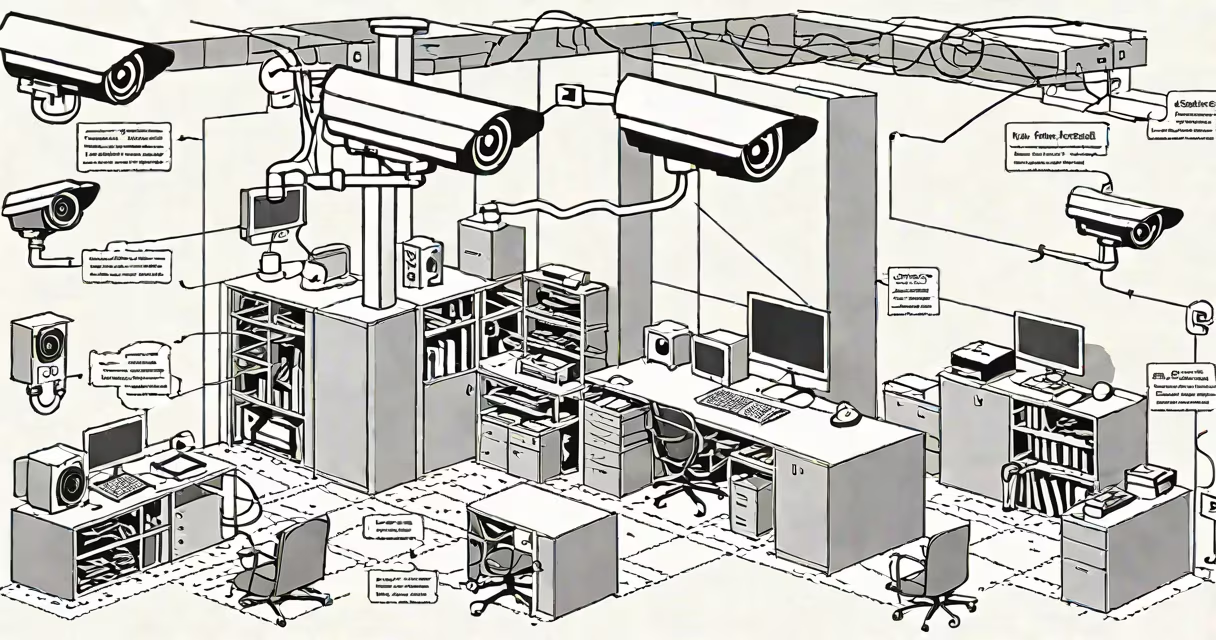
Security cameras without wifi transmit video signals through physical cables or store footage locally on internal drives, functioning entirely offline. They rely on power and wired connections rather than wireless networks, making them resilient to internet outages and hacking attempts.
These systems typically use coaxial or Ethernet cables to send video data from the camera to a recording device such as a Digital Video Recorder (DVR) or Network Video Recorder (NVR). Unlike cloud-based systems, they don't require an internet connection to record or display live feeds. This makes them ideal for homes, small businesses, and high-security environments where reliability and privacy are critical.
For example, a standard analog CCTV system uses BNC connectors and RG59 coaxial cable to carry video signals from a camera to a DVR. The DVR then compresses and stores the footage on a hard drive. A monitor connected via HDMI or VGA displays the live feed. All operations happen within a closed loop-no data leaves the premises unless manually accessed.
Each offline security camera system depends on four core parts: the camera, transmission medium, recording device, and display or monitoring system. The camera captures video using a lens and image sensor-typically CMOS or CCD. The signal travels through a dedicated wire, either coaxial (for analog) or twisted-pair Ethernet (for IP models).
For analog systems, the signal remains unprocessed until it reaches the DVR. The DVR digitizes the incoming video, applies compression (usually H.264 or H.265), and writes it to a hard drive. Modern DVRs support multiple channels, allowing up to 16 cameras to connect simultaneously. Resolution varies-common options include 720p HD, 1080p Full HD, and 4K Ultra HD depending on camera model and bandwidth.
IP cameras that operate without wifi still use Ethernet cables to connect to a local NVR. These cameras process video internally and stream compressed data over the network. Even though they're "network-capable," they don't need Wi-Fi-they can run on a private LAN with a switch and router, isolated from the internet. This setup prevents remote access but enhances data security.
There are two primary categories: analog (CCTV) and IP-based. Both can work without internet, but their architecture differs.
| Type | Transmission Method | Storage Location | Best For |
|---|---|---|---|
| Analog CCTV | Coaxial cable (RG59) | DVR internal HDD | Small homes, basic surveillance, low cost |
| IP Cameras (wired) | Ethernet (Cat5e/Cat6) | NVR internal HDD or SD card | Businesses, large properties, higher resolution needs |
While both types avoid internet dependency, IP systems offer better image quality and advanced features like motion detection, facial recognition, and remote viewing-provided the viewer connects directly to the local network. Analog systems remain simpler and cheaper, with fewer points of failure.
A real-world example: a convenience store owner installs four analog cameras using coaxial cables running from each door to a single DVR in the back office. The DVR records 24/7, storing footage for 30 days on a 1TB hard drive. If a theft occurs, the manager pulls up the clip on-site using a monitor connected to the DVR. No internet required. No cloud fees. No risk of data breaches.
Many assume that "no wifi" means "low quality" or "outdated." That's incorrect. Modern wired systems can deliver 4K resolution, night vision, weather resistance, and intelligent analytics-all without a Wi-Fi connection.
Another misconception is that offline systems cannot be monitored remotely. While they don't stream live video over the internet, they can be viewed locally via a monitor or through a direct network connection. For instance, connecting a laptop to the same local network as the NVR allows real-time access to feeds using software like Hik-Connect or Dahua Client.
Crucially, offline systems are not inherently less secure than online ones. In fact, they're harder to hack because they lack external network exposure. According to the FBI's Internet Crime Complaint Center (IC3), over 70% of video surveillance breaches occur through compromised cloud accounts or weak Wi-Fi passwords. A properly configured offline system avoids this entire attack surface.
I installed a 4-camera wired system at my home last winter. I used four 1080p IP cameras with Cat6 cables running to a local NVR. The NVR sat in a closet with a 2TB drive. I connected it to my router via Ethernet, but disabled the Wi-Fi function entirely. No internet access meant no remote alerts-but I didn't need them. I checked footage daily on a tablet connected to the same local network.
The system survived a 72-hour power outage thanks to a backup battery pack. When power returned, it resumed recording automatically. I never lost a frame. Cloud systems often fail during outages due to dependency on constant connectivity.
For those considering switching from a cloud-based system, start by evaluating your current setup. If you're using a camera that streams to the cloud, consider replacing it with a wired model and connecting it to a local recorder. You'll reduce monthly fees and improve data privacy.
Choose a security camera without wifi when:
These systems are also preferred in regulated industries-healthcare, finance, and government facilities-where data retention laws require on-premises storage.
Security cameras without wifi aren't obsolete-they're purpose-built for stability, privacy, and resilience. They function independently of internet infrastructure, relying instead on physical wiring and local processing. With proper setup, they provide reliable, tamper-resistant monitoring for homes and businesses alike.