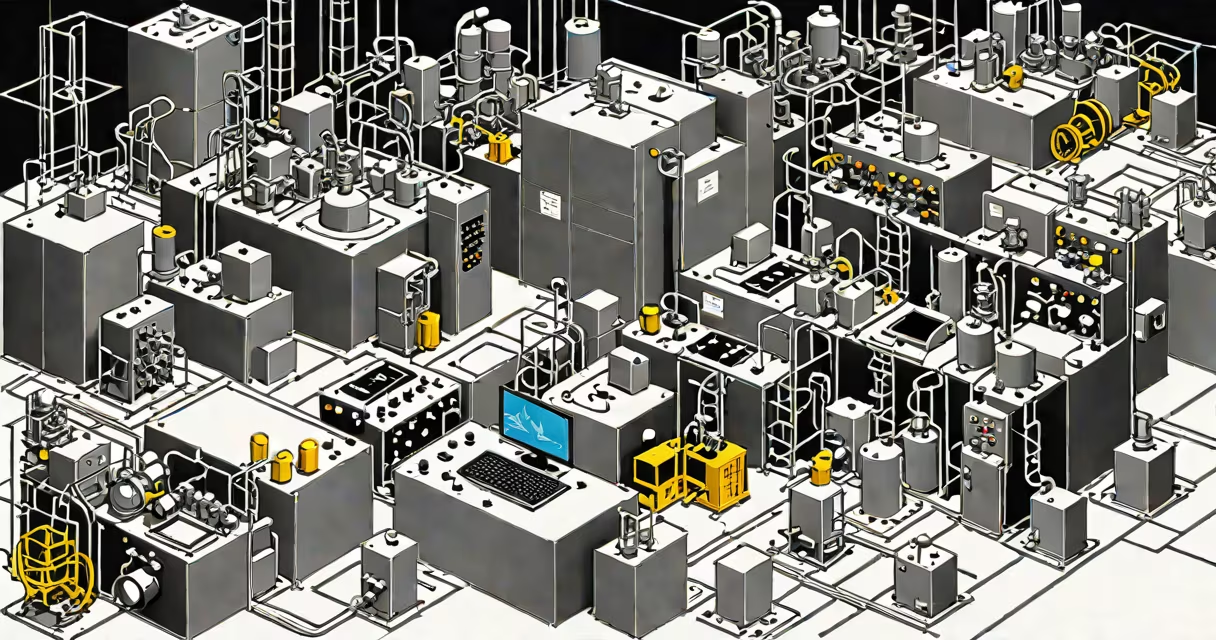
Industrial Control Systems (ICS) are specialized computer networks that manage and monitor physical processes in critical infrastructure such as power generation, water treatment, oil and gas pipelines, and manufacturing. These systems operate continuously, often in real time, to ensure safety, efficiency, and reliability of industrial operations.
ICS encompasses multiple technologies including Supervisory Control and Data Acquisition (SCADA), Distributed Control Systems (DCS), and Programmable Logic Controllers (PLCs). Unlike traditional IT systems focused on data processing and business operations, ICS prioritizes uninterrupted physical process control. A failure in an ICS can lead to equipment damage, environmental harm, or public safety risks.
The rise of interconnected systems has exposed ICS to cyber threats previously seen only in corporate IT environments. Attacks targeting ICS have increased since the 2010 Stuxnet incident, which disrupted uranium enrichment centrifuges in Iran using malware designed to exploit PLCs. This event marked a turning point in recognizing ICS as a high-value target for nation-state actors and cybercriminals alike.
ICS functions through a layered architecture. At the lowest level are field devices-sensors, valves, motors-that collect and act on physical data. Above them are controllers, typically PLCs or RTUs (Remote Terminal Units), which execute logic based on sensor inputs. The supervisory layer includes SCADA systems that provide human-machine interfaces (HMIs), historical data logging, and remote monitoring.
These layers communicate via proprietary protocols such as Modbus, DNP3, and Profibus. Many of these protocols were developed decades ago without built-in security features. They lack encryption, authentication, and access controls, making them vulnerable to interception, manipulation, or denial-of-service attacks.
A real-world example occurred in 2016 when hackers compromised the ICS at a Ukrainian power grid facility. Using malware known as BlackEnergy, attackers remotely disabled circuit breakers, causing widespread blackouts affecting over 230,000 people. The attack exploited weak network segmentation and unpatched software, demonstrating how a single breach in an ICS environment can cascade into large-scale disruption.
There are three primary categories of ICS, each serving distinct roles in industrial operations:
| Type | Function | Security Focus |
|---|---|---|
| SCADA | Monitors and controls large-scale processes across wide geographic areas (e.g., pipeline networks). | Secure remote access, anomaly detection, encrypted communication. |
| DCS | Manages continuous processes in refineries, chemical plants, and paper mills. | Process stability, fail-safe mechanisms, secure configuration management. |
| PLC-based Systems | Controls discrete automation tasks in factories and assembly lines. | Firmware integrity, secure programming interfaces, physical access protection. |
Despite their differences, all ICS types share a common vulnerability: they often run outdated operating systems and firmware with no automatic update mechanisms. For example, many PLCs still use Windows XP or embedded Linux versions from the early 2000s. These systems remain in service because replacing them disrupts production, creating long-term exposure windows.
One non-obvious fact: ICS environments frequently prioritize availability over confidentiality. In a steel mill, a brief interruption in control signals can cause molten metal spills or furnace explosions. As a result, engineers may disable firewalls or restrict logging to avoid latency-even if it increases risk. This trade-off makes ICS security fundamentally different from enterprise IT security, where data confidentiality is paramount.
ICS is deployed wherever physical processes require automated oversight. Major applications include:
Each sector faces unique threat vectors. In water treatment, attackers could alter chemical dosing levels to poison supplies. In manufacturing, a compromised robot arm could damage machinery or injure workers. According to the U.S. Department of Homeland Security's Industrial Control Systems Cyber Emergency Response Team (ICS-CERT), over 1,200 ICS-related vulnerabilities were reported between 2015 and 2022, with 70% involving unauthenticated remote access.
Security measures in ICS focus on defense-in-depth strategies: network segmentation, air-gapping where feasible, endpoint hardening, and continuous monitoring. However, complete isolation is rare. Most modern ICS now integrate with enterprise IT networks for maintenance, reporting, and asset tracking-creating hybrid attack surfaces.
I experienced this firsthand during a penetration test at a food processing plant. The facility used a SCADA system connected to a corporate network via a VPN. An attacker who breached the IT network gained lateral movement rights and eventually accessed the ICS network. From there, they could manipulate conveyor speeds and temperature settings-potentially spoiling entire batches of product. The fix required redesigning network boundaries and implementing role-based access controls.
Many assume ICS is obsolete or isolated from modern cyber threats. This is false. ICS is increasingly targeted due to its strategic value. A successful attack on a port's crane control system could halt global shipping. A breach in a nuclear facility's cooling system could trigger a meltdown.
Another misconception is that ICS security is solely about preventing data theft. While data exfiltration occurs, the primary goal of attackers is often disruption or sabotage. The 2021 Colonial Pipeline ransomware attack, while initially targeting IT systems, shut down fuel delivery across the U.S. East Coast-demonstrating how IT and ICS convergence creates systemic risk.
Some believe that older ICS systems are inherently safe because they're "not connected." But even isolated systems can be compromised through supply chain attacks. Malicious firmware updates, USB drives infected with malware, or insider threats can introduce threats without network connectivity.
Finally, organizations often confuse ICS with standard IT security frameworks. NIST SP 800-82 Rev. 2, published by the National Institute of Standards and Technology, explicitly states that ICS requires tailored approaches due to real-time constraints and safety-critical requirements. Standard IT practices like frequent patching or full disk encryption can destabilize ICS operations.
When evaluating ICS security, look beyond firewalls and antivirus. Focus on asset inventory, change control procedures, incident response plans specific to industrial scenarios, and regular red team exercises simulating real-world attacks. Resources like the ICS-CERT advisories and the MITRE ATT&CK structure's ICS-specific matrix offer actionable guidance.
Understanding what is ICS in cyber security is not optional-it's foundational for protecting national infrastructure. As industries adopt smart manufacturing and digital twins, the boundary between IT and OT continues to blur. The challenge lies in securing physical systems without compromising their core function: keeping the lights on, the water clean, and the machines running safely.