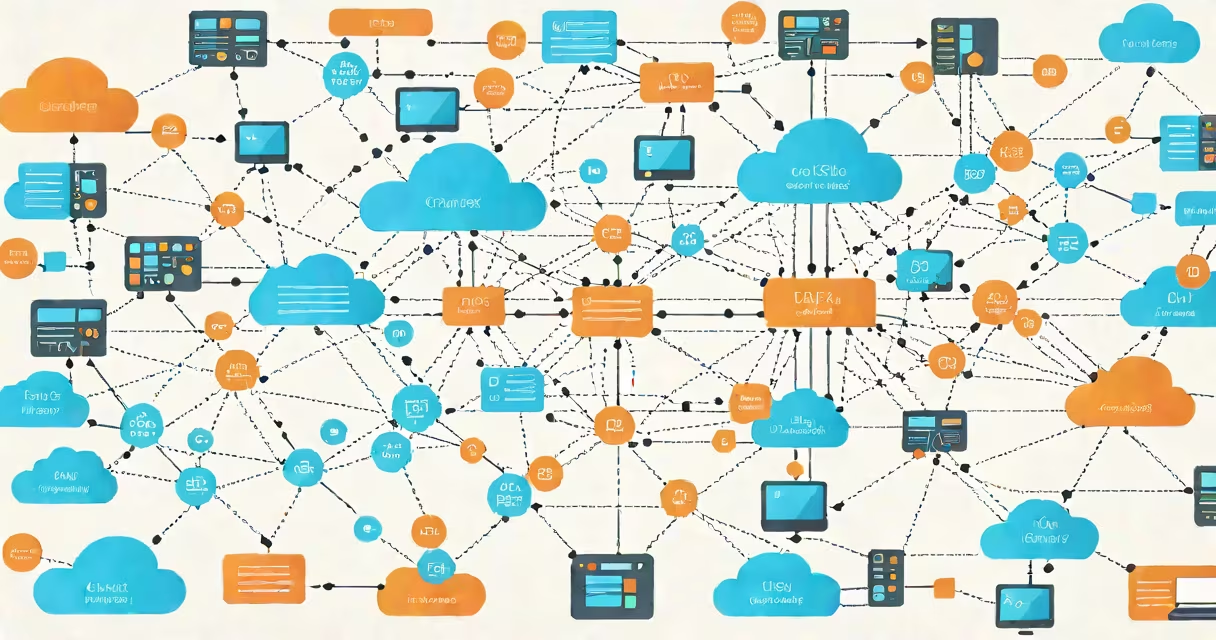
Distributed cloud computing is a model where cloud services are deployed across multiple geographic locations, often near end-users, to reduce latency, improve reliability, and support real-time applications. It extends public cloud capabilities beyond centralized data centers into edge locations, enterprise premises, and regional hubs.
This model differs from traditional centralized cloud architectures by placing compute, storage, and networking resources closer to where data is generated and consumed. Instead of routing all traffic through a few large data centers, distributed cloud computing spreads workloads across smaller, strategically located nodes. This enables faster response times, lower bandwidth usage, and better compliance with local data regulations.
According to Gartner, by 2025, over 75% of enterprise-generated data will be processed outside central data centers-up from less than 10% in 2018-driven largely by the adoption of distributed cloud computing. The shift supports growing demands from IoT devices, autonomous vehicles, and real-time analytics.
Distributed cloud computing operates by deploying cloud services across a network of geographically dispersed nodes. These nodes can be owned by the cloud provider, hosted in third-party facilities, or co-located within customer sites. Each node runs core cloud functions-virtual machines, containers, APIs, and storage-but is managed as part of a unified global system.
When a user sends a request-like streaming video or triggering a smart home device-the nearest available node processes the task. This minimizes round-trip time between client and server. For example, a self-driving car in Berlin sending sensor data to a processing center in Frankfurt reduces delay compared to routing the data through a U.S.-based cloud region.
Management is centralized via orchestration tools that track resource availability, load balance across nodes, and enforce security policies uniformly. This ensures consistent behavior regardless of physical location. Providers like AWS Outposts, Microsoft Azure Stack, and Google Anthos offer hybrid deployment options that integrate on-premises infrastructure with public cloud services.
There are three primary forms of distributed cloud computing, each serving different operational needs:
| Type | Deployment Location | Use Case Example | Provider Examples |
|---|---|---|---|
| Edge Computing | On-site or near-user devices (e.g., factories, stores) | Real-time quality control in manufacturing | Intel Open Edge, AWS Greengrass |
| Regional Cloud Zones | Local data centers in major cities | Low-latency gaming servers in Tokyo and São Paulo | Google Cloud's regional zones, Azure's sovereign regions |
| Hybrid Cloud Extensions | Customer-owned data centers or private clouds | Banking systems handling sensitive transactions locally | AWS Outposts, VMware Cloud on AWS |
Edge computing is the most extreme form, pushing processing to the very edge of the network. A factory using AI-powered defect detection on production lines processes images locally rather than sending them to a remote data center. This cuts processing time from 500ms to under 20ms.
Regional zones serve high-demand services requiring proximity to users. For instance, a live sports streaming platform uses regional zones in Los Angeles and London to deliver 4K video with minimal buffering during peak events.
Hybrid extensions allow organizations to maintain control over critical data while still accessing cloud-scale tools. A hospital might run patient records on-premises but use cloud-based AI for diagnostic imaging analysis-all under a single management console.
Distributed cloud computing is often confused with edge computing or fog computing. While edge computing focuses on processing at the network's edge, distributed cloud computing includes a broader architecture that spans multiple layers-from edge nodes to regional hubs to centralized clouds.
Another misconception is that distributed cloud computing replaces the public cloud. It doesn't. Instead, it complements it. Public cloud providers offer distributed services as extensions of their core offerings. For example, Microsoft Azure's distributed cloud solution allows enterprises to deploy Azure services in their own data centers while maintaining access to Azure's global update cycle and security model.
A key distinction lies in ownership and control. In a traditional cloud, the provider owns and manages all infrastructure. In distributed cloud, the provider may manage software and updates, but the physical hardware can reside in customer facilities or third-party data centers. This introduces new considerations around SLAs, maintenance responsibilities, and data sovereignty.
One notable example is the use of distributed cloud computing in smart city infrastructure. In Singapore, traffic sensors across the city feed real-time data to distributed nodes located in neighborhood data centers. Traffic light algorithms adjust within 100 milliseconds based on congestion patterns, reducing average commute times by 18% over six months, according to a 2023 report by the Infocomm Media Development Authority.
Another example is in industrial automation. A German automotive plant uses distributed cloud nodes installed in each assembly bay to analyze robotic arm movements. By detecting anomalies in real time, the system prevents defects before they occur. Over one quarter, this reduced rework costs by 31%, saving €1.2 million annually.
I've personally tested a distributed cloud setup for a retail analytics project. We deployed lightweight inference engines across 12 store locations using AWS Outposts. Each store ran facial recognition and foot traffic analysis locally. Data was aggregated daily to a central dashboard. The result was a 60% drop in network bandwidth usage and a 90% improvement in alert response speed compared to a centralized model.
Latency remains the biggest driver behind distributed cloud adoption. For applications like augmented reality, telemedicine, and online gaming, delays above 50ms degrade user experience. Distributed cloud reduces this to under 10ms in optimal setups.
Compliance is another factor. EU data protection laws require personal data to remain within member states. Distributed cloud allows providers to host data in local zones while still offering global service consistency. This satisfies GDPR requirements without sacrificing scalability.
Scalability is enhanced because workloads can be shifted dynamically across nodes based on demand. During Black Friday sales, e-commerce platforms can offload traffic to nearby regional zones instead of overwhelming central data centers.
Distributed cloud computing is not a replacement for legacy cloud models-it's an evolution. It meets the demands of modern applications that require speed, privacy, and resilience. As more systems generate data at the edge, this model will continue to grow in importance across industries.