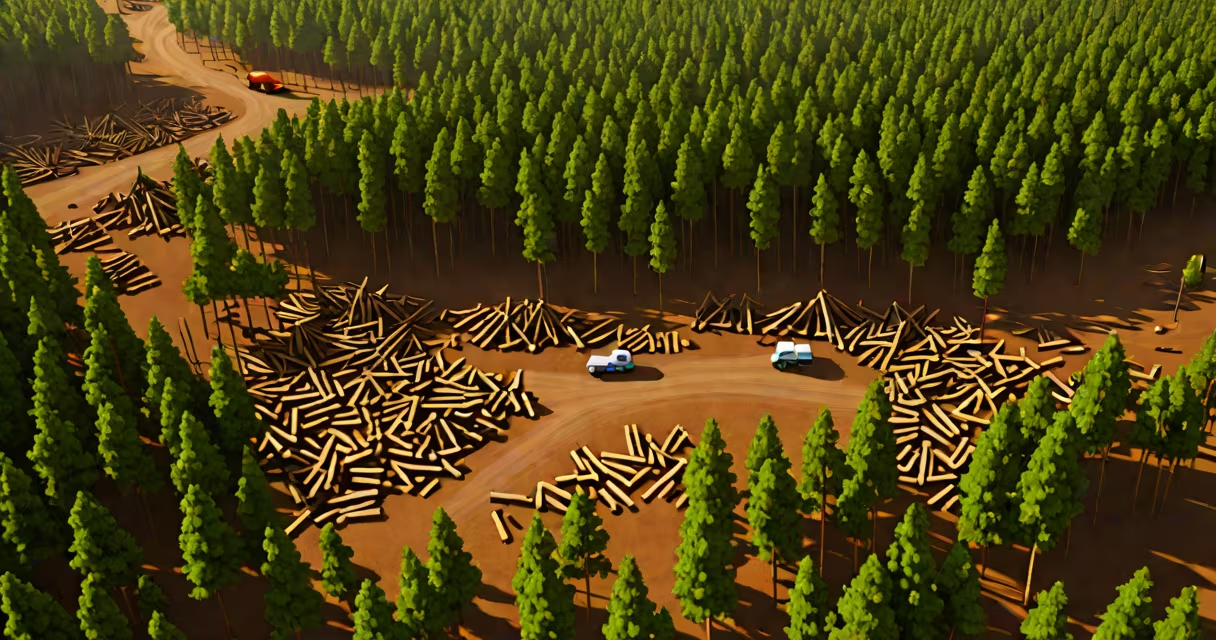
Illegal logging meaning refers to the unauthorized cutting, removal, or sale of timber from forests, violating national laws, regulations, or international agreements. It includes harvesting without permits, exceeding quotas, entering protected areas, or using forged documentation.
This activity occurs across tropical and temperate regions, often in countries with weak governance or limited monitoring capacity. The World Bank estimates that 15% to 30% of global timber trade involves illegally sourced wood, contributing to habitat loss and carbon emissions.
Unlike legal forestry operations, which follow environmental impact assessments and sustainable harvest plans, illegal logging prioritizes profit over ecological integrity. It frequently overlaps with corruption, organized crime, and land grabbing.
Illegal logging typically follows a three-stage process: access, extraction, and transport. Operators gain entry through bribes, forged permits, or exploiting remote locations. Once inside, they cut high-value trees such as mahogany, teak, or rosewood-often targeting species with high market demand.
Extraction methods vary. Some use chainsaws and small machinery; others rely on manual labor. Trees are felled, stripped of bark, and processed into logs or planks on-site. Transport happens via unmarked vehicles or boats, often through informal routes to avoid checkpoints.
A 2022 study by Global Forest Watch found that 70% of illegal logging incidents in Indonesia occurred in areas with degraded surveillance due to budget cuts and staff shortages. This lack of oversight enables rapid exploitation before authorities respond.
Not all illegal logging is the same. The activity spans several categories based on intent, scale, and compliance violations:
| Type | Description | Example |
|---|---|---|
| Unlicensed Harvesting | Cutting trees without a valid permit or license. | Harvesting in a national park without authorization. |
| Over-Harvesting | Exceeding agreed-upon volume limits set by law. | Logging 500 cubic meters when the annual quota is 300. |
| False Documentation | Using forged or altered paperwork to claim legality. | Submitting a certificate showing "sustainable" origin for wood from a protected zone. |
| Illegal Trade | Selling timber across borders without customs clearance. | Exporting logs from Cambodia to China without export licenses. |
Some operations blend legal and illegal elements. For instance, a company may hold a permit for low-impact logging but secretly extract rare hardwoods beyond their allowed area. These hybrid cases are harder to detect and prosecute.
Illegal logging contributes directly to deforestation, biodiversity loss, and climate change. The Food and Agriculture Organization (FAO) reports that 10 million hectares of forest were lost annually between 2015 and 2020-much of it linked to illegal activities.
When forests disappear, so do habitats for endangered species. In the Congo Basin, illegal logging has reduced gorilla populations by 60% since 2000. Similarly, in Borneo, orangutans face extinction due to habitat fragmentation caused by illicit timber operations.
Local communities suffer too. Indigenous groups in the Amazon report increased violence and displacement after logging crews move in. A 2021 report by Human Rights Watch documented 47 incidents of land conflict tied to illegal logging in Peru between 2018 and 2020.
Many assume illegal logging only happens in remote jungles. In reality, it occurs in managed forests, urban greenbelts, and even private plantations. A 2023 investigation by Transparency International revealed that 12% of timber imported into the EU came from sources with documented illegal activity, despite EU regulations requiring due diligence.
Another myth is that illegal logging is purely a developing-world problem. While tropical nations bear the highest burden, industrialized countries like the United States and Germany have seen illegal timber enter supply chains through complex import networks. For example, a 2020 audit by the U.S. Department of Justice uncovered a scheme smuggling Canadian softwood into California under false origin labels.
It's also incorrect to equate illegal logging with all unsustainable forestry. Legal logging can still harm ecosystems if practices ignore long-term regeneration. Conversely, some illegal operations occur in degraded forests where recovery is possible-but that doesn't justify breaking the law.
In 2019, a joint operation by Peruvian environmental police and satellite analysts identified a network extracting mahogany from the Tambopata National Reserve. The group used GPS spoofing to mask their location and transported logs via river routes to avoid detection.
They operated under a shell company registered in Panama. Documents showed the company claimed to have harvested 1,200 cubic meters of timber over six months-well above the reserve's annual limit of 200 cubic meters. Satellite imagery confirmed the area had lost 18 hectares of primary forest during that period.
After a 14-month investigation, authorities seized 37 trucks and arrested 11 individuals. The case highlighted how illegal logging combines technical evasion, financial opacity, and geographic concealment.
Understanding illegal logging meaning requires recognizing it as both a legal and ecological violation. It is not simply about cutting trees-it's about circumventing systems meant to protect forests, people, and planetary health.
Efforts to stop illegal logging depend on stronger enforcement, transparent supply chains, and public awareness. Without these, the environmental and social costs continue to rise.