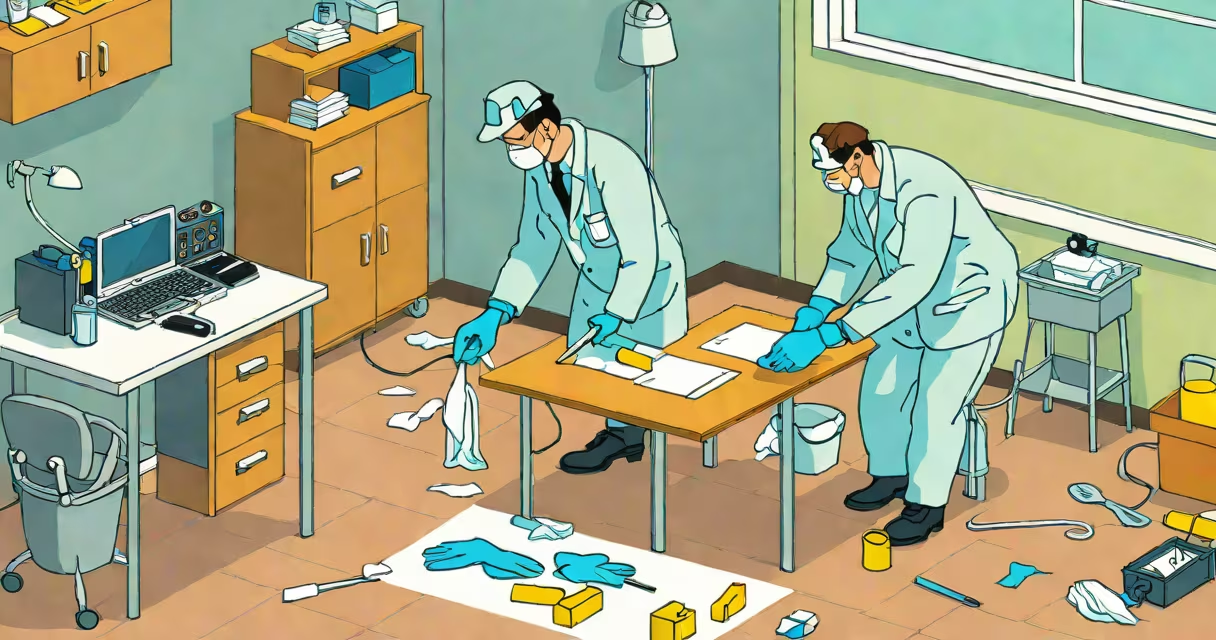
Crime scene investigator roles involve systematically documenting, collecting, and preserving physical evidence at crime scenes to support criminal investigations. These professionals work under law enforcement protocols to ensure evidence remains admissible in court. Their work forms the foundation of forensic analysis in cases ranging from homicides to property crimes.
Each role begins with securing the scene to prevent contamination. Investigators then conduct a systematic walkthrough, photographing and sketching the area before collecting items such as fingerprints, bloodstains, fibers, or weapons. All collected materials are packaged, labeled, and logged into chain-of-custody records to maintain legal integrity. This process helps evidence can be traced from the scene to the courtroom.
The U.S. Department of Justice reports that nearly 90% of felony cases rely on physical evidence collected by crime scene investigators. According to the National Institute of Justice, proper documentation reduces error rates in forensic interpretation by up to 60%. These figures show the critical nature of accurate, standardized procedures in investigative outcomes.
Upon arrival at a scene, crime scene investigators follow a structured protocol. They begin by establishing perimeter control, often using barriers and signage to restrict access. Only authorized personnel enter during the initial phase. A preliminary survey identifies potential evidence zones and high-risk areas such as blood spatter patterns or bullet trajectories.
Next, investigators use tools like UV lights, alternate light sources, and powder kits to reveal latent fingerprints. They may dust surfaces or apply chemical reagents to improve visibility. Once visible, prints are photographed and lifted using adhesive tape or gelatin lifters. These samples are later analyzed in labs using automated fingerprint identification systems (AFIS).
A real-world example occurred in 2019 during the investigation of a burglary in Phoenix, Arizona. A single partial fingerprint was recovered from a broken window frame. The crime scene investigator documented the location, angle, and surrounding context before sending the print to the state forensic lab. Matched against a database, it led to the arrest of a repeat offender within 72 hours.
While all crime scene investigators perform foundational tasks, many specialize based on case type or evidence category. Roles vary by jurisdiction and agency structure, but common specializations include:
| Role Type | Primary Focus | Typical Equipment Used | Example Case Application |
|---|---|---|---|
| Document Examiner | Handwriting, forged documents, ink analysis | Microscope, spectrophotometer, UV lamp | Identifying a forged will in a contested estate case |
| Trace Evidence Specialist | Fibers, hair, soil, glass fragments | Comparative microscope, balance scale, tweezers | Linking a suspect's clothing to carpet fibers at a murder scene |
| Firearms and Toolmark Analyst | Bullets, casings, tool marks on objects | Comparison microscope, ballistic gel, measuring calipers | Determining which gun fired a bullet found near a victim |
These roles require advanced training beyond basic scene processing. For example, a trace evidence specialist must understand material composition differences between synthetic and natural fibers, and how environmental exposure alters degradation patterns. Misidentifying a fiber as human when it's actually from a pet's fur can lead to wrongful leads.
One non-obvious distinction: crime scene investigator roles are not uniform across states. California requires certification through the California Forensic Science Commission, while Texas mandates completion of the Texas Department of Public Safety's Crime Scene Investigator Academy. Failure to meet state-specific standards can disqualify evidence in trial.
Many assume crime scene investigator roles mirror television portrayals, particularly those seen on shows like *CSI* or *NCIS*. In reality, most crime scene investigators spend less than 20% of their time at actual crime scenes. The majority of their work occurs in laboratories, report writing, or court preparation.
Another misconception is that all crime scene investigators are sworn officers. In fact, many are civilian employees hired under public safety contracts. The FBI's Uniform Crime Reporting program lists over 12,000 civilian forensic technicians working in local and federal agencies-over half are not police officers.
I once observed a team in Denver process a domestic violence scene where the primary investigator was a former biology teacher who had completed a two-year certification program. She handled evidence collection, documented findings in a digital log, and later testified in court. Her background in cellular biology helped her identify microscopic tissue samples that linked the suspect to the victim's clothing.
Entry-level crime scene investigator roles typically require a bachelor's degree in forensic science, criminal justice, or a related field. Some departments accept candidates with relevant military experience or certifications in evidence handling. The FBI's National Academy offers a 10-week course in crime scene management, attended annually by over 200 professionals nationwide.
Advanced roles demand specialized education. For example, becoming a forensic anthropologist-a rare but important role in mass fatality or skeletal remains cases-requires a PhD and years of fieldwork. The American Board of Forensic Anthropology certifies fewer than 150 practitioners in the U.S., highlighting the niche nature of certain specialties.
After gaining experience, crime scene investigators may advance to supervisory roles, manage regional evidence units, or serve as consultants in high-profile cases. The Bureau of Labor Statistics projects a 12% growth in forensic science technician employment from 2022 to 2032-faster than average-driven by increased reliance on DNA and digital evidence.
Understanding crime scene investigator roles reveals their essential contribution to justice. These professionals do not solve crimes alone, but they provide the factual basis upon which investigations proceed. Their meticulous work helps decisions rest on verified facts, not assumptions.