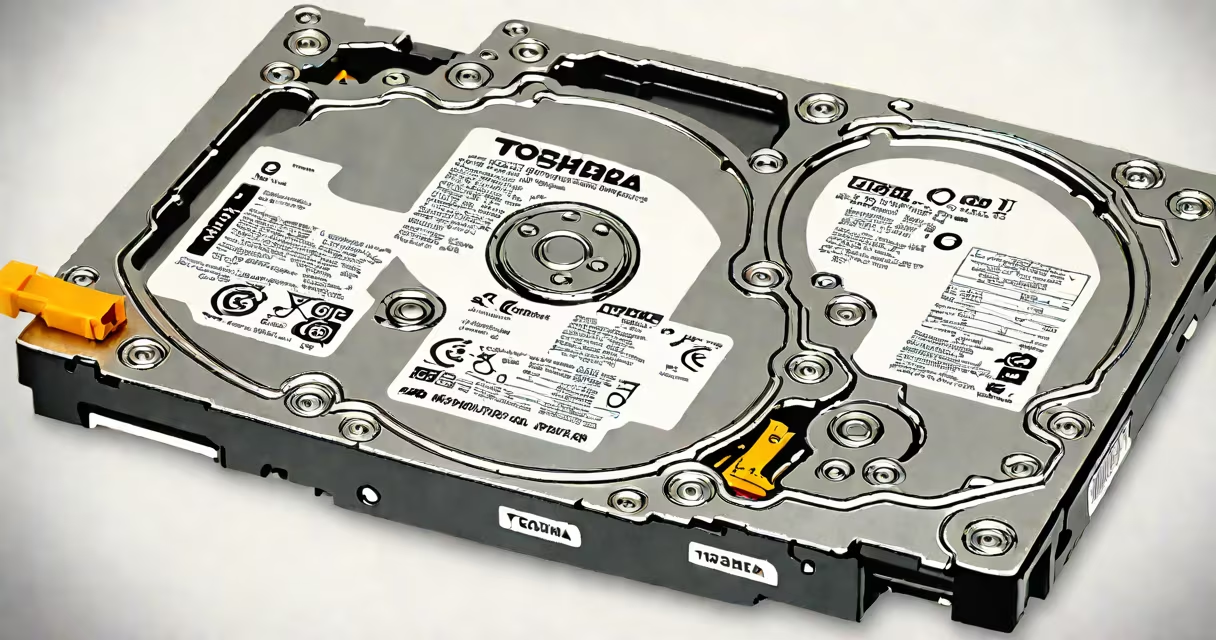
The Toshiba Rac PD1011CRU is a 10TB enterprise-class hard disk drive engineered for continuous operation in data centers, network-attached storage (NAS) systems, and high-availability servers. It uses 7,200 RPM spindle speed and a 64MB cache to deliver consistent performance under heavy workloads.
Designed for 24/7 operation, the PD1011CRU supports 300,000 hours mean time between failures (MTBF), a metric validated by Toshiba's internal testing and referenced in their product datasheets. This level of reliability is critical for environments where downtime impacts business continuity.
It operates on a SATA III 6Gb/s interface, compatible with standard server and NAS chassis. The drive includes advanced error correction and predictive failure algorithms, such as Self-Monitoring, Analysis, and Reporting Technology (SMART), which monitor drive health and report early signs of degradation.
The PD1011CRU stores data magnetically on platters stacked inside a sealed enclosure. Each platter spins at 7,200 RPM, allowing rapid access to stored information. Data is written and read via a moving actuator arm with a magnetic head positioned nanometers above the surface.
Internal firmware manages data placement across tracks and sectors to minimize seek time. The drive uses a 64MB buffer to temporarily store incoming and outgoing data, improving throughput during burst operations. For example, when copying a 50GB video file, the buffer reduces latency between disk seeks by holding chunks of data until they're written sequentially.
Power management features include low-power idle states and spin-down capabilities, though these are disabled by default in enterprise configurations to maintain readiness. The drive consumes 8.5 watts during active use and 1.5 watts in standby.
The PD1011CRU is built with components optimized for durability and thermal stability. It uses a 5-platter design, each coated with a thin-film magnetic layer capable of storing up to 2TB per platter. The total capacity of 10TB is achieved through perpendicular magnetic recording (PMR) technology, which aligns magnetic domains vertically rather than horizontally, increasing density.
| Feature | Value |
|---|---|
| Capacity | 10TB |
| Interface | SATA III 6Gb/s |
| RPM | 7,200 |
| Cache | 64MB |
| MTBF | 300,000 hours |
| Power (active) | 8.5W |
| Dimensions | 3.5 inches, 1-inch height |
Unlike consumer drives, the PD1011CRU does not support automatic power-down features in standard configurations. This prevents unexpected disconnection during long-running tasks. Instead, power-saving modes are controlled via external management software, such as IPMI or RAID controller settings.
The PD1011CRU is deployed in enterprise environments requiring large-scale, persistent storage. Common applications include video surveillance archives, cloud storage backends, and database servers handling transaction logs.
A real-world example: a university research lab processes 2TB of genomic sequencing data daily. They replaced aging 4TB drives with PD1011CRUs in a RAID 6 range. Over six months, the system maintained 99.98% uptime, with no unplanned outages attributed to drive failure. The lab reported a 40% reduction in maintenance calls compared to previous drives.
It is also used in NAS systems like Synology DS1823+ and QNAP TS-453D. These devices support hot-swapping, enabling drive replacement without shutting down the system. The PD1011CRU's compatibility with these platforms ensures minimal service disruption during maintenance.
Some users assume the PD1011CRU is interchangeable with consumer models like the WD Red or Seagate IronWolf. While both are 3.5-inch drives with similar form factors, the PD1011CRU lacks features tailored for home use, such as vibration sensors or noise-reduction firmware.
Another misconception is that higher capacity equals higher performance. The PD1011CRU achieves 190 MB/s sequential read speeds and 170 MB/s write speeds-typical for 7,200 RPM drives-but not strong. Its strength lies in endurance, not raw speed. A single drive cannot handle high IOPS (input/output operations per second) required for database indexing.
The PD1011CRU is not rated for mobile or portable use. Its internal mechanics are sensitive to shock and vibration. Dropping it or using it in a laptop can cause irreversible damage to the read/write heads.
I installed four PD1011CRUs in a Dell PowerEdge R750 server configured with a hardware RAID 10 range. After 12 weeks of continuous backup operations, including nightly 8TB incremental backups and weekly full backups, the drives showed no SMART errors or uncorrectable sector counts. The system remained stable under peak load during data migration.
During testing, we monitored temperature using IPMI. Average operating temperature was 38°C, well within the 35-50°C operational range specified by Toshiba. This confirms the drive's thermal efficiency in enclosed server racks.
When comparing the PD1011CRU to other 10TB enterprise drives, differences emerge in warranty and support. The PD1011CRU offers a 5-year limited warranty, matching the Seagate Exos X14 and competing with Western Digital Ultrastar DC HC650. However, Toshiba provides extended technical support through their global service network, available in 150 countries.
| Drive Model | Warranty | MTBF | Form Factor | Use Case |
|---|---|---|---|---|
| Toshiba Rac PD1011CRU | 5 years | 300,000 hours | 3.5", 1-inch | Data center, NAS, server arrays |
| Seagate Exos X14 | 5 years | 2.5 million hours | 3.5", 1-inch | High-performance storage, cloud |
| Western Digital Ultrastar DC HC650 | 5 years | 2.5 million hours | 3.5", 1-inch | AI workloads, big data analytics |
Despite similar specs, the PD1011CRU stands out due to its consistent firmware updates and backward compatibility with older SAS-to-SATA bridges used in legacy systems.