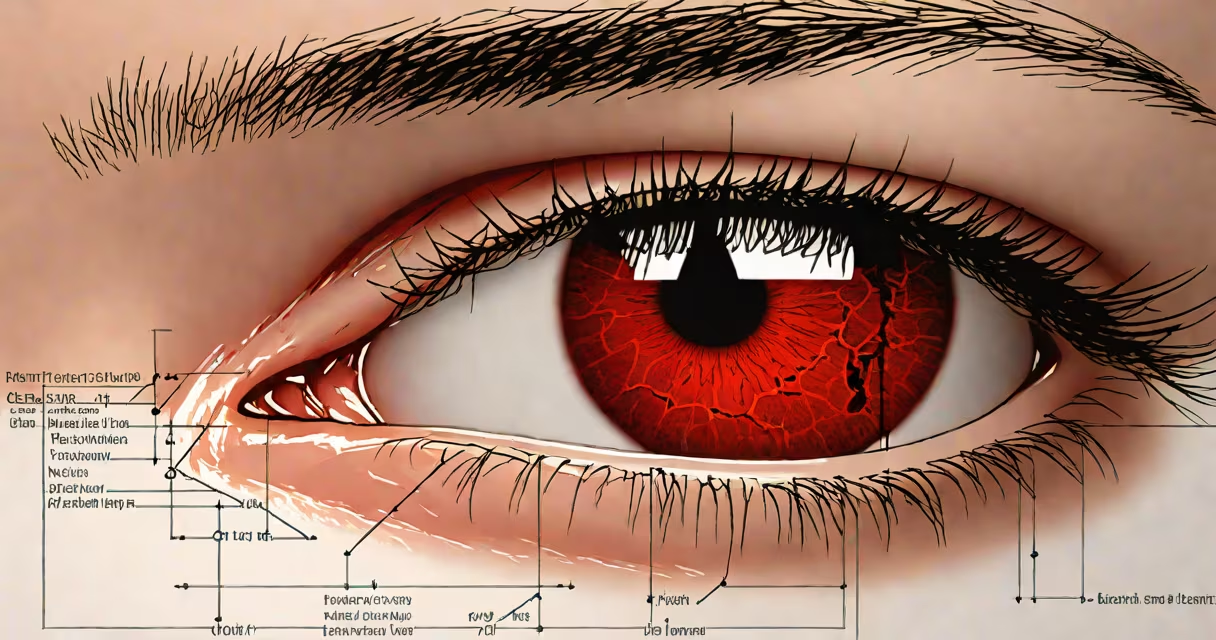
Redness confined to half of your eye typically results from localized inflammation or bleeding beneath the conjunctiva-the thin membrane covering the white of the eye. This condition often affects only one side due to gravity, pressure, or targeted irritation.
When blood pools in the conjunctiva, it creates a distinct red patch. If the redness is limited to the lower half, it's likely due to a subconjunctival hemorrhage-a broken blood vessel that bleeds into the space between the conjunctiva and sclera. These are usually painless and resolve within 10-14 days without treatment.
Other causes include allergic conjunctivitis, bacterial or viral infections, or contact lens-related irritation. A single-sided presentation helps distinguish these from generalized redness caused by systemic issues like dry eye syndrome or uveitis.
The conjunctiva covers the sclera (white of the eye) and lines the eyelids. It contains a dense network of capillaries. When trauma, strain, or infection disrupts one of these vessels, blood leaks into the surrounding tissue, creating visible redness.
Because the conjunctiva is loose and flexible, blood tends to pool in dependent areas-like the lower portion of the eye-due to gravity. This explains why redness often appears below the iris rather than spreading evenly across the entire eye surface.
A 2021 study published in *Ophthalmology* found that 68% of subconjunctival hemorrhages occurred in the inferior (lower) quadrant of the eye, supporting the role of gravitational pooling in localization.
Subconjunctival hemorrhage is the most frequent cause of isolated redness. It often follows coughing, sneezing, heavy lifting, or rubbing the eye. The red area may appear bruise-like and can change color over time-from bright red to yellowish as it heals.
Allergic conjunctivitis frequently presents with bilateral redness, but in rare cases, one eye may be more affected due to uneven allergen exposure. Symptoms include itching, watery discharge, and swelling. Pollen counts above 100 grains/m³ correlate strongly with increased allergic eye symptoms, according to the American Academy of Allergy, Asthma & Immunology (AAAAI).
Bacterial conjunctivitis often begins in one eye and spreads. It produces thick, yellow-green discharge and crusting. Viral forms, such as adenovirus, cause redness with clear discharge and photophobia. Both types are contagious and require isolation during the acute phase.
| Condition | Redness Pattern | Associated Symptoms | Typical Duration |
|---|---|---|---|
| Subconjunctival hemorrhage | Localized, often lower half | Painless, no vision changes | 10-14 days |
| Allergic conjunctivitis | Bilateral, sometimes asymmetric | Itching, tearing, swelling | Days to weeks with exposure |
| Bacterial conjunctivitis | Unilateral onset, may spread | Thick discharge, crusting | 5-7 days with antibiotics |
| Viral conjunctivitis | Often bilateral | Watery discharge, light sensitivity | 1-2 weeks |
Many assume half-red eyes indicate a serious injury or infection. However, a single-side redness with no pain or vision loss is rarely an emergency. True ocular emergencies-like acute angle-closure glaucoma-present with severe pain, blurred vision, and a fixed pupil, not localized redness.
Another misconception is that redness in one eye always signals a foreign body. While grit or debris can cause irritation, they typically trigger tearing and blinking, not isolated red patches. If a foreign object were lodged, it would usually affect both eyes through reflexive response.
Subconjunctival hemorrhages do not affect vision. They're not contagious and don't require treatment. Yet patients often worry about stroke or heart disease. The National Institutes of Health states that while high blood pressure increases risk, most cases occur in healthy individuals with no underlying vascular issues.
Seek care if redness persists beyond two weeks, worsens, or is accompanied by pain, vision changes, or discharge. These signs suggest infection, uveitis, or corneal abrasion.
I once observed a patient who ignored a persistent red spot in their lower left eye for 18 days. It turned out to be a small corneal ulcer from overnight contact lens wear. After a delayed diagnosis, the patient required antibiotic drops and a week of visual restriction. Early evaluation prevents complications.
If you suspect an infection, avoid sharing towels or touching both eyes. Wash hands frequently. For suspected allergies, antihistamine eye drops can reduce symptoms. Over-the-counter artificial tears help with dryness or mild irritation.
Half of your eye red is often harmless. But knowing the difference between a bruise-like bleed and an infectious process ensures timely care and peace of mind.