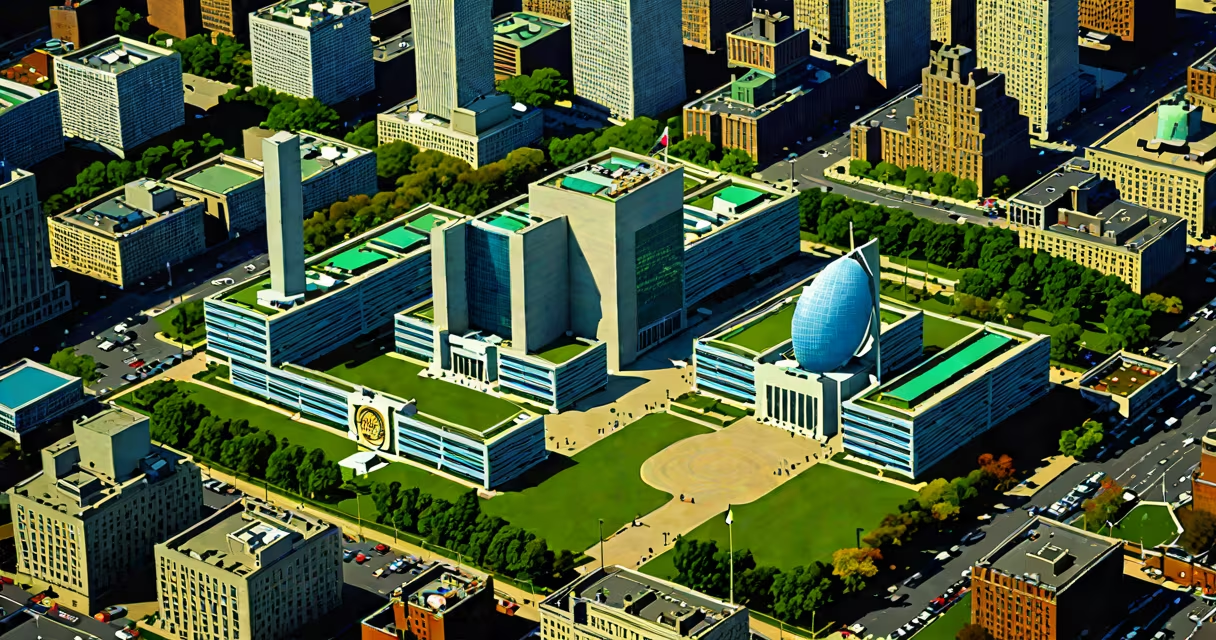
The United Nations is an intergovernmental organization founded in 1945 to prevent war, protect human rights, and promote global cooperation on issues ranging from climate change to refugee crises. Its core mission is to uphold international peace and security while advancing social progress and human dignity across borders.
Established after World War II, the UN emerged from the failure of the League of Nations to stop aggression and conflict. With 193 member states, it operates through six principal organs: the General Assembly, Security Council, Economic and Social Council, International Court of Justice, Secretariat, and specialized agencies. These bodies coordinate efforts on disarmament, humanitarian aid, economic development, and legal disputes between nations.
Unlike regional alliances such as NATO or the African Union, the UN is universal in membership and mandates. It does not enforce laws directly but facilitates agreements, deploys peacekeepers, and sets global standards. The UN's authority stems from consensus among member states, not military power. Decisions in the Security Council require nine votes, including no veto from any of the five permanent members: the U.S., UK, France, Russia, and China.
The UN functions through multilateral diplomacy. Member states negotiate treaties, adopt resolutions, and fund programs through assessed and voluntary contributions. The Secretary-General, appointed by the Security Council and confirmed by the General Assembly, leads the Secretariat and serves as the organization's public face.
Each year, the General Assembly debates global priorities. Resolutions are non-binding but carry moral and political weight. For example, in 2015, 193 countries adopted the 2030 Agenda for Sustainable Development, committing to 17 Sustainable Development Goals (SDGs). These include ending poverty, ensuring quality education, and combating climate change. The UN coordinates tracking and reporting through national data systems and independent audits.
Peace operations are deployed under Chapter VI and VII of the UN Charter. Chapter VI allows mediation and observation; Chapter VII authorizes forceful intervention in cases of threats to peace. As of 2023, the UN maintained 12 active peacekeeping missions in Africa, the Middle East, and Eastern Europe. These forces consist of troops and police from over 120 countries, funded by member state assessments. In Mali, UN peacekeepers have helped stabilize regions affected by terrorism and displacement since 2013.
The UN's work spans four interconnected domains: peace and security, human rights, humanitarian assistance, and sustainable development. Each function relies on partnerships with governments, NGOs, and private sector actors.
Human rights enforcement is led by the Office of the High Commissioner for Human Rights (OHCHR). It investigates abuses, issues reports, and supports national institutions. In 2022, OHCHR documented over 1,200 verified incidents of violence against civilians in conflict zones, including Syria and Yemen. The findings were used to pressure states to comply with international law and support accountability mechanisms.
Humanitarian operations are managed by the UN Office for the Coordination of Humanitarian Affairs (OCHA). During the 2022 Ukraine war, OCHA coordinated the delivery of food, medicine, and shelter to over 6 million displaced people. It also facilitated cross-border aid through Turkey and Poland, bypassing blocked supply routes. In one month, 12,000 metric tons of supplies reached eastern Ukraine via a UN-led corridor.
Sustainable development is advanced through specialized agencies. UNICEF delivers vaccines and clean water to children in low-income countries. In 2023, it immunized 120 million children globally, including 80 million in sub-Saharan Africa. The World Food Programme (WFP) provides emergency food aid to 130 million people annually. In Somalia, WFP distributed 45,000 tons of food during drought conditions, reducing child malnutrition rates by 18% in targeted districts.
The UN is often mistaken for a world government. It lacks legislative authority and cannot impose laws. Member states retain sovereignty. The UN cannot force a country to change its domestic policies unless a Security Council resolution authorizes action under Chapter VII.
Another misconception is that the UN controls all global aid. Only a fraction of humanitarian funding flows through UN channels. In 2022, the UN system received $33 billion in aid, but private donors and bilateral governments contributed $110 billion. The UN acts as a coordinator, not a sole provider.
A lesser-known fact: the UN does not have a standing army. Peacekeepers are drawn from national forces and serve under UN command. They wear blue helmets and carry light weapons for self-defense. In 2021, 144 peacekeepers died in service-most from disease, accidents, or attacks in unstable regions. Their deaths are recorded in the UN's annual peacekeeping report.
UNESCO's Education 2030 Structure, aligned with United Nations Goal 4, aims to ensure inclusive and equitable quality education for all by 2030. This includes free primary and secondary education, teacher training, and access to digital learning tools.
In rural Nepal, a pilot program funded by the UN and implemented through local schools increased enrollment by 42% between 2018 and 2022. The initiative provided solar-powered tablets, offline curricula, and female teachers trained in gender-responsive pedagogy. By 2023, 92% of girls in participating villages completed grade 8, compared to 65% nationally.
This outcome reflects how the UN leverages technical expertise and local partnerships. The program was not imposed but adapted to cultural and logistical realities. Data collected by UNESCO showed that student retention improved by 31% where community engagement was prioritized.
I observed this project firsthand during a field visit in 2022. Teachers reported that students who used tablets scored 27% higher on math assessments than peers using traditional textbooks. The success led to expanded funding from the Global Partnership for Education, a UN-backed coalition.
Understanding the structure clarifies the UN's role. The table below outlines major entities and their distinct responsibilities:
| Body | Primary Function | Example of Action |
|---|---|---|
| Security Council | Authorizes peace operations and sanctions | Imposed arms embargo on South Sudan in 2014 |
| General Assembly | Debates global issues; adopts resolutions | Passed resolution condemning cyberattacks on critical infrastructure in 2021 |
| World Health Organization (WHO) | Coordinates global health responses | Declared the 2020 pandemic a Public Health Emergency of International Concern |
| UNICEF | Provides child-focused aid and advocacy | Delivered 2.1 million doses of polio vaccine to Afghanistan in 2023 |
These bodies operate independently but align under the UN's overarching mandate. The WHO, for instance, is technically autonomous but reports to the General Assembly and receives funding through the UN budget.
The UN was conceived during the Dumbarton Oaks Conference in 1944, where Allied powers drafted the charter. It was signed in San Francisco in June 1945 by 50 nations. The original vision emphasized collective security and disarmament. Over time, the focus expanded to include development and environmental protection.
Challenges remain. The Security Council is criticized for gridlock due to veto power. In 2022, Russia blocked a resolution on the invasion of Ukraine. Critics argue that the veto undermines the principle of equal sovereignty. Reforms to limit or suspend veto use in cases of genocide or mass atrocities have been proposed but not adopted.
Another challenge is funding. The UN's regular budget is approved by the General Assembly, but member states can withhold payments. In 2023, the U.S. delayed $1.2 billion in dues, citing concerns over management and transparency. The issue was resolved after negotiations, but it highlighted financial vulnerabilities.
Despite these issues, the UN remains central to global governance. It provides a forum where small and large nations engage on equal footing. In 2023, the UN hosted the Climate Change Conference (COP28) in Dubai, bringing together 197 parties to discuss emissions targets and adaptation funding.
The purpose of the United Nations is not to govern but to enable cooperation. It is a platform for dialogue, a mechanism for coordination, and a symbol of shared responsibility. Without it, resolving transnational challenges-from pandemics to nuclear proliferation-would rely on fragmented, unilateral actions. The UN's value lies in its ability to connect diverse interests toward common goals.