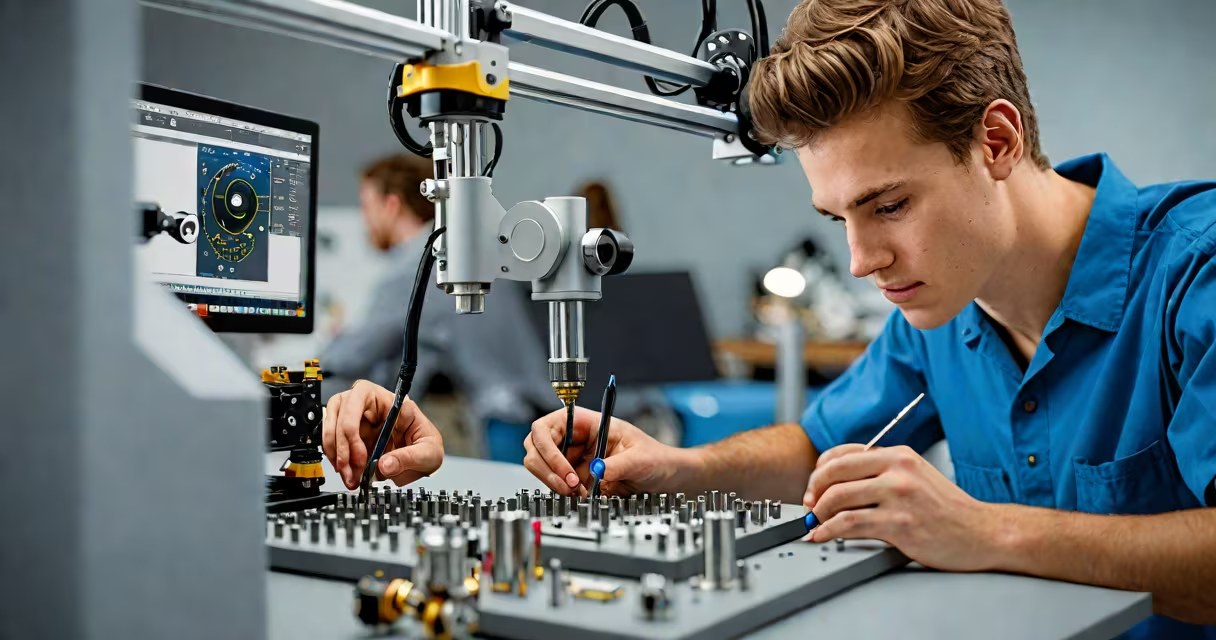
Aspiring mechanical engineers typically need a bachelor's degree in mechanical engineering or a closely related field from an ABET-accredited program. This foundational education includes coursework in physics, mathematics, materials science, thermodynamics, and design principles. Graduates with this credential qualify for entry-level positions in industries ranging from automotive to aerospace.
The core curriculum for a mechanical engineering bachelor's degree emphasizes applied science and problem-solving. Students take courses in calculus, differential equations, statics, dynamics, fluid mechanics, heat transfer, and control systems. These subjects build analytical and computational skills essential for designing machines, systems, and components. For example, a student designing a robotic arm must apply Newtonian mechanics to calculate torque and joint movement under load.
ABET (Accreditation Board for Engineering and Technology) accredits programs that meet national standards for engineering education. Programs accredited by ABET ensure graduates have the technical depth and ethical grounding required for professional practice. According to ABET's 2023 standards, accredited programs must include at least 120 semester hours of study, with significant hands-on laboratory and project-based learning. Without ABET accreditation, a degree may not qualify for licensure as a Professional Engineer (PE).
A typical mechanical engineering bachelor's program spans four years and includes both theoretical and practical training. The first two years focus on general education and foundational sciences. Students complete courses in college algebra, calculus I-III, introductory physics, chemistry, and computer programming. These form the basis for understanding complex physical systems.
The junior and senior years emphasize engineering-specific topics. Courses such as machine design, finite element analysis, manufacturing processes, and mechatronics allow students to integrate multiple disciplines. A capstone senior project often requires teams to develop a prototype-from concept to testing-addressing a real-world challenge like improving energy efficiency in HVAC systems.
| Year | Typical Coursework | Key Learning Outcome |
|---|---|---|
| First Year | Calculus I, General Physics, Chemistry, Intro to Engineering | Build math and science foundation |
| Second Year | Differential Equations, Statics, Materials Science, Programming | Apply math to physical systems |
| Third Year | Thermodynamics, Fluid Mechanics, Dynamics, Manufacturing | Model energy and motion systems |
| Fourth Year | Machine Design, Control Systems, Capstone Project | Integrate knowledge into functional solutions |
Internships and co-op experiences are common during the undergraduate years. Many programs require or strongly encourage students to complete at least one summer internship. For example, a student interning at General Motors may assist in testing suspension systems using simulation software, gaining exposure to industry practices and safety protocols.
While a bachelor's degree qualifies individuals for most entry-level roles, many mechanical engineers pursue graduate degrees for specialization or research careers. A master's degree in mechanical engineering allows deeper study in areas like robotics, biomechanics, or sustainable energy systems. Some programs offer concentrations in additive manufacturing, thermal systems, or autonomous vehicle dynamics.
Doctoral programs (Ph.D.) are necessary for academic positions or high-level research roles. A Ph.D. candidate might spend three to five years investigating novel materials for heat exchangers or developing algorithms for adaptive control in wind turbines. Research published in journals like *Journal of Mechanical Design* or *ASME Journal of Engineering for Gas Turbines and Power* contributes to technological progress.
Non-degree paths exist but are limited. Individuals with associate degrees in mechanical technology may work as technicians or drafters, supporting engineers in prototyping and testing. However, they cannot assume responsibility for independent design or sign off on engineering plans. Only those with a bachelor's degree from an ABET-accredited program can become licensed Professional Engineers.
Many assume that mechanical engineering is solely about building engines or fixing cars. While automotive applications are common, the field spans biomedical devices, renewable energy systems, consumer electronics, and space exploration. A mechanical engineer might design a prosthetic limb that mimics natural joint motion or develop a compact cooling system for satellite electronics.
Another misconception is that mechanical engineers only work with physical parts. Modern mechanical systems increasingly involve embedded software and sensors. A mechanical engineer designing a smart thermostat must understand feedback loops, microcontroller interfaces, and power management-all blending hardware and software expertise.
One non-obvious fact: not all mechanical engineering jobs require a degree. Entry-level technician roles in manufacturing or maintenance may hire candidates with vocational training or certifications. But these roles lack authority to approve designs or manage projects. The U.S. Bureau of Labor Statistics notes that 94% of mechanical engineers hold at least a bachelor's degree, and employment growth is highest for those with advanced credentials.
Consider a team of mechanical engineering seniors tasked with creating a solar-powered water pump for rural communities. They begin by analyzing local climate data-average sunlight hours, temperature extremes, and rainfall patterns. Using thermodynamic models, they calculate the optimal panel tilt and storage capacity needed to maintain flow during cloudy periods.
They select materials based on corrosion resistance and cost. Aluminum is chosen for the frame due to its strength-to-weight ratio and availability. The pump mechanism uses a diaphragm design to avoid clogging from sediment. The team runs simulations in ANSYS Fluent to test fluid dynamics and pressure distribution.
After prototyping, they conduct field tests in a simulated environment. Data shows the system delivers 15 liters per minute under peak sun, meeting the target. The final report includes failure mode analysis, cost breakdown, and recommendations for scaling production. This project integrates physics, materials science, and real-world constraints-exactly what a mechanical engineering education prepares students for.
Graduating with a bachelor's degree in mechanical engineering from an ABET-accredited institution is the standard requirement for most professional roles. This education provides the tools to analyze forces, model system behavior, and create safe, efficient, and new designs. As technology evolves, the demand for engineers who combine creativity with rigorous scientific training remains strong.