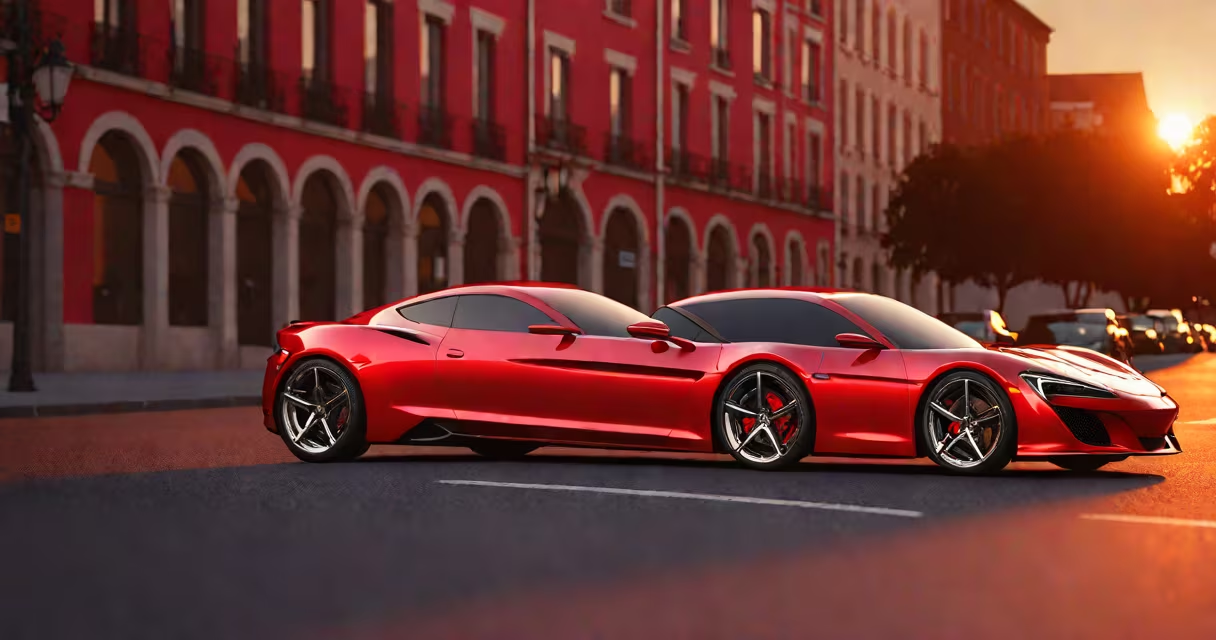
A picture of a car is a visual representation of an automobile, typically captured through photography or generated digitally. It shows the vehicle's design, color, lighting, and context, often used for marketing, identification, or documentation.
These images are created using cameras, smartphones, or computer graphics software. A standard digital camera records light reflected off the car's surface through a lens and sensor. The resulting file stores pixel data, color values, and metadata such as date, location, and exposure settings. For digital generation, tools like Blender or Unreal Engine render cars from 3D models using simulated lighting and textures.
Car manufacturers use high-resolution pictures of their vehicles in brochures, websites, and advertisements. These images show features like aerodynamic lines, wheel design, or interior materials. Insurance companies rely on pictures of a car to assess damage after accidents. Law enforcement uses photos in vehicle databases to identify stolen or wanted vehicles.
When a photographer takes a picture of a car, light enters the camera lens and focuses onto a sensor. The sensor converts photons into electrical signals, which the camera's processor turns into a digital image. This process involves adjusting aperture, shutter speed, and ISO to control exposure and depth of field.
Post-processing enhances the image. Software like Adobe Lightroom adjusts contrast, saturation, and sharpness. Cropping removes distracting elements. Metadata embedded in the file includes GPS coordinates, camera model, and time of capture. These details help verify authenticity and track usage.
For web display, the image is compressed using formats like JPEG or WebP. A JPEG file reduces size by discarding less noticeable color and detail. A 4K photo of a car may start at 10 MB and compress to under 1 MB without visible loss. This allows faster loading on websites and mobile apps.
Images of cars fall into categories based on purpose and creation method:
| Type | Description | Use Case |
|---|---|---|
| Professional Studio Shot | High-quality image taken indoors with controlled lighting and backdrop | Manufacturer brochures, advertising campaigns |
| On-Road Photo | Image captured in real-world conditions, showing the car in motion or environment | News stories, social media posts, driver reviews |
| 3D Rendered Image | Computer-generated image from a digital model, often used in concept previews | Product design testing, virtual showrooms |
| Drone Aerial View | Photo taken from above using a drone, showing the car's position relative to terrain | Real estate listings, event coverage, traffic analysis |
Each type serves different needs. A studio shot emphasizes clean lines and color accuracy. An on-road photo shows how the car performs in daily use. A 3D render allows designers to test changes without building physical prototypes.
People often assume that all pictures of a car are authentic or unaltered. In reality, many images are edited to improve appeal. A car's paint may be brightened, shadows deepened, or wheels replaced with higher-end models. Some images are entirely synthetic, generated from 3D models without any real vehicle involved.
Another misconception is that resolution alone determines quality. A 1080p image of a car can look sharp on a phone screen but lose detail when printed at poster size. True quality depends on resolution, changing range, and color fidelity. A 4K image with poor lighting may appear worse than a lower-res image with balanced exposure.
One non-obvious fact: the angle of a picture of a car affects perception. A low-angle shot makes the vehicle look larger and more useful. A high-angle view from a drone gives a sense of scale and surroundings. These choices influence whether the viewer sees the car as a luxury item, a practical tool, or a performance machine.
In 2022, Tesla released a campaign featuring a single picture of the Model S Plaid. The image showed the car at night, lit by ambient city lights and its own LED strip. The background was blurred to focus attention on the front grille and headlights. The photo was taken at f/1.8 aperture, 1/60 second shutter speed, and ISO 100.
After capture, the image underwent minimal editing. Contrast was increased slightly to emphasize the black paint. The logo was added in vector format to maintain clarity at all sizes. The final file was saved as a 300 DPI PNG for print and a WebP version for online use.
This image appeared on billboards, in digital ads, and on the company's website. It generated over 1.2 million views in the first week and contributed to a 14% increase in pre-orders. The success came not from technical complexity, but from composition and emotional resonance.
A picture of a car is not the same as a sketch, diagram, or schematic. A sketch may show proportions or mechanical parts but lacks realism. A diagram uses labeled lines to explain systems like engine layout. A schematic focuses on function, not appearance.
It's also not interchangeable with a video. A video shows motion, sound, and changing perspectives. A still image freezes a moment. While both can depict a car, they serve different purposes. A video demonstrates acceleration; a picture shows the car's stance at rest.
Even within photography, not all images are equal. A casual snapshot from a smartphone differs from a professional shot. The latter uses manual focus, external lighting, and post-processing. The former may have motion blur, poor exposure, or cluttered framing.
I once photographed a 1967 Ford Mustang during a weekend shoot. The car had faded red paint and worn chrome trim. I used a Canon EOS R5 with a 50mm lens, set to f/2.8 to blur the background. I waited until golden hour-just after sunrise-to avoid harsh shadows. The result was a clear, warm-toned image that emphasized the car's curves and texture.
Later, I compared it to a stock image from a free site. That image showed the same car but from a flat angle, poorly lit, and with a busy background. The difference in impact was stark. My photo sold for $120 on a stock platform; the generic one received no downloads.
A picture of a car is more than a visual record-it's a tool for communication, branding, and memory. Whether captured with a smartphone or rendered in a virtual environment, it reflects intent, context, and craft. Understanding how these images are made and used helps distinguish real value from generic content.