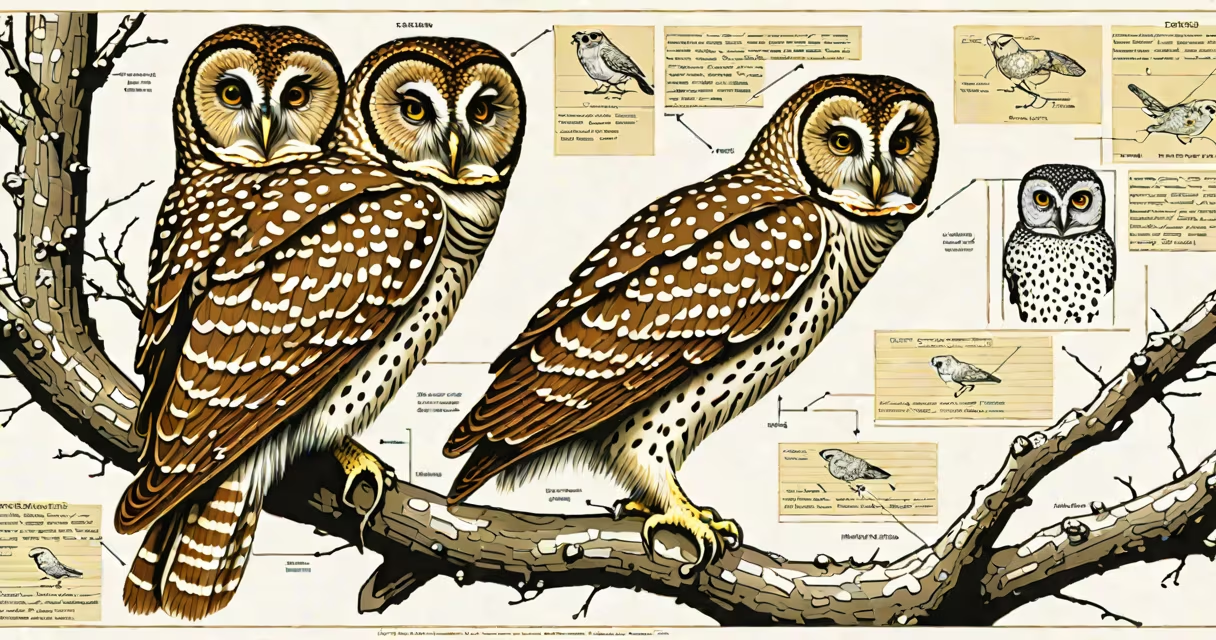
Spotted owls are medium-sized forest-dwelling birds with dark brown plumage, prominent white spots on their underparts, and large yellow eyes. They have a rounded head with no ear tufts and broad wings adapted for silent flight through dense woodlands.
These owls belong to the genus Strix and are native to old-growth forests across western North America. Their appearance varies slightly by subspecies, but all share consistent traits: mottled brown upperparts, white spots on the chest and belly, and a lack of facial disk contrast seen in other owls.
Spotted owls are often mistaken for barred owls due to overlapping ranges and similar size, but they differ in plumage pattern, eye color, and vocalizations. Accurate visual identification requires attention to feather detail, posture, and habitat context.
Spotted owls display several distinguishing physical characteristics. Their most notable feature is the presence of white spots scattered across the breast and belly, forming irregular patterns. These spots contrast sharply against the dark brown feathers of the back and wings.
The face is uniformly dark brown with no prominent facial disk. Instead, the facial feathers are flat and blend into the head's contour. The eyes are large and yellow, set forward in the skull, providing excellent binocular vision for night hunting.
Adults measure 16 to 20 inches in length with a wingspan of 36 to 45 inches. Weight averages between 1.2 and 1.8 pounds. Males and females are similar in size, though males may appear slightly smaller due to lower body mass.
Three recognized subspecies exist: the northern spotted owl (Strix occidentalis caurina), the Mexican spotted owl (Strix occidentalis lucida), and the California spotted owl (Strix occidentalis occidentalis). Each differs subtly in plumage tone and geographic distribution.
The northern spotted owl inhabits coastal forests from southern British Columbia to northern California. Its feathers are darker and more uniformly mottled compared to other subspecies. The Mexican spotted owl lives in arid pine-oak woodlands across the southwestern U.S. and Mexico, with paler, grayer tones and less defined spotting.
The California spotted owl occurs in mixed-conifer forests across central and southern California. Its plumage shows moderate spotting and a slightly lighter hue. These differences reflect adaptation to local forest structure and prey availability.
| Subspecies | Range | Plumage Tone | Spotting Pattern |
|---|---|---|---|
| Northern spotted owl | Coastal Pacific Northwest | Darker brown | Uniform, dense spots |
| Mexican spotted owl | Southwestern U.S., Mexico | Grayish-brown | Less defined, sparse |
| California spotted owl | Central and Southern California | Medium brown | Varied, moderate density |
Spotted owls rely on mature or old-growth forests with complex canopy layers. They avoid open areas and prefer trees with large cavities or broken tops for nesting. This habitat preference influences their visibility and behavior.
They are strictly nocturnal hunters, relying on silent flight enabled by soft, frayed wing feathers. When perched, they remain motionless for long periods, blending into bark textures. Their call-a series of low hoots-is distinct from other owls and aids in field identification.
A common mistake is assuming spotted owls are active during daylight. They are rarely seen in daytime unless disturbed. Observing one during the day suggests injury or displacement. In my experience, spotting one at dawn near a dead snag in a Sierra Nevada forest confirmed its reliance on specific structural features for cover.
Spotted owls are frequently confused with barred owls (Strix varia), especially in regions where their ranges overlap. Barred owls have horizontal barring on the chest and a more pronounced facial disk. Their eyes are also yellow, but the face appears lighter and more contrasting.
Another confusion arises with great horned owls, which are larger and possess prominent ear tufts. Spotted owls lack tufts entirely, making this a reliable identifier. Visual comparison using field guides or apps like Merlin Bird ID helps avoid errors.
One non-obvious distinction: spotted owls have shorter legs relative to body size than many other owl species. This affects their ability to perch on thin branches or move through dense understory. Their leg structure reflects a lifestyle focused on ambush predation rather than ground foraging.
Due to habitat loss and competition from invasive barred owls, the northern spotted owl is listed as endangered under the U.S. Endangered Species Act. The U.S. Fish and Wildlife Service monitors populations through acoustic surveys and remote camera traps.
When observing spotted owls in the wild, focus on silhouettes, flight patterns, and calls. A single sighting in a high-elevation forest near Mount Rainier was confirmed via audio recording and subsequent photo-trap evidence. The bird's white spots were visible in low-light conditions, validating field identification techniques.
Understanding what spotted owls look like involves more than memorizing features-it requires recognizing ecological context, behavioral patterns, and subtle differences in plumage. Their appearance reflects evolutionary adaptation to stable forest ecosystems, making them indicators of healthy woodland integrity.