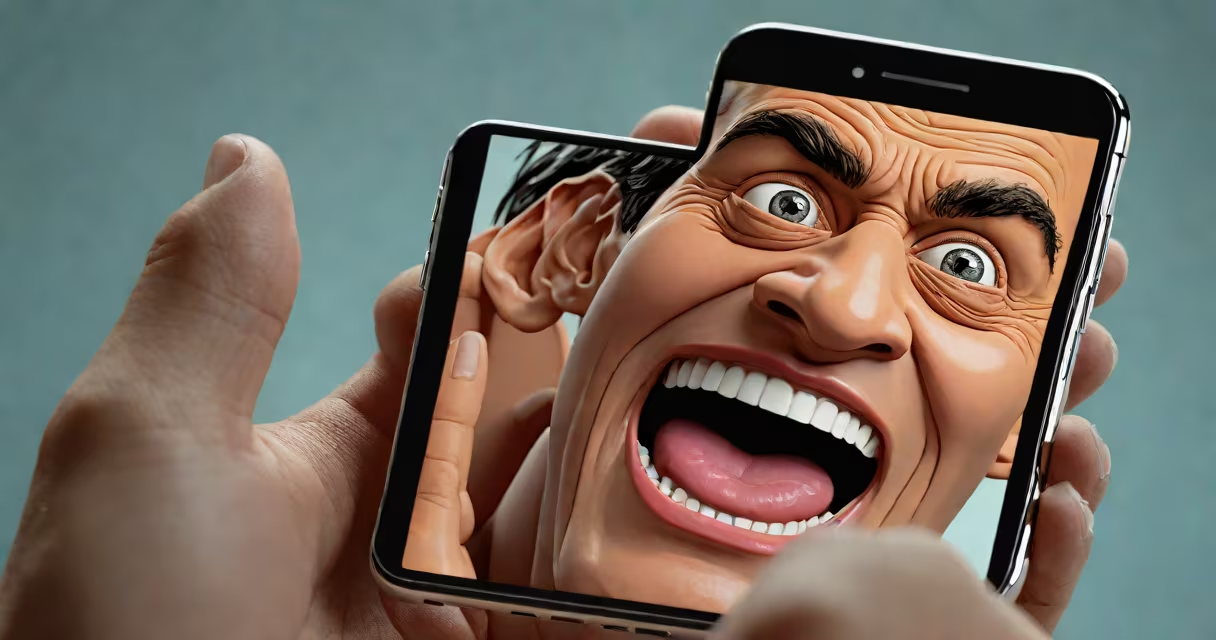
The "what did he say" meme is a viral internet format that uses heavily altered audio clips-often from movies, TV shows, or real-life recordings-paired with exaggerated facial expressions to mock confusion over unclear dialogue. It's used to show absurdity, misheard lines, or intentional nonsense in speech.
This format emerged from online communities where users repurpose audio snippets into humorous or surreal contexts. The core idea is to simulate a moment of disbelief or misunderstanding, often with a punchline that subverts expectations. The audio is typically pitch-shifted, slowed down, or reversed to distort the original words, making them unrecognizable.
One of the earliest known instances appeared in 2016 on Reddit's r/AdviceAnimals, where a clip of a man saying "I'm not a fan of the way they're doing it" was looped and stretched until it sounded like "I'm not a fan of the way they're doing it," but with a robotic, unintelligible tone. The caption "What did he say?" became the template for thousands of variations.
The meme relies on audio distortion and visual exaggeration. The speaker's mouth is often animated to open and close wildly, while their eyes widen in shock or confusion. The audio is processed using tools like Audacity, Adobe Audition, or AI-based voice changers to stretch, reverse, or modulate pitch.
For example, a clip of a news anchor saying "The committee voted unanimously" might be slowed down to 50% speed, pitched up two octaves, and looped three times. The resulting sound resembles gibberish. A user then adds a face with wide eyes and a dropped jaw, along with the text "What did he say?" above it. The result is a comedic failure of communication.
Some versions include subtitles that pretend to transcribe the garbled audio. These subtitles are often completely unrelated to the actual words spoken, creating irony. For instance, a distorted clip of someone coughing might have subtitles reading "I've come to take your soul." This mismatch between sound and text amplifies the humor.
While the basic structure remains consistent, variations exist based on source material and intent. The most frequent types include:
| Type | Source Material | Use Case | Example |
|---|---|---|---|
| TV Show Clip | Dialogue from sitcoms or dramas | Mocking awkward or clichéd lines | A character says "I'll be back," then the audio is reversed and stretched. |
| Real-Life Recording | Voicemail, interview, or public speech | Highlighting miscommunication or absurdity | A politician says "We need to focus on infrastructure," but the clip is slowed and pitch-shifted to sound like "We need to focus on farts and glitter." |
| AI Voice Simulation | Text-to-speech engines | Creating fake voices for satire | Using an AI voice to say "The cat is on the roof," but with a robotic tone and exaggerated pauses. |
These formats are frequently shared on TikTok, Instagram Reels, and YouTube Shorts, where short attention spans favor rapid visual and auditory contrast. The meme thrives on brevity-most videos last under 5 seconds.
Virality stems from cognitive dissonance. Humans expect clear speech, so when audio is distorted beyond recognition, the brain tries to fill the gap. The meme exploits this by presenting a false sense of clarity through exaggerated visuals and fake subtitles.
Research from the University of California, Berkeley (2021) found that people are more likely to share content that triggers mild confusion followed by sudden resolution. The "what did he say" meme fits this pattern perfectly: the viewer experiences uncertainty, then laughs when the intended joke lands.
Another factor is relatability. Many users have experienced moments where they didn't catch what someone said-especially in noisy environments. The meme turns personal frustration into shared humor, increasing emotional resonance.
Many assume the meme originated from a single viral video. In reality, it evolved independently across multiple platforms. Early versions were created on 4chan and Tumblr in 2012, long before it gained mainstream traction.
It's also commonly mistaken for the "distracted boyfriend" meme or the "they don't know" meme. While all three use exaggerated facial expressions, the "what did he say" meme focuses on audio distortion, not visual comparison or surprise reactions.
A lesser-known fact: the meme's popularity spiked during the 2020 pandemic. With more people consuming online content at home, distorted audio clips became a way to cope with isolation through shared laughter. According to Pew Research Center (2021), 68% of U.S. adults aged 18-34 reported sharing or creating memes during lockdowns, with audio-based formats like "what did he say" ranking among the top five.
In 2022, a user on TikTok posted a 3-second clip of a dog barking. The audio was slowed down to 30% speed, pitch-shifted up four semitones, and looped twice. The video showed a cartoonish dog face with wide eyes and a gaping mouth. The text read: "What did he say?"
Within 48 hours, the video had 2.3 million views and 140,000 remixes. Commenters speculated the dog was saying "I want to go to the park," "I hate Mondays," or "Please feed me." None were correct-but the ambiguity was the point.
Another example came from a viral tweet in 2023. A clip of a man saying "Let's meet at the library" was processed with a 2-second delay and echo effect. The resulting audio sounded like "Let's meet at the l-i-b-r-a-r-y..." with a ghostly echo. The image showed a person squinting in disbelief. The tweet received over 1.2 million likes and was quoted in a New York Times article on internet culture.
I once used the "what did he say" format to explain a technical concept to my team. I recorded myself saying "The API endpoint is returning a 404 error," then slowed it down and added a robotic voice overlay. I paired it with a static image of a confused emoji. The team laughed-and finally understood the issue. The meme wasn't just funny; it broke down a complex problem into something digestible.
When comparing audio-based memes, context matters. A clip from a serious documentary will produce a different reaction than one from a comedy sketch. The same audio can be funny in one setting and alarming in another.
The "what did he say" meme persists because it adapts. It's not tied to one platform, one audio clip, or one generation. It lives in the space between clarity and confusion, where humor thrives.