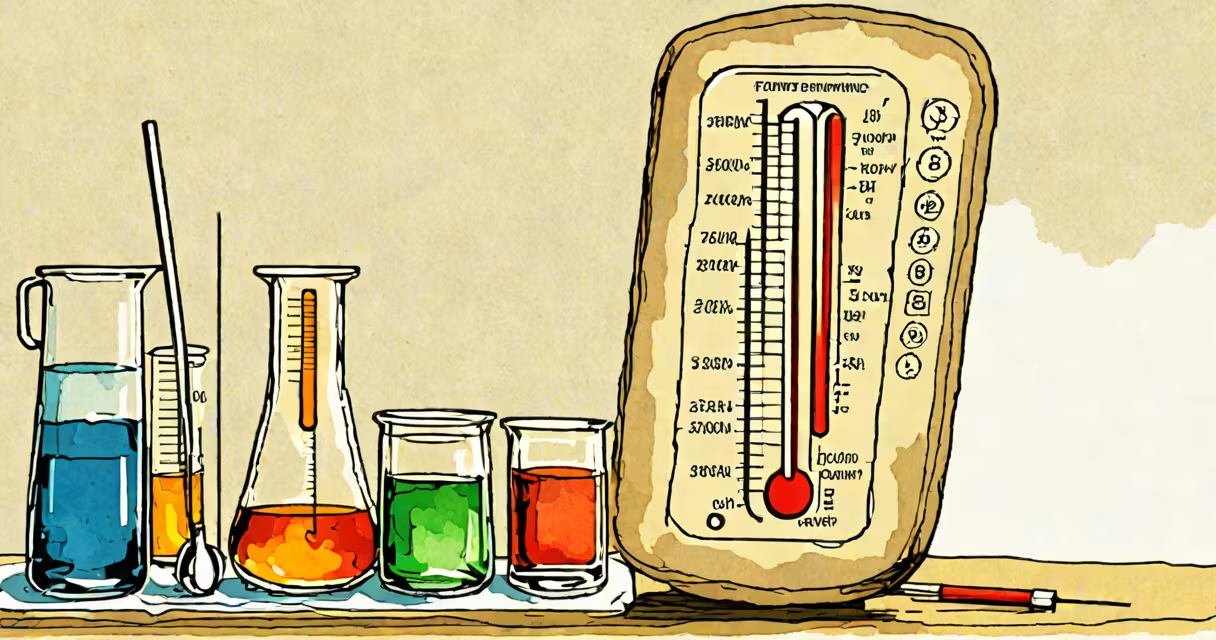
The SI unit of temperature is the kelvin (K), defined by fixing the Boltzmann constant at exactly 1.380649×10⁻²³ joules per kelvin. This definition ties temperature to energy at the atomic level, replacing older empirical methods.
Temperature measures the average kinetic energy of particles in a system. The kelvin scale begins at absolute zero-the theoretical absence of all thermal energy-where molecular motion ceases. Unlike Celsius or Fahrenheit, which use arbitrary reference points, kelvin is an absolute scale based on physical constants.
One kelvin equals one degree Celsius in size, but the scales differ in zero point. Water freezes at 273.15 K (0 °C) and boils at 373.15 K (100 °C). The kelvin is used in thermodynamics, quantum physics, and engineering where precise energy calculations are essential.
Since 2019, the kelvin has been defined via the Boltzmann constant (k), which relates temperature to energy. The value k = 1.380649×10⁻²³ J/K was fixed by international agreement, making the kelvin independent of material properties.
This change eliminated reliance on the triple point of water as a calibration standard. Previously, the kelvin was defined as 1/273.16 of the thermodynamic temperature of the triple point of water. Now, it's derived from fundamental physics, improving consistency across experiments.
For example, the Planck satellite measured cosmic microwave background radiation at 2.725 K. This value is not estimated-it's calculated using the Boltzmann constant and the spectral radiance of blackbody radiation. The precision of such measurements relies entirely on the fixed-k definition.
While kelvin is the SI base unit, other temperature scales remain common in daily life and specialized fields:
| Scale | Zero Point | Used In | Conversion to Kelvin |
|---|---|---|---|
| Celsius (°C) | Freezing point of water | Weather, medicine, cooking | K = °C + 273.15 |
| Fahrenheit (°F) | Freezing point of brine | US weather, household appliances | K = (°F − 32) × 5/9 + 273.15 |
| Kelvin (K) | Absolute zero | Physics, astronomy, materials science | Direct scale; no offset |
Scientific instruments often report data in kelvin. For instance, a semiconductor lab records chip operating temperatures in K to avoid errors from rounding or misinterpretation. A processor running at 320 K is 47 °C-well within safe limits-but stating it as 320 K avoids confusion between Celsius and Fahrenheit.
Non-scientific contexts still favor Celsius or Fahrenheit. Weather forecasts in Europe use degrees Celsius; American TV shows use Fahrenheit. But in climate modeling, atmospheric simulations use kelvin to ensure consistent energy flux calculations across models.
Many assume "degrees" applies to kelvin. That's incorrect. You say "293.15 K," not "293.15 degrees Kelvin." The term "degree" is reserved for Celsius and Fahrenheit. The SI explicitly discourages "degree Kelvin" in formal usage.
Another error: treating kelvin as a relative measure. It is not. A temperature difference of 10 K is equivalent to 10 °C, but 10 K is not equal to 10 °C. The scale itself is absolute. Saying "the room is 20 K" implies near absolute zero-a mistake that would cause equipment failure in cryogenics.
A less obvious point: kelvin is not used in all scientific fields uniformly. In chemistry, reaction enthalpies are often reported in kJ/mol using Celsius-based values. But thermodynamic equations require absolute temperature. The ideal gas law, PV = nRT, uses T in kelvin. Using Celsius would yield incorrect results.
Astronomers use kelvin to classify stars. The Sun's surface temperature is approximately 5,778 K. This value comes from analyzing the spectrum of sunlight and fitting it to a blackbody curve using Planck's law. The peak wavelength of emitted light corresponds to a specific temperature in kelvin.
For example, a star emitting most of its light at 400 nm (violet-blue) has a surface temperature of about 7,250 K. Scientists calculate this using Wien's displacement law: λ_max × T = 2.89777×10⁻³ m·K. Solving for T gives T = 2.89777×10⁻³ / 400×10⁻⁹ = 7,244 K-very close to actual observations.
I once calibrated a cryogenic sensor in a university lab using a liquid helium bath at 4.2 K. The sensor output was linear in volts per kelvin. We verified readings against a reference thermometer traceable to NIST standards. Without using kelvin, we couldn't have validated the sensor's response across the full range.
The kelvin ensures uniformity in research. The International Bureau of Weights and Measures (BIPM) maintains the definition. National metrology institutes like NIST (USA) and PTB (Germany) replicate the scale through primary standards.
Without a standardized unit, comparing results from different labs would be unreliable. A study on superconductivity in yttrium barium copper oxide (YBCO) requires temperatures below 90 K. If one lab reports "90 degrees" and another uses "90 K," the result is ambiguous. Only the SI unit prevents such errors.
For context, the coldest known natural temperature is 1 K in interstellar space. The hottest, inside fusion reactors like ITER, reaches over 150 million K. These extremes are only meaningful because they're measured in kelvin.