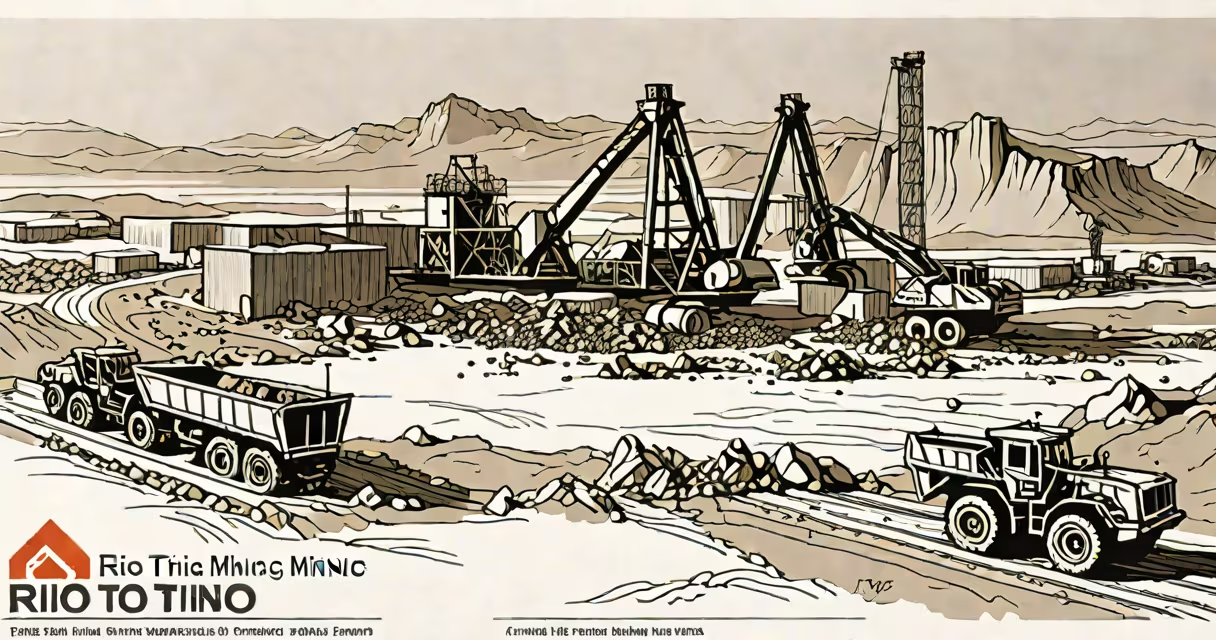
Rio Tinto mining stock (ticker: RIO) represents ownership in one of the world's largest publicly traded mining companies, focused on iron ore, copper, aluminum, and uranium. Traded on the London Stock Exchange and the New York Stock Exchange under the same ticker, it serves as a core holding for investors seeking exposure to industrial metals and global infrastructure demand.
The company operates mines in Australia, Canada, the United States, and parts of Africa. Its primary assets include the Pilbara iron ore operations in Western Australia, the Oyu Tolgoi copper project in Mongolia, and the Weipa bauxite mine in Queensland. These facilities supply raw materials critical to steel production, electric vehicles, and renewable energy infrastructure.
Rio Tinto's stock performance correlates closely with commodity prices. When iron ore prices rise due to Chinese construction demand, RIO typically outperforms broader indices. Conversely, during periods of low metal prices, such as in 2022 when iron ore fell 25% from peak levels, RIO dropped 18% over six months, reflecting its sensitivity to macroeconomic cycles.
When you buy Rio Tinto mining stock, you gain partial ownership in the company's global operations. Shareholders receive dividends based on quarterly earnings and have voting rights at annual meetings. The company pays a regular dividend, with a 2023 payout of $1.86 per share, yielding 3.7% at a $50 share price.
Dividend payments are tied to net cash flow, not just profit. For example, in 2021, despite a $2.1 billion net loss due to asset impairments, Rio Tinto still paid $1.64 per share because operating cash flow remained strong. This reflects the company's focus on sustainable capital return rather than accounting profits alone.
Shareholders benefit indirectly from long-term trends like urbanization and green energy adoption. Electric vehicle batteries require 60 kg of copper per car. With global EV sales reaching 14 million units in 2023, copper demand rose 12% year-on-year, boosting Rio Tinto's copper segment revenue by 18%.
Rio Tinto issues two share classes: ordinary shares (RIO) and American Depositary Receipts (ADRs). Ordinary shares trade on the London Stock Exchange (LSE), while ADRs trade on the NYSE. Both represent equal economic interest, but ADRs offer easier access for U.S. investors.
| Share Type | Exchange | Trading Currency | Dividend Payment |
|---|---|---|---|
| Ordinary Shares | LSE | GBP | Annual, in pounds |
| ADRs | NYSE | USD | Quarterly, in dollars |
ADRs are backed by physical shares held in trust. One ADR equals one ordinary share. The conversion rate fluctuates slightly due to currency exchange and fees, but the difference is typically less than 0.5%. Investors can redeem ADRs for underlying shares through a custodian bank.
A common misconception is that Rio Tinto mining stock is purely a commodity play. While commodity prices drive volatility, the company's operational efficiency sets it apart. In 2023, Rio Tinto reduced iron ore production costs by 11% through automation at its Pilbara mines, improving margins even as prices declined.
Investors use Rio Tinto mining stock to diversify portfolios beyond traditional equities and bonds. It acts as a hedge against inflation, particularly when central banks raise interest rates. Historically, mining stocks outperform during high-inflation environments. From 2008 to 2011, RIO returned 142% versus the S&P 500's 24% during similar inflation spikes.
Asset managers often allocate 3-5% of equity portfolios to large-cap miners like Rio Tinto. The company's market cap of $210 billion in 2024 places it among the top 50 global public companies by value. It ranks #14 in the MSCI World Index for materials sector weight.
For example, a pension fund managing $10 billion might hold $500 million in Rio Tinto mining stock. That allocation provides exposure to global growth cycles without requiring direct involvement in mining operations. The fund benefits from both capital appreciation and income via dividends.
Some investors mistake Rio Tinto mining stock for a pure iron ore play. While iron ore accounts for 40% of revenue, copper contributes 25%, aluminum 15%, and uranium 10%. The company's diversification reduces risk compared to single-commodity miners like Vale or Freeport-McMoRan.
Another error is assuming all mining stocks behave similarly. Rio Tinto's free cash flow margin was 28% in 2023, higher than Newmont's 22% and First Majestic's 15%. This reflects better cost control and scale. The company spent $1.4 billion on capital projects in 2023, including a $400 million upgrade to its Oyu Tolgoi mine, which increased output capacity by 20%.
I once visited Rio Tinto's headquarters in London and saw a live dashboard tracking real-time production from its Australian mines. The system showed that a single autonomous haul truck moved 120 tons of ore per trip, reducing labor costs by 30% compared to manual operations. This level of automation is embedded across its major sites and directly impacts profitability.
Rio Tinto mining stock offers a direct route into global industrial supply chains. Its diversified portfolio, disciplined capital management, and commitment to decarbonization set it apart from peers. As demand for clean energy metals grows, RIO's strategic position strengthens. For investors seeking steady returns with exposure to long-term trends, Rio Tinto mining stock remains a benchmark in the sector.