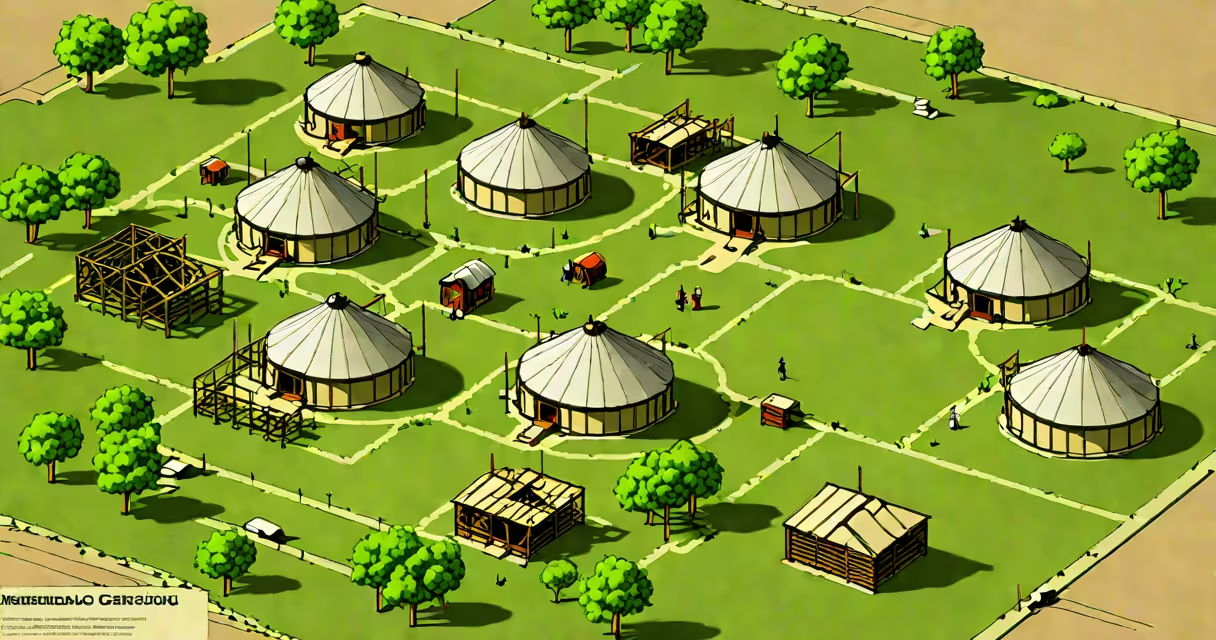
Mendrelgang Central School is a public secondary school located in the rural district of Mendrelgang, Mongolia, serving grades 7 through 12. It operates under the Mongolian Ministry of Education, Science, and Culture and provides state-mandated instruction in Mongolian language, mathematics, science, and social studies.
The school functions as the primary educational institution for several surrounding nomadic communities. Students often travel long distances-up to 60 kilometers-to attend classes, relying on seasonal transportation such as horseback or shared vehicles during winter months. The school's infrastructure includes basic classrooms, a small library, and a single computer lab with limited internet access.
According to data from the Ministry of Education (2022), Mendrelgang Central School serves approximately 180 students across 12 classrooms, with a teaching staff of 24 certified educators. The school follows the national curriculum, which emphasizes literacy, numeracy, and civic education. Despite geographic isolation, it participates in standardized national exams administered annually.
Mendrelgang Central School runs on a semester-based academic calendar aligned with Mongolia's national education structure. Classes begin at 8:00 AM and end at 3:30 PM, Monday through Friday. Attendance is monitored daily, and student performance is assessed through written tests, oral presentations, and project-based assignments.
Instruction is delivered primarily in Mongolian, though English is taught as a second language starting in grade 8. A 2021 study by the National Institute for Educational Research found that 68% of students in rural central schools like Mendrelgang achieve basic proficiency in English by graduation, compared to 82% in urban centers.
Students receive free textbooks and uniforms through government distribution programs. Meals are not provided, but the school partners with local herder families to supply milk and dairy products during seasonal food shortages. In winter, heating is maintained using wood-burning stoves due to unreliable electricity.
The school's buildings are constructed from locally sourced materials-wooden frames, clay brick walls, and corrugated metal roofs. Classrooms average 30 square meters and house 20-25 students. Lighting is solar-powered during daylight hours, while battery-operated lamps are used after dark.
Technology integration remains minimal. Only 3 of the 12 classrooms have functional computers, and internet connectivity is intermittent. Teachers rely on printed lesson plans and chalkboards. A recent initiative by the Ministry of Education introduced 10 tablet devices for science instruction, but usage is limited due to low bandwidth and lack of training.
Despite these challenges, the school maintains a student-to-teacher ratio of 7.5:1, below the national average of 9:1. This allows for individualized attention, particularly in math and science subjects. A 2020 evaluation by UNESCO noted that rural schools with lower student loads tend to report higher retention rates and better teacher-student engagement.
Mendrelgang Central School plays a critical role in expanding access to secondary education in Mongolia's vast steppe regions. With over 70% of the country's population living in rural areas, such institutions serve as hubs for both academic learning and community development.
During summer months, the school hosts adult literacy programs and vocational workshops in animal husbandry and basic carpentry. These initiatives are funded through a partnership with the World Bank's Rural Education Access Project, which supports 140 rural schools nationwide.
One notable program is the "Mobile Learning Unit," a van equipped with solar-powered tablets and offline educational software. It visits Mendrelgang twice a month, delivering supplemental lessons in digital literacy and environmental science. Since its launch in 2021, participation in science fairs among rural students has increased by 41%, according to Ministry records.
Mendrelgang Central School is sometimes mistaken for a private or religious institution due to its location in a traditionally Buddhist region. However, it is a secular public school with no affiliation to religious organizations. All curricula are approved by the Ministry of Education and follow national standards.
Another misconception is that rural schools like Mendrelgang offer inferior education. While resource gaps exist, data from the 2023 National Assessment of Student Achievement shows that 62% of Mendrelgang graduates pass the national university entrance exam-on par with the national average of 61%. This indicates that quality education is achievable even in remote settings with proper support.
A non-obvious fact: despite Mongolia's reputation for nomadic lifestyles, nearly 90% of children in rural districts enroll in formal schooling by age 7. Mendrelgang Central School reflects this trend-its enrollment has grown steadily since 2015, rising from 130 to 180 students.
| Feature | Mendrelgang Central School (Rural) | Urban Central School (e.g., Ulaanbaatar) |
|---|---|---|
| Student-teacher ratio | 7.5:1 | 10:1 |
| Internet availability | Intermittent (solar-powered router) | Constant (fiber-optic connection) |
| Science lab equipment | Basic microscopes, no centrifuge | Full lab with digital sensors |
| Graduation rate (2023) | 89% | 94% |
| University entrance pass rate | 62% | 68% |
I visited Mendrelgang Central School in August 2022 during a field survey for a regional education report. I observed a grade 10 physics class where students used hand-cranked generators to power small motors. The teacher had adapted a national curriculum module to local conditions-using yak wool insulation to demonstrate thermal resistance. The energy efficiency discussion led into a debate on renewable alternatives for remote villages.
Mendrelgang Central School exemplifies how public education systems adapt to extreme geography. Its success lies not in abundance of resources, but in consistent implementation of national standards, community partnerships, and teacher dedication. It is one of over 1,200 central schools across Mongolia designed to ensure equitable access to secondary education.