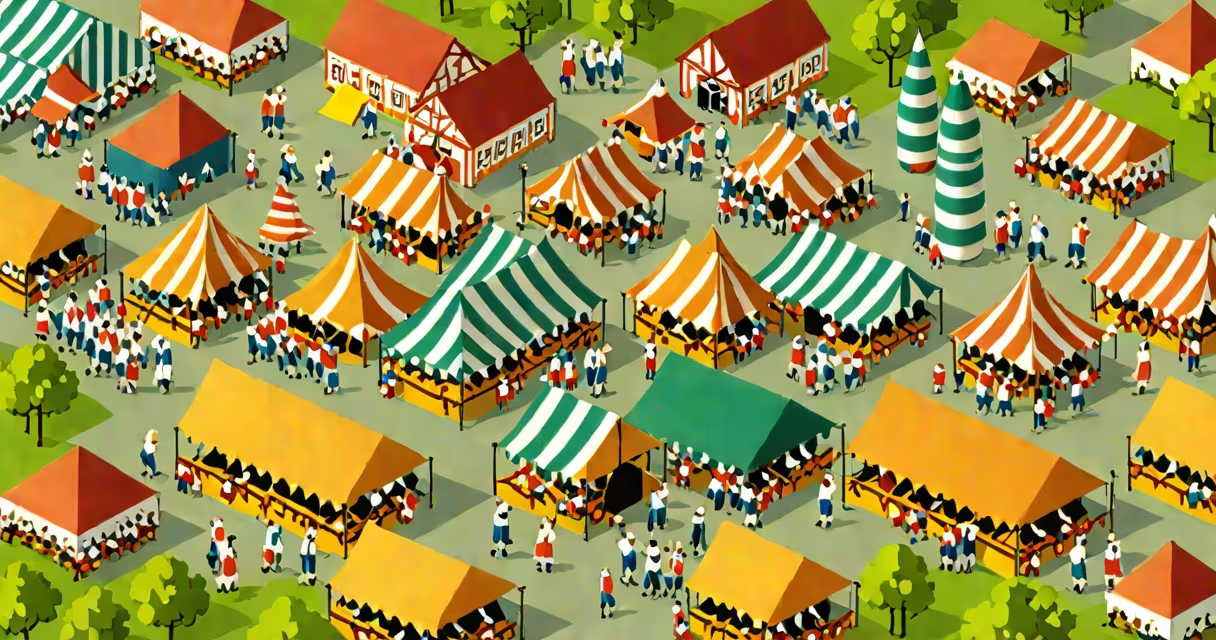
Oktoberfest originated in Munich, Germany, in 1810 as a celebration of the marriage of Crown Prince Ludwig of Bavaria and Princess Therese of Saxe-Hildburghausen. The event was held on the grounds now known as Theresienwiese, named in honor of the princess.
The original festivities included horse races, military parades, and public feasting. The royal couple's wedding marked the beginning of a tradition that grew into a city-wide festival lasting 16 days, starting in late September and extending into October.
Today, Oktoberfest remains rooted in its 1810 origins, though it has expanded far beyond its initial scope. The festival now draws over six million visitors annually and features hundreds of beer tents, traditional costumes, and cultural performances.
On October 12, 1810, crowds gathered on the meadow outside Munich's city walls-then a rural area-to celebrate the marriage of Crown Prince Ludwig and Princess Therese. The event was organized by the Bavarian government and included a series of equestrian events, including a grand horse race.
Local residents were invited to attend, and the success of the turnout led officials to declare the event an annual tradition. The site was officially named Theresienwiese-"Therese's Meadow"-after the bride. The name stuck, and the festival became synonymous with the location.
By 1811, the celebration had grown to include food vendors, music, and early forms of beer sales. The first documented use of the term "Oktoberfest" appeared in a newspaper report from 1813, describing the ongoing festivities.
Oktoberfest is not just a beer festival-it is a structured cultural event with specific traditions. The festival runs from the third Saturday in September through the first Sunday in October, lasting 16 days.
Each year, the event begins with the ceremonial tapping of the first keg by the mayor of Munich. This act, called the "O'zapft is!" (literally "It's tapped!"), marks the official start of beer service. The phrase is spoken in Bavarian dialect and signals the opening of the beer tents.
Beer served at Oktoberfest must meet strict standards. All beer is brewed within Munich under the Reinheitsgebot-a purity law dating to 1516 that limits ingredients to water, barley, hops, and yeast. The beer is served in one-liter mugs called "Masskrüge," and consumption is regulated by volume and price.
| Feature | Description |
|---|---|
| Duration | 16 days, starting third Saturday in September |
| Location | Theresienwiese, Munich |
| Beer Standard | Brewed in Munich under Reinheitsgebot |
| Volume | Served in 1-liter mugs (Masskrüge) |
| Opening Ceremony | Mayor taps first keg with the phrase "O'zapft is!" |
Many people assume Oktoberfest is primarily about drinking large quantities of beer. While beer is central, the festival includes many activities focused on culture, music, and community.
Another misconception is that Oktoberfest began in the 19th century as a commercial beer event. In reality, it was a civic and royal celebration. The first beer tents didn't appear until decades later, and they were initially small, informal setups run by local brewers.
A lesser-known fact: the original 1810 celebration lasted only four days. The modern 16-day format was established in the 1850s, after the festival's popularity grew. The extension was driven by demand from tourists and regional visitors who wanted more time to participate.
Oktoberfest-inspired festivals now exist in over 100 countries, including the United States, Canada, Japan, and Australia. These events often borrow the name and imagery but differ in scale and authenticity.
For example, the Oktoberfest in San Francisco, California, began in 1981 and attracts around 200,000 attendees annually. It features German food, music, and beer, but the event is not held on Theresienwiese and does not follow the same brewing regulations.
When I visited Munich in 2019, I attended the festival during the opening weekend. I witnessed the mayor tap the first keg live-crowds roared as the sound of the hammer echoed across the field. I drank a Masskrug of Helles lager from a tent operated by Paulaner Brewery. The beer was cold, crisp, and perfectly balanced-exactly as described in the Reinheitsgebot.
Even today, the core identity of Oktoberfest remains tied to its origins. The festival still honors the 1810 wedding, and the city of Munich maintains strict oversight over branding, beer quality, and event logistics.
Understanding where Oktoberfest originated helps explain its enduring structure and cultural significance. The festival is not a spontaneous party-it is a continuation of a 214-year-old tradition rooted in civic pride and historical continuity.
According to the Bavarian State Archives, the original 1810 invitation list included nobility, military officers, and local dignitaries. Attendance was limited to those with formal invitations. Over time, the event opened to the public, but the spirit of inclusion and celebration remains central.
For travelers, knowing the origin of Oktoberfest adds context to the experience. It is not just a place to drink beer-it is a living monument to Bavarian heritage, royal history, and communal joy.
Oktoberfest originated in Munich in 1810 as a royal wedding celebration. Its evolution into a global phenomenon reflects both cultural endurance and adaptation. The festival continues to draw millions each year, grounded in its authentic roots.