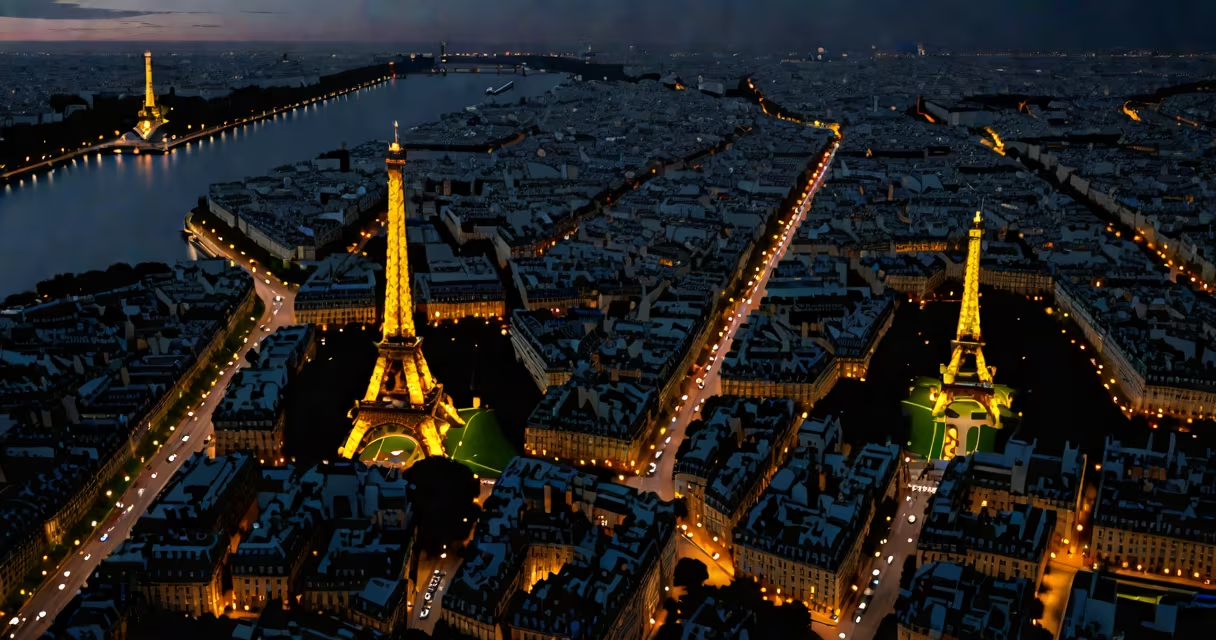
Paris at night is a blend of soft golden light, quiet cobblestone alleys, and iconic structures glowing under the stars. The city shifts from daytime energy to a slower, more romantic rhythm, with monuments like the Eiffel Tower and Notre-Dame illuminated against a deep blue sky.
The transformation begins around 7 PM. Streetlamps flicker on, café terraces fill with people sipping wine, and the Seine reflects the city's lights in rippling patterns. This is not just a visual spectacle-it's a sensory shift. The air cools, footsteps echo less sharply, and distant music drifts from open windows.
Paris at night is not one scene. It's a series of moments: a couple sharing a croissant at a corner bistro, a street musician playing jazz near the Métro, the faint chime of a church bell marking the hour. These details form the city's nighttime identity, distinct from its daytime self.
Electricity powers the city's nighttime glow. The Eiffel Tower, for example, lights up every hour between 7 PM and midnight, and again at 1 AM, 2 AM, and 3 AM during summer. Each display lasts five minutes, timed to the minute. The lights are powered by a dedicated grid managed by the City of Paris.
Public transport continues running until 1:30 AM on weekdays and later on weekends. The Métro stays open until 1:45 AM, allowing visitors to move freely. Many restaurants close by 11 PM, but bars and brasseries often stay open past midnight, especially in neighborhoods like Le Marais and Montmartre.
Security remains visible but unobtrusive. Police patrols and surveillance cameras operate throughout central districts. Tourists report feeling safe walking alone after dark in well-lit areas, though caution is advised in isolated zones like parts of the 18th arrondissement after 11 PM.
Paris at night stands out because of its deliberate pacing. Unlike cities that grow louder after dark, Paris slows down. There's no neon frenzy. Instead, lighting is warm, architectural, and intentional. The city doesn't shout-it whispers.
One example: the Pont des Arts. During the day, it's a bridge for sightseeing. At night, it becomes a place for couples to attach padlocks as symbols of love. Though the city removed most locks in 2015 due to structural concerns, the tradition persists-some couples still leave small tokens, and the spot remains emotionally charged.
A lesser-known fact: the Louvre's glass pyramid is lit from within at night. The structure glows softly, casting shadows on the courtyard. Visitors often walk through the underground entrance after hours, drawn by the contrast between the ancient stone walls and the modern glass.
Best times to visit: late spring to early autumn (May through September). Nights are longer, temperatures milder, and outdoor seating remains open later. Avoid July and August if you prefer fewer crowds-many locals leave the city.
Top locations:
For a full experience, start at Place de la Concorde at 8 PM. Walk west along the Champs-Élysées, then turn onto Rue de Rivoli. By 9 PM, you'll reach the Louvre. From there, cross the Seine and head toward the Île de la Cité. The entire route takes about 90 minutes and covers four major districts.
Many assume Paris at night is dangerous. The reality is that crime rates drop after dark in tourist-heavy zones. According to the French Ministry of Interior, incidents in central Paris fell 12% between 2019 and 2022, despite rising visitor numbers.
Another myth: "All restaurants close early." While many shut by 10 PM, popular spots like Le Comptoir du Relais (10 Rue de l'Échiquier) stay open until 1 AM. They serve classic dishes-duck à l'orange, steak frites-with minimal wait times.
Some confuse Paris at night with Paris in winter. Winter nights bring colder temps and shorter days. The city feels quieter, with fewer tourists. But the lights remain-the same towers, same bridges. The difference is atmosphere, not availability.
On a Tuesday in June, a traveler arrived at Charles de Gaulle Airport at 6 PM. After a 45-minute train ride to Gare du Nord, they took a taxi to the Latin Quarter. Dinner was at L'As du Fallafel (12 Rue de la Huchette), where they ordered falafel with tahini and a glass of rosé. The meal cost €16.
After dinner, they walked to the Panthéon. The building was lit from within, casting a pale blue glow on the surrounding square. They stayed for 20 minutes, watching tourists take photos.
Next, they crossed the Seine and boarded a Seine cruise departing from Pont Neuf. The boat passed under the Pont Neuf, the Pont des Arts, and the Pont Marie. At 10:15 PM, the Eiffel Tower lit up for the first time. The traveler snapped a photo using a tripod-exposure set to 10 seconds, ISO 100.
They ended the night at a bar in Le Marais called Le Baron. The interior was dim, with red velvet booths and live jazz. A cocktail cost €12. They left at 1:15 AM, walking back to their hotel via Rue des Francs-Bourgeois.
This sequence-dinner, monument viewing, river cruise, bar-covers the core elements of Paris at night. It's not about ticking off sights. It's about immersion.
Paris at night is not a party city. It lacks the loud clubs and late-night dancing seen in Berlin or Tokyo. Most nightlife ends by 1 AM. Even the most energetic bars close by 2 AM.
It's also not a place for spontaneous exploration. Without a plan, you risk missing key moments-like the Eiffel Tower's hourly light show. Maps and apps like Google Maps or Citymapper help, but knowing a few key spots in advance improves the experience.
And it's not just for couples. Solo travelers, friends, families-all find value. One friend of mine, who traveled alone, spent a night wandering the streets of Montmartre. He stopped at a bakery, bought a pain au chocolat, and sat on a bench overlooking the city. He said it felt like he'd stepped into a painting.
Paris at night is not a single event. It's a rhythm-a city breathing slowly under a sky full of stars. The lights don't just explain buildings. They reveal how Paris lives after dark.