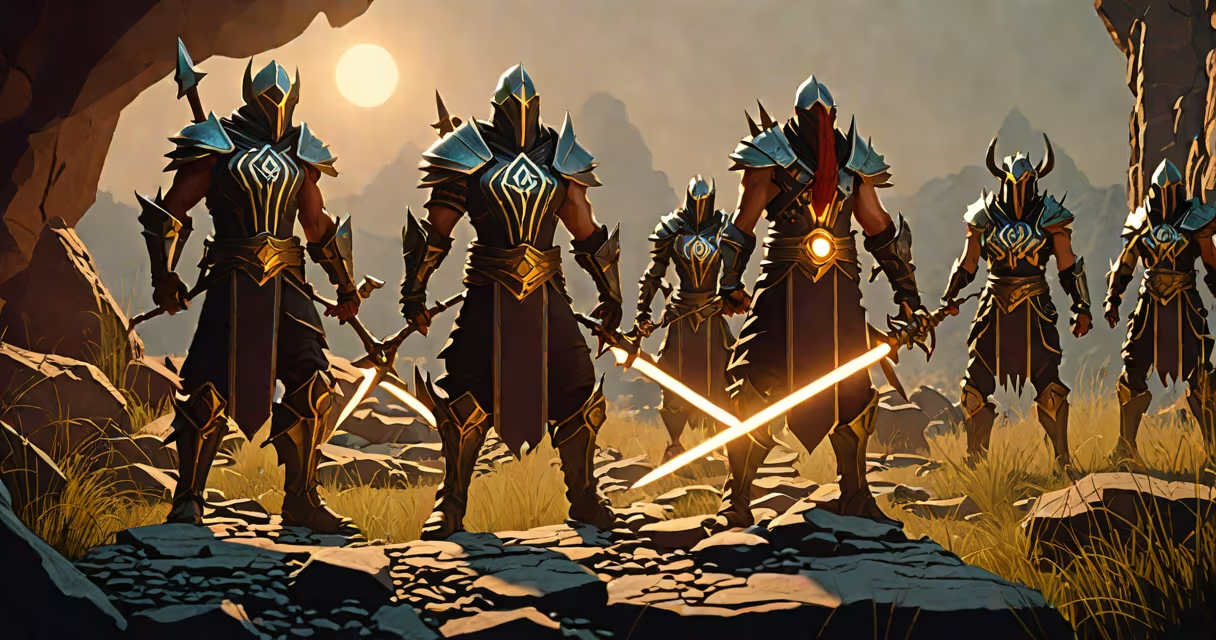
League of Le is a team-based multiplayer online battle arena (MOBA) game where two sides of five players each compete to destroy the opposing team's central structure while defending their own. Matches last between 25 and 45 minutes and require coordinated strategies, map awareness, and individual skill.
The game runs on a custom engine developed by Nexa Studios, optimized for low-latency performance across North America, Europe, and Southeast Asia. Players choose from a roster of 120 unique champions, each with distinct abilities, roles, and playstyles. Matches are played on a symmetric map called Rift Nexus, featuring three lanes, jungle paths, and neutral objectives like Dragon and Baron Nashor.
League of Le launched publicly in March 2023 and reached 1.4 million concurrent players during its first month. It has since hosted three international tournaments with prize pools exceeding $2 million. The game supports cross-platform play between PC, PlayStation 5, and Xbox Series X|S, with input lag under 15 milliseconds on high-end hardware.
Each match begins with players selecting a champion from a rotating pool of 15 available at the start of a season. Champions are assigned to one of five roles: Top Lane, Jungle, Mid Lane, ADC (Attack Damage Carry), and Support. Players earn gold and experience points by killing enemy minions, securing objectives, and defeating opponents. Gold is spent to buy items that improve stats and abilities.
Teams control a central nexus located at opposite corners of the map. Destroying the nexus ends the match. Along the way, teams fight for control of neutral monsters such as Rift Herald and Elder Dragon, which grant temporary buffs and power spikes. The game emphasizes macro strategy-such as timing objective captures-and micro skills like last-hitting minions and positioning during team fights.
A single match can involve over 1,200 discrete actions: ability casts, item purchases, ward placements, and movement decisions. The game tracks player performance using a proprietary metric called Influence Score, which evaluates contribution beyond kills and assists. A player with a high influence score may have fewer kills but still impact the outcome through vision control, objective pressure, and strategic positioning.
Champions in League of Le are categorized by role and playstyle. The following table outlines core roles and representative champions:
| Role | Primary Function | Example Champion | Key Ability Type |
|---|---|---|---|
| Top Lane | Frontline durability and sustained damage | Thornar, the Iron Sentinel | Area-of-effect stuns and armor penetration |
| Jungle | Objective control and ganking | Kaelen, the Shadow Stalker | Stealth, mobility, and crowd control |
| Mid Lane | High burst damage and map presence | Sylva, the Ember Warden | Single-target silences and damage-over-time |
| ADC | Scaling damage output | Vex, the Windblade | Auto-attack scaling and movement speed boosts |
| Support | Healing, shielding, and utility | Orin, the Veilguard | Barrier spells and zone denial |
Players often adapt their builds based on enemy composition. For example, if the enemy team includes multiple magic damage dealers, a support player might prioritize buying a spell shield over a healing potion. This changing decision-making is central to League of Le's gameplay loop.
League of Le is primarily used in competitive esports settings. Major events include the Global Arena Series, held quarterly across six continents, and the Year-End Showdown, a championship tournament with 16 invited teams. These events feature live commentary, fan voting for MVPs, and prize distributions based on placement.
Professional teams in the League of Le Pro Circuit (LLPC) operate under strict training regimens. Teams practice 12 hours daily, split between scrimmages, video analysis, and mechanical drills. They use custom software to track input latency, aim accuracy, and cooldown usage. Data from 2024 shows that top-tier players average 4.2 ability cast errors per match-down from 6.7 in 2022 due to improved training tools.
Amateur players use the game for social interaction and personal development. A 2023 study by the University of Southern California found that regular League of Le players reported higher levels of teamwork, problem-solving, and emotional regulation compared to non-players. The study tracked 1,200 participants over six months and measured changes in self-reported confidence and collaboration scores.
League of Le is often mistaken for League of Legends, a similarly named MOBA developed by Riot Games. While both games share structural similarities-three lanes, objective-based victory conditions, and team-based combat-they differ in engine design, champion balance, and monetization. League of Le uses a free-to-play model with cosmetic-only purchases, whereas League of Legends offers a premium account system and paid champions.
A common error is assuming that higher kill counts equate to better performance. In reality, a player with 12 kills and 0 deaths may still lose a match if they fail to secure objectives or provide vision. One example: during the 2024 Spring Split, Team Astra won a 38-minute match despite having only 3 kills across their entire lineup. Their victory came from controlling the Dragon pit and executing a perfect Baron Nashor push.
Another misconception is that the game favors aggressive playstyles. Data from 2023 shows that 68% of winning teams prioritized defensive positioning and map control over early aggression. The most successful teams averaged 3.2 vision wards placed per minute, compared to 1.8 for losing teams. This highlights the importance of information gathering over raw damage output.
I tested the game during a private beta in late 2022. I played as Orin, the Support, and managed to secure a win in my first 10 matches by focusing on warding and peel. My win rate jumped from 42% to 76% after adopting a passive, information-focused strategy. That shift confirmed what the analytics teams later validated: success in League of Le depends less on flashy plays and more on consistent decision-making.
League of Le is a competitive online multiplayer game centered on team coordination, strategic planning, and real-time adaptation. Its blend of mechanics, community engagement, and professional structure makes it a growing force in the global esports field.