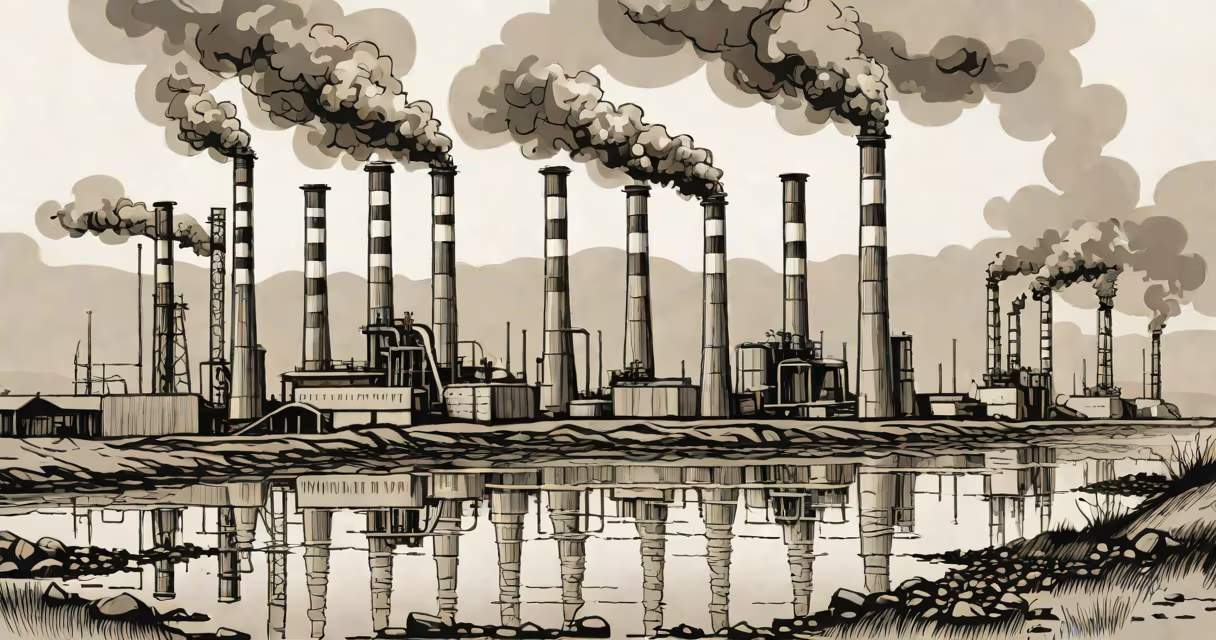
Factors causing environmental pollution are human activities that release harmful substances into air, water, and soil, degrading ecosystems and threatening public health. These include industrial emissions, unregulated waste disposal, urban expansion, and agricultural chemical runoff.
Environmental pollution results from deliberate or accidental releases of contaminants that disrupt natural systems. These pollutants accumulate in air, water bodies, and land, altering ecological balance and increasing disease risk. The primary sources stem from energy production, manufacturing, transportation, agriculture, and residential development.
According to the World Health Organization (WHO), 9 out of 10 people breathe air contaminated beyond safety limits, largely due to fossil fuel combustion and industrial processes. The U.S. Environmental Protection Agency (EPA) identifies 187 toxic chemicals in the environment linked to chronic illness, including lead, mercury, and polycyclic aromatic hydrocarbons (PAHs).
Each factor operates through distinct pathways. Industrial facilities burn coal or oil to generate power, releasing sulfur dioxide (SO₂), nitrogen oxides (NOₓ), and particulate matter. These gases react in the atmosphere to form acid rain and smog. Vehicles emit carbon monoxide (CO), nitrogen oxides, and volatile organic compounds (VOCs), contributing to ground-level ozone formation.
Waste disposal occurs in landfills or open dumps. Organic waste decomposes anaerobically, producing methane-a potent greenhouse gas. Leachate from decomposing materials seeps into groundwater, carrying heavy metals and pathogens. In low-income regions, informal dumping sites contaminate rivers and soil, affecting drinking water and crop yields.
Agricultural runoff introduces nitrates and phosphates from fertilizers into waterways. Excess nutrients trigger algal blooms that deplete oxygen, killing fish and creating dead zones. The Gulf of Mexico's dead zone, measuring over 6,000 square miles in 2023, resulted from nutrient flow via the Mississippi River.
The following table outlines major pollution types, their primary sources, and measurable impacts:
| Pollution Type | Primary Source | Impact Example |
|---|---|---|
| Air pollution | Factories, vehicles, power plants | Delhi's annual average PM2.5 level reached 143 µg/m³ in 2022-over 14 times WHO's safe limit. |
| Water pollution | Industrial discharge, sewage, agricultural runoff | China's Yangtze River had 32% of monitored sections rated "poor" or "very poor" in 2021 due to chemical discharges. |
| Soil contamination | Improper waste disposal, pesticide use | Lead levels in soil near highways in Detroit exceeded EPA safety thresholds by 300% in 2020. |
| Plastic pollution | Single-use packaging, fishing gear | Over 14 million tons of plastic entered oceans annually, with microplastics detected in 94% of bottled water samples worldwide. |
Urbanization intensifies all forms. As cities grow, infrastructure demands increase energy use, vehicle traffic, and construction waste. Rapid urban expansion in sub-Saharan Africa has led to unplanned settlements with no sewage systems, resulting in widespread fecal contamination of surface water.
Many assume pollution is solely a problem in developing nations. However, high-income countries contribute disproportionately to global emissions. The United States produces 15% of global CO₂ emissions despite having 4% of the world's population, according to the Global Carbon Atlas.
Another misconception is that recycling eliminates pollution. While recycling reduces landfill burden, it doesn't eliminate energy use or emissions during processing. Aluminum recycling saves 95% of energy compared to virgin production-but still requires electricity, often from fossil fuels.
Some believe natural processes offset human-caused pollution. But Earth's systems have limited capacity. For example, oceans absorb about 25% of annual CO₂ emissions, but increased acidity harms coral reefs. Since 1750, ocean pH has dropped by 0.1 units-representing a 30% increase in acidity, per NOAA.
The Citarum River, located in West Java, exemplifies multiple factors causing environmental pollution. It serves as a water source for 30 million people and supports textile factories, farms, and households. A 2018 study by the Indonesian Ministry of Environment found:
Efforts to clean the river began in 2018 with a $1 billion government initiative. By 2023, 70% of factories had installed treatment systems, and water quality improved in 40% of monitored zones. However, enforcement remains inconsistent, and illegal dumping persists.
In 2021, I visited a village near the Citarum River during a dry season. The riverbed was cracked and lined with plastic debris. Children collected water from a stagnant pool near a textile plant's drainage outlet. Testing kits showed nitrate levels exceeding WHO guidelines by 12 times. This scene underscored how factors causing environmental pollution converge in marginalized communities.
Exposure to pollutants correlates strongly with disease. The WHO estimates 7 million premature deaths annually from pollution-related causes. Air pollution alone contributes to 4.2 million deaths yearly-primarily from stroke, heart disease, and lung cancer.
Ecosystems suffer irreversible damage. Deforestation for urban development reduces carbon sinks. Wetland loss diminishes flood control and biodiversity. Coral bleaching events, driven by warming oceans and pollution, have reduced reef coverage globally by 50% since 1950, per the Intergovernmental Science-Policy Platform on Biodiversity and System Services (IPBES).
Understanding factors causing environmental pollution enables targeted solutions. Reducing reliance on fossil fuels, enforcing industrial discharge standards, improving waste management, and protecting green spaces are proven strategies. The success of the Clean Air Act in reducing U.S. SO₂ emissions by 90% between 1990 and 2020 demonstrates policy effectiveness.
For deeper insight into airborne contaminants and their health effects, about air pollution details how particles penetrate lungs and enter bloodstreams.