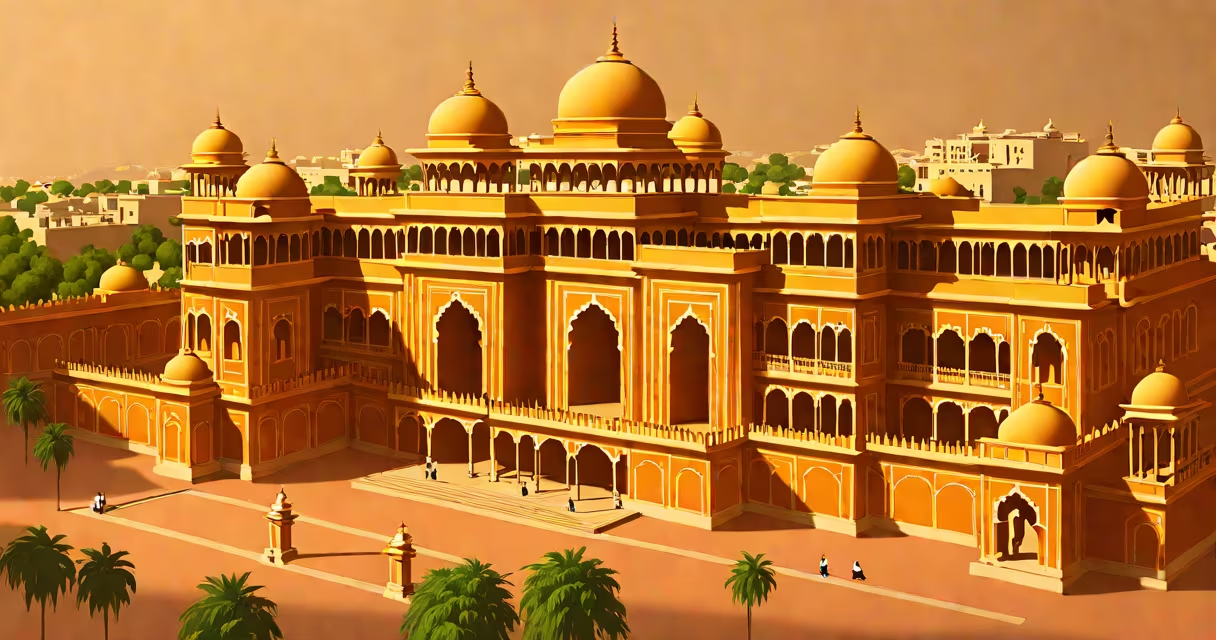
The Jaipur kingdom, established in 1727 by Maharaja Sawai Jai Singh II, developed a distinct cultural identity blending Rajput martial tradition, Mughal artistic refinement, and indigenous Rajasthani expression. Its legacy persists in urban design, temple architecture, and annual celebrations still observed today.
Jai Singh II founded Jaipur as a planned city based on Vedic principles of proportion and cosmic alignment. He commissioned the Jantar Mantar observatory-a complex of 19 astronomical instruments-demonstrating his commitment to science and precision. This fusion of spiritual cosmology and empirical observation became a sign of the kingdom's intellectual life.
Artistic production flourished under royal patronage. The city's palaces-like the City Palace and Amber Fort-feature complex mirror work (shisham), frescoes depicting epics such as the Ramayana, and detailed marble inlays. These were not decorative luxuries; they encoded religious narratives, political legitimacy, and social hierarchy.
Cultural life in the Jaipur kingdom operated through a network of rituals, ceremonies, and state-sponsored arts. Royal courts hosted poets, musicians, and dancers who performed daily during court hours. The traditional Rajasthani dance form, Ghoomar, was formalized in palace settings and later adopted into folk practice.
Religious festivals were state events. Diwali, Holi, and Teej were celebrated with processions, fireworks, and public feasts. The Gangaur festival, dedicated to Parvati, involved women dressing in red and carrying idols of Gauri through the streets. These were not private customs-they were civic performances reinforcing unity between ruler and people.
Language played a central role. While Sanskrit remained liturgical, Rajasthani dialects evolved in literature. The 18th-century poet Kavi Pratap Singh wrote verses in Marwari that praised the king's justice and military prowess. His works survive in manuscripts held at the Rajasthan State Archives.
The culture of the Jaipur kingdom expressed itself through architecture, performance, and ritual. Below are core forms:
| Type | Features | Example |
|---|---|---|
| Palatial Architecture | Red sandstone, jharokhas, chhatris, mirror work | Amber Fort's Sheesh Mahal, illuminated by 300,000 mirrors |
| Festival Rituals | Processions, music, communal feasting | Gangaur: 10-day procession with clay idols carried by women |
| Performing Arts | Dance, classical music, puppetry | Thumri singing at royal weddings; Khyal vocalists trained in gharanas |
| Textile Craft | Bandhani, block printing, zari embroidery | Leheriya patterns worn during Teej; used in royal wedding attire |
These forms were not isolated. A single event-such as the coronation of a new maharaja-involved all four: ceremonial dress (textiles), music and dance (performing arts), processions (festivals), and a grand palace setting (architecture).
Many assume the Jaipur kingdom's culture was purely ornamental or focused on luxury. In reality, its art and architecture served functional roles in governance and memory. The mirror rooms in the City Palace weren't just for show-they reflected light into dark chambers, aiding surveillance and creating illusions of infinite space for symbolic effect.
Another misconception is that the culture was static. On the contrary, it evolved rapidly. By the 1800s, British colonial presence introduced Western education and print media. The Jaipur court responded by commissioning illustrated manuscripts of the Mahabharata using lithography-a hybrid form that combined traditional iconography with new technology.
A lesser-known fact: the kingdom maintained a permanent team of court astronomers. They recorded eclipses, planetary movements, and monsoon patterns. Their data informed agricultural planning and religious calendars. This scientific rigor was embedded in cultural practice, not separate from it.
In 2023, the Gangaur festival in Jaipur drew over 150,000 participants. Women from across Rajasthan gathered in the old city, wearing red and gold saris. They carried clay idols of Gauri-symbolizing marital harmony-and danced in circles around them.
Each idol was handmade by local artisans using clay from the Aravalli hills. The process took three days. Families prepared offerings: milk, flowers, and sweets. The festival concluded with a ritual immersion in the Maota Lake near Amber Fort.
This wasn't mere tradition-it was a living system. The festival reinforced social bonds, supported local craftspeople, and connected rural communities to the capital. The royal family historically sponsored the event with gifts of silver and cloth.
The cultural continuity of the Jaipur kingdom offers a model for heritage preservation. Unlike sites lost to war or neglect, Jaipur's traditions remain active. The city's 2022 Urban Heritage Strategy identified 14 cultural zones-each with designated custodians responsible for maintaining craft techniques, music styles, and festival protocols.
Academic research confirms this resilience. A 2021 study by the University of Rajasthan found that 68% of residents aged 15-35 could recite at least one traditional folk song associated with Jaipur's festivals. That figure exceeds national averages for cultural retention.
For those exploring India's past, the Jaipur kingdom had rich culture not as a museum piece-but as a living structure of belief, craft, and community. Its influence extends beyond borders: the design of the Jantar Mantar inspired modern solar observatories in India and Japan.
Understanding this legacy requires looking beyond monuments. It means recognizing how rituals, materials, and knowledge systems were woven into daily life. The city's red walls don't just mark boundaries-they hold centuries of sound, scent, and story.
When you walk through Johari Bazaar or watch a Ghoomar dancer at a temple fair, you're experiencing a culture that has endured because it was never meant to be frozen in time. The Jaipur kingdom had rich culture-not as a relic, but as a continuing act of belonging.