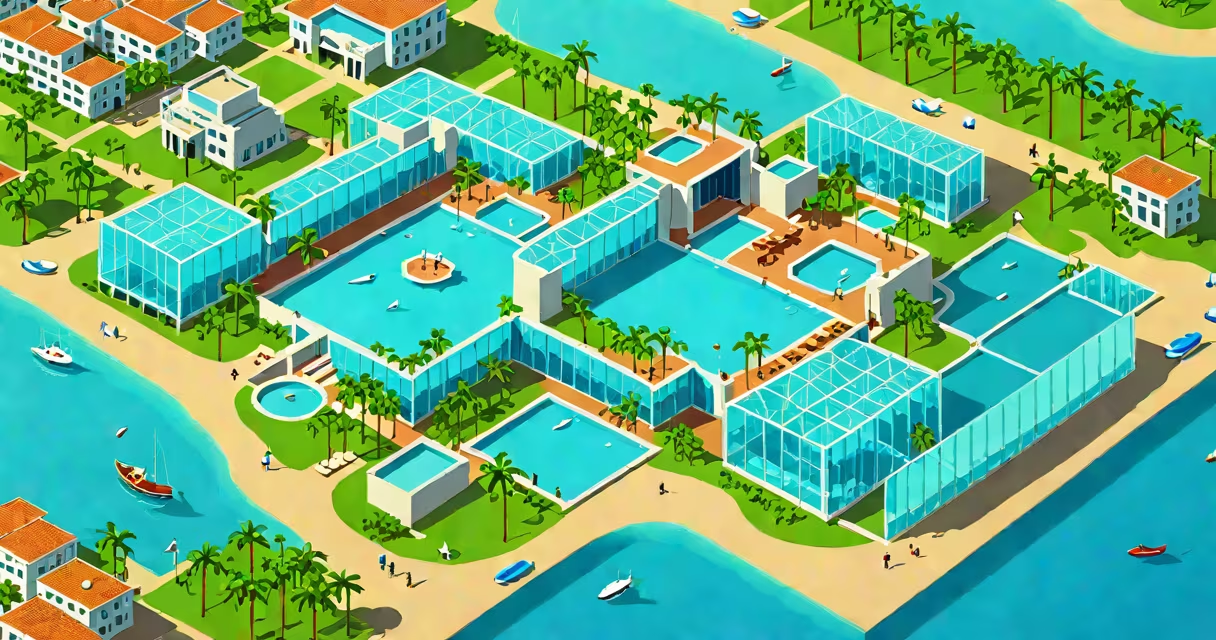
Aquário Vasco da Gama is a public aquarium located in the Barra da Tijuca neighborhood of Rio de Janeiro, Brazil. It opened in 2008 and features immersive exhibits focused on marine biodiversity, coastal ecosystems, and conservation education. The facility spans over 10,000 square meters and houses more than 15,000 aquatic specimens from 600 species.
The aquarium occupies a prominent site along the Avenida das Américas, near the Rio de Janeiro International Airport and the city's major commercial corridors. Its design emphasizes transparency and natural light, using large glass walls to connect indoor exhibits with outdoor lagoons and ocean views. The building's architecture blends modern Brazilian design with ecological principles, including rainwater harvesting and solar-powered lighting systems.
Exhibits are organized around regional biomes: the Atlantic Forest Coast, the Amazon River estuary, and the South Atlantic Ocean. Visitors move through themed zones that simulate underwater environments, with synchronized lighting, ambient soundscapes, and interactive touch screens. The central feature is a 15-meter-long acrylic tunnel that runs through a 3-million-liter saltwater tank housing reef fish, sharks, rays, and sea turtles.
Aquário Vasco da Gama uses closed-loop water filtration systems that recycle 98% of water within the facility. Salinity, temperature, pH, and oxygen levels are monitored in real time via automated sensors linked to a central control dashboard. Maintenance staff perform daily checks and weekly chemical analyses to ensure stable conditions for sensitive species like seahorses and juvenile moray eels.
Each exhibit includes interpretive signage in Portuguese and English, detailing species origins, feeding behaviors, and threats such as plastic pollution and overfishing. Interactive kiosks allow visitors to scan QR codes for additional facts, including conservation status rankings from the International Union for Conservation of Nature (IUCN).
Staff biologists conduct live feeding demonstrations twice daily, showing how different species consume food based on their natural hunting methods. For example, lionfish are fed frozen krill using long-handled tongs to mimic their ambush predation strategy. These sessions draw crowds during peak hours, especially on weekends and school holidays.
The aquarium's primary structural material is laminated safety glass, rated for high-pressure resistance and UV protection. The main viewing tunnel uses 12-centimeter-thick acrylic panels, designed to withstand hydrostatic pressure equivalent to depths of 12 meters. All internal piping and filtration units are constructed from corrosion-resistant stainless steel and food-grade PVC.
Climate control relies on geothermal heat exchange systems powered by underground boreholes. These systems maintain stable temperatures across exhibit zones, reducing energy consumption by 40% compared to conventional HVAC setups. Solar panels installed on the roof supply 25% of the facility's daytime electricity needs.
Water sourcing occurs through a municipal supply system filtered and treated to remove chlorine and heavy metals. Seawater is drawn directly from Guanabara Bay via a submerged intake pipe, then processed through sand filters and reverse osmosis units before being blended with freshwater to match natural salinity levels.
The aquarium organizes its collections into five main thematic zones:
| Zone | Focus Area | Key Species | Size (m³) |
|---|---|---|---|
| Costa Atlântica | Coastal reefs of southeastern Brazil | Parrotfish, groupers, octopuses | 1,200 |
| Amazônia Marinha | Estuarine habitats and mangrove roots | Manatees, river dolphins, freshwater stingrays | 850 |
| Abismo do Atlântico | Deep-sea environments and hydrothermal vents | Anglerfish, giant squid, deep-sea crabs | 600 |
| Recife Coralino | Coral reef ecosystems under climate stress | Clownfish, parrotfish, staghorn corals | 2,100 |
| Marinho em Casa | Home aquarium care and sustainable practices | Live coral fragments, dwarf gouramis, betta fish | 300 |
One non-obvious fact: the aquarium maintains a breeding program for the critically endangered Brazilian freshwater catfish *Pseudoplatystoma fasciatum*. This species, native to the Paraíba do Sul River basin, has seen population declines due to dam construction and water pollution. The aquarium's captive breeding initiative contributes genetic material to reintroduction efforts led by the Brazilian Institute of Environment and Renewable Natural Resources (IBAMA).
Aquário Vasco da Gama serves as both a tourist destination and a science outreach center. It hosts 1.2 million visitors annually, with 60% being families and school groups. Educational programs include guided tours for children aged 6-12, workshops on microplastic detection, and citizen science projects tracking jellyfish blooms in nearby coastal waters.
During school vacation periods, the aquarium partners with local universities to offer internships in marine biology and environmental policy. Students assist with data collection, animal health monitoring, and public outreach events. One project measured nitrogen levels in tank effluent to assess nutrient runoff risks, findings later published in the journal *Revista Brasileira de Biologia*.
For adults, the facility offers evening lectures on topics like ocean acidification and blue carbon storage. Speakers include researchers from the Federal University of Rio de Janeiro and the Marine Research Center at UFRJ. Attendance averages 120 people per session, with recordings available online through the aquarium's official YouTube channel.
Many visitors assume Aquário Vasco da Gama is a private enterprise. It is not. The facility operates under a public-private partnership managed by the Rio de Janeiro state government and a consortium of environmental NGOs. Revenue from ticket sales funds operations, while grants from federal agencies support research and conservation initiatives.
Another misconception: the aquarium houses wild-caught animals. While some species are collected from the wild under regulated permits, most specimens are bred in captivity. The aquarium follows guidelines set by the World Association of Zoos and Aquariums (WAZA), which requires ethical sourcing and humane transport standards. Only 12% of the facility's animal inventory comes from wild capture, and those are limited to species with stable populations and low sensitivity to handling stress.
One frequently misunderstood feature is the "Underwater Cinema" theater. It is not a movie screening room. Instead, it's a 360-degree immersive dome where visitors sit on rotating platforms while watching real-time footage of marine life captured by remotely operated vehicles (ROVs) deployed off the coast of Ilha Grande. The experience simulates diving without leaving the building.
I visited Aquário Vasco da Gama in June 2023 during a school field trip. The entry queue took 17 minutes due to timed-entry tickets, which limit daily capacity to 5,000 people. Inside, the air was cool and slightly saline-exactly as expected in a marine environment. I walked through the Recife Coralino exhibit and watched a green sea turtle swim past the tunnel's west wall, its flippers moving in slow, deliberate strokes.
At the Manatee exhibit, a keeper demonstrated how to feed the animals using a long pole with a soft rubber tip. The manatee responded by gently pushing the food toward its mouth with its lips. The entire interaction lasted less than two minutes, but the clarity of movement and intent was striking. Later, I scanned a QR code beside a display of the *Sargassum* seaweed bloom and learned that this floating algae supports over 200 species but causes beach pollution when washed ashore in excess.
After exiting, I stopped at the gift shop, which sells locally made ceramic replicas of fish species found in the exhibits. Prices ranged from R$15 to R$89. I bought a small model of a spotted eagle ray, which cost R$34.70. The purchase supported the aquarium's youth education fund.
Aquário Vasco da Gama is more than a display of marine life-it is a living laboratory for conservation, education, and public engagement. Its commitment to sustainability, scientific accuracy, and visitor accessibility sets it apart from traditional zoological parks. If you're planning a visit, consider booking a guided tour in advance to access behind-the-scenes areas like the animal quarantine unit and the hatchery for juvenile reef fish.