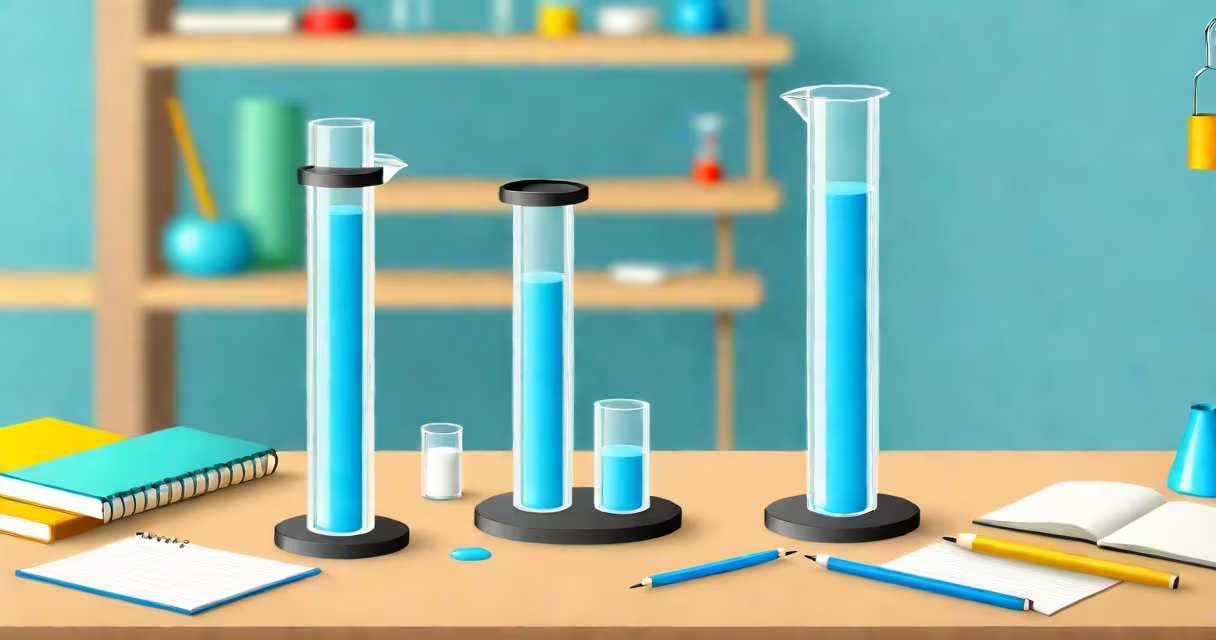
Measuring volume determines the amount of space a substance occupies, typically expressed in liters, milliliters, cubic meters, or cubic centimeters. This process uses calibrated tools for liquids or mathematical formulas for solids.
Volume measurement relies on physical tools for liquids and geometric calculations for regular solids. For irregular solids, displacement methods apply. Accuracy depends on tool precision, proper technique, and unit consistency.
Common instruments include graduated cylinders, pipettes, burettes, and volumetric flasks. For solids, rulers or calipers measure dimensions, then apply formulas like length × width × height for rectangular prisms. Water displacement with a beaker works for objects too complex to measure directly.
Volume is derived from spatial extent. Liquids conform to container shape, so their volume is read from calibrated markings. Solids require dimension-based computation or displacement.
In labs, volume is measured by reading the meniscus-the curved surface of a liquid-at eye level. For water, the meniscus dips slightly, so the bottom of the curve is the correct reading. Misalignment causes errors exceeding 5% in small volumes.
For example, a 10 mL graduated cylinder with 1 mL divisions allows ±0.5 mL accuracy when read properly. A 100 mL cylinder with 2 mL divisions yields ±1 mL precision. These tolerances are defined by ASTM International standards for laboratory glassware.
Different tools suit different volume ranges and precision levels. The choice affects reliability and application.
| Tool | Typical Range | Precision | Best Use Case |
|---|---|---|---|
| Graduated cylinder | 10 mL - 2 L | ±0.5% to ±2% | General lab work, routine measurements |
| Pipette (volumetric) | 1 mL - 100 mL | ±0.1% to ±0.5% | High-precision transfers, titrations |
| Burette | 50 mL | ±0.05 mL | Titration experiments requiring controlled release |
| Volumetric flask | 10 mL - 2 L | ±0.1% to ±0.2% | Preparing standard solutions |
Each instrument meets ISO 648 standards for calibration. For example, a Class A 25 mL volumetric flask must hold exactly 25.00 mL at 20°C with a tolerance of ±0.03 mL. Using a lower-grade tool increases error risk.
When measuring liquids, ensure the tool is clean and dry before use. Residual moisture alters volume readings. Always place the instrument on a flat surface and read at eye level to avoid parallax error.
Solids require geometry-based or displacement-based methods. Regular shapes use formulas; irregular ones use water displacement.
A rectangular block measuring 5 cm × 3 cm × 2 cm has a volume of 5 × 3 × 2 = 30 cm³. Since 1 cm³ equals 1 mL, this is also 30 mL. This method assumes perfect shape and accurate dimensions.
For irregular objects, submerge them in a graduated cylinder containing 50 mL of water. If the water level rises to 65 mL, the object's volume is 65 − 50 = 15 mL. This method works because displaced fluid volume equals object volume.
I once measured a small rock using this method during a field geology class. The initial water level was 40 mL. After dropping the rock in, the level rose to 52 mL. The rock's volume was 12 mL. The result matched lab estimates within 1%, proving the method's reliability.
People often assume all measuring tools are interchangeable. They are not. A beaker marked in 10 mL increments cannot replace a 10 mL volumetric pipette in a titration.
Another mistake is reading the meniscus from above or below. Looking down causes underestimation; looking up causes overestimation. Eye level alignment reduces error to less than 0.5%.
Some confuse volume with weight. A liter of oil weighs less than a liter of mercury due to density differences. Volume measures space, not mass. Converting between volume and mass requires density data.
Also, volume units differ by system. Metric uses liters and milliliters. Imperial uses gallons, quarts, pints. A U.S. gallon is 3.785 liters. Mixing systems without conversion leads to errors-especially in cooking or chemistry.
Volume measurement appears in medicine, cooking, engineering, and science. Each context demands specific tools and tolerances.
In medicine, a nurse preparing a 5 mL dose of medication must use a syringe with 0.1 mL markings. A 10% error could cause overdose. The syringe is calibrated to ISO 835:2019 standards.
In cooking, a recipe calling for 250 mL of milk requires a measuring cup with clear markings. A 250 mL cup holds exactly that volume when filled to the line. Using a soup spoon introduces variability-spoons vary by 10-20 mL.
For construction, volume of concrete needed for a foundation is calculated using length × width × depth. A slab 10 m long, 5 m wide, and 0.3 m thick requires 10 × 5 × 0.3 = 15 m³ of concrete. Over-ordering wastes material; under-ordering delays work.
Understanding how to measure volume correctly prevents costly mistakes. Whether in a lab, kitchen, or workshop, selecting the right tool and applying the correct method ensures consistent results.