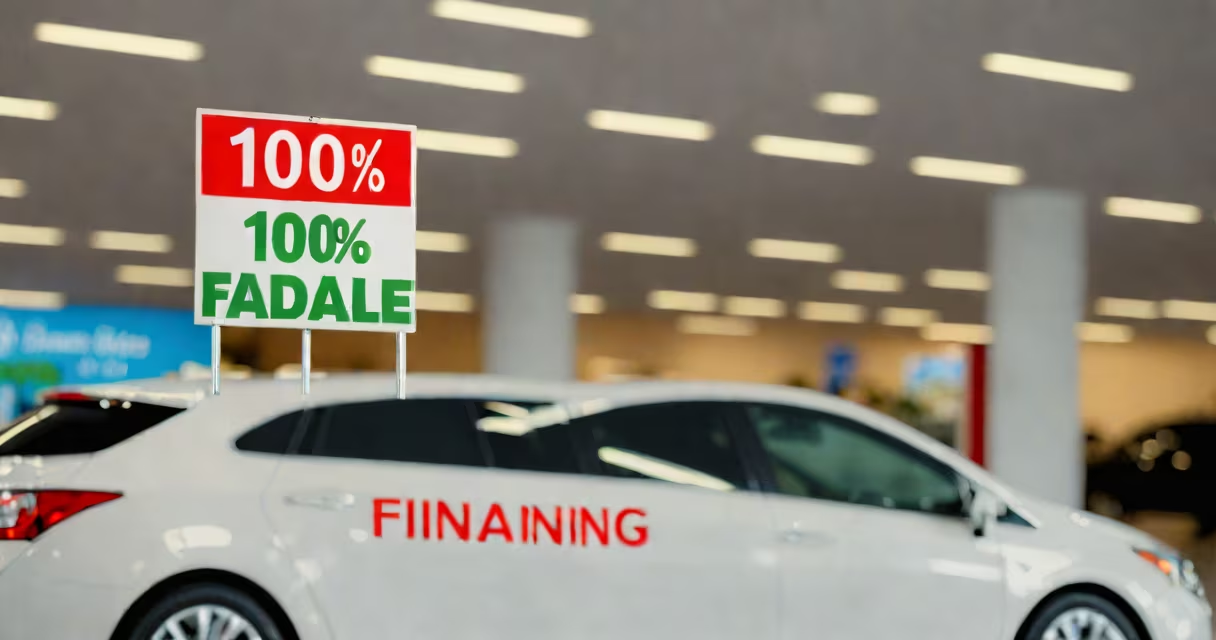
100 financing means a lender covers the entire purchase price of a vehicle without requiring a down payment. The borrower assumes full ownership upon signing the contract, and the loan amount equals the vehicle's sale price.
This term appears frequently in auto sales, especially during promotional periods. It suggests buyers can drive away with a new or used car without paying upfront. However, it does not eliminate cost-it shifts the burden to higher monthly payments or longer repayment terms.
For example, a $30,000 car advertised with 100 financing means the buyer borrows $30,000 and begins repaying it immediately. The lender may charge interest, extend the term to 72 months, or require a credit score above 680. The absence of a down payment increases risk for the lender, which often results in stricter approval standards.
Lenders offer 100 financing by assuming the full risk of the loan. They evaluate the buyer's credit history, income, debt-to-income ratio, and employment stability before approving. Approval doesn't guarantee favorable terms-many 100 financing deals carry high interest rates due to perceived risk.
When a dealer offers 100 financing, they typically partner with a bank or finance company. The customer signs a loan agreement, receives the vehicle keys, and begins making payments. The lender holds a lien on the car until the balance is paid off.
A real-world example: A buyer selects a 2023 Honda CR-V listed at $32,500. The dealership advertises "100% financing available." The buyer qualifies with a FICO score of 710 and a stable job. The lender approves a $32,500 loan at 12.9% APR over 60 months. Monthly payments come to $706. The buyer pays $42,360 total over five years-$9,860 in interest.
100 financing appears in several forms, each with distinct conditions:
| Type | Down Payment Required? | Interest Rate Typical Range | Common Use Cases |
|---|---|---|---|
| New car lease with 100% coverage | No | 3.5% - 7.5% | Leasing programs from manufacturers like Ford or Toyota |
| Used car loan at 100% loan-to-value | No | 10% - 20% | Dealerships offering "no money down" promotions |
| Refinance with 100% equity replacement | No | 8% - 15% | Repaying existing loans with new financing |
These options are most common in the U.S. auto market during seasonal sales events like Black Friday or end-of-year clearance. According to the National Automobile Dealers Association (NADA), 34% of new car leases in 2023 included 100% financing terms, up from 22% in 2020.
Some dealerships advertise 100 financing but include hidden fees-like documentation charges or extended warranty costs-that increase the effective loan amount. A $25,000 car with $1,200 in fees becomes a $26,200 loan, even if the buyer pays nothing upfront.
100 financing is often confused with 0% financing. While both allow no down payment, 0% financing means no interest over the loan term. 100 financing may carry high interest-sometimes exceeding 15% annually-and is not interest-free.
Another confusion arises between 100 financing and "buy here, pay here" models. Buy here, pay here dealerships issue their own loans and often charge 20%-30% APR. These are not traditional 100 financing programs-they're high-risk lending operations with aggressive repossession policies.
A critical distinction: 100 financing does not mean the vehicle is free. It means the full purchase price is financed. You still owe the full amount, plus interest, over time. The average American car loan lasts 69 months, according to Experian's Q4 2023 report. That means a 100 financing deal can stretch beyond five years.
Qualification depends heavily on creditworthiness. Lenders typically require a minimum FICO score of 680 for 100 financing approval. Applicants with scores below 620 are rarely approved unless they have a co-signer.
I once observed a customer at a Detroit dealership apply for 100 financing on a $28,000 used SUV. His credit score was 630. The finance manager declined him outright. He returned two weeks later with a co-signer and was approved-but at 18.9% APR. Over five years, he'd pay $37,400 total, including $9,400 in interest.
Key red flags include:
Always review the full loan agreement. Check the annual percentage rate (APR), total interest paid, and whether the lender reports to all three major credit bureaus. Missing payments can damage credit scores and lead to repossession.
Remember: 100 financing removes the initial cash barrier, but it increases long-term cost. Always compare total repayment amounts across options. A $30,000 car with 100% financing at 14% APR over 72 months totals $44,500-over $14,000 more than the original price.
Before accepting any 100 financing offer, calculate the total cost of borrowing. Use online calculators to estimate payments and interest. Verify the lender's reputation through the Better Business Bureau or state consumer protection agency. A low down payment isn't always a benefit-it can be a trap.
100 financing is a tool, not a solution. It enables access to vehicles but demands careful scrutiny. When used responsibly, it helps people move forward. When misused, it leads to financial strain. Know the terms. Know the numbers. Know your limits.