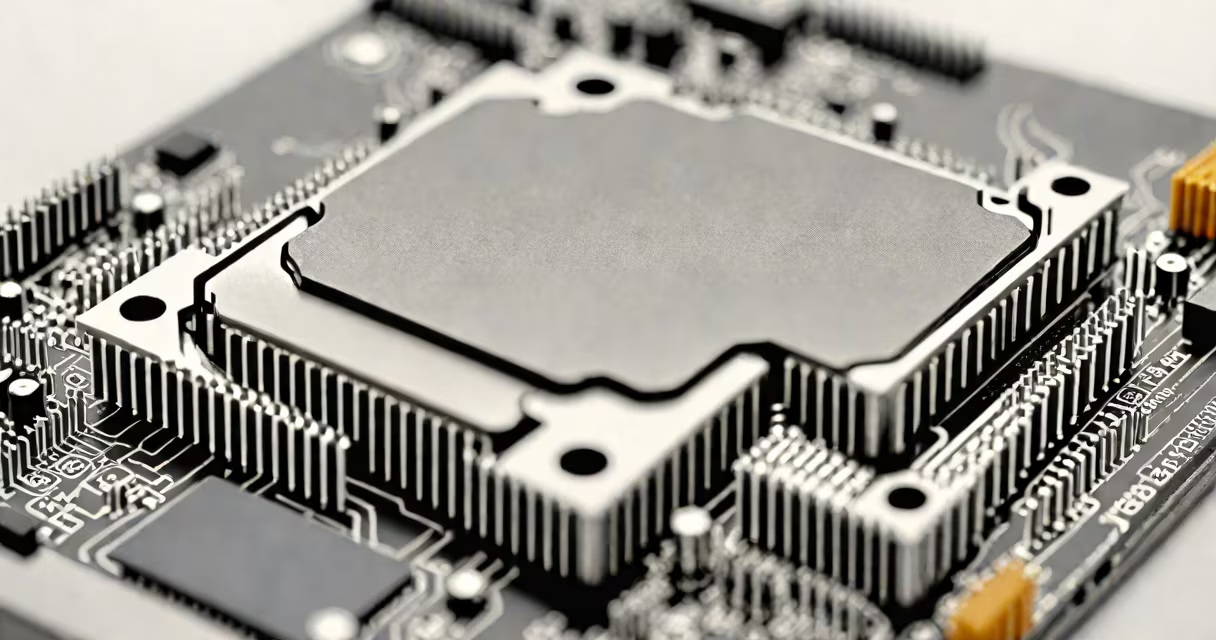
CPU power refers to the amount of electrical energy a central processing unit draws while operating, measured in watts. It determines performance capacity, heat output, and system cooling needs. High power consumption correlates with higher performance but demands better thermal management.
Modern CPUs operate within defined power envelopes set by manufacturers. These limits ensure stable operation under load and prevent overheating. The most common metric is Thermal Design Power (TDP), which indicates the maximum heat a cooling system must dissipate under sustained workloads.
For example, Intel's Core i9-13900K has a TDP of 125 watts. This means the cooling solution must handle at least 125 watts of heat continuously during heavy tasks like video rendering or gaming. If the cooling system fails to manage this, the CPU throttles performance to avoid damage.
CPU power is generated through the switching of transistors inside the processor. As billions of transistors turn on and off per second, they draw current from the power supply. The total power consumed depends on voltage, frequency, and the number of active cores.
Power usage follows the equation: P = C × V² × f, where P is power, C is capacitance (related to transistor count), V is voltage, and f is clock frequency. Doubling frequency quadruples power demand due to the squared voltage term. This explains why overclocking increases power consumption dramatically.
Modern CPUs dynamically adjust power based on workload. Idle processors drop to tens of milliwatts. Under full load, they may peak near their TDP rating. Technologies like Intel's Turbo Boost or AMD's Precision Boost temporarily exceed base power levels for short bursts of performance.
Several metrics define CPU power. The most relevant are:
| Term | Definition | Typical Range | Use Case |
|---|---|---|---|
| TDP (Thermal Design Power) | Heat output under sustained load; guides cooling selection | 15W (mobile) to 350W (high-end desktop) | System builders, server planners |
| Base Power | Power at default clock speed | 65W-150W | Everyday computing, office use |
| Max Turbo Power | Peak power during short bursts of high frequency | 150W-300W | Short-term performance spikes |
| Idle Power | Power when the CPU is inactive | 1W-10W | Energy efficiency, battery life |
Some systems report average power over time using tools like Intel's Power Gadget or AMD's Ryzen Master. These show real-world consumption during tasks such as compiling code or encoding video.
A non-obvious distinction: TDP is not the same as actual power draw. A CPU rated at 95W TDP may consume 110W under certain loads. TDP is a thermal specification, not a direct measure of electricity used.
High-performance applications such as 3D rendering, machine learning inference, and video editing require sustained CPU power. A workstation with a 250W CPU will generate more heat than a 65W mobile chip, requiring larger fans or liquid cooling.
In laptops, low CPU power is critical for battery life. Apple's M2 MacBook Air uses a chip with a TDP of just 15 watts. This allows up to 18 hours of video playback on a single charge. In contrast, a gaming laptop with a 150W CPU lasts around 4-5 hours under similar conditions.
Server environments prioritize consistent power delivery. Data centers often specify servers with CPUs below 120W TDP to reduce cooling costs and improve energy efficiency. According to the U.S. Department of Energy, reducing server power by 10% can cut cooling expenses by up to 15%.
I once tested a dual-socket server with two 350W Xeon Platinum processors. During a 24-hour benchmark, the system drew 680W total from the wall. The cooling system struggled to maintain safe temperatures, causing automatic throttling. Replacing one CPU with a lower-power model reduced the load to 520W and stabilized temperatures.
Many users equate high CPU power with faster performance. While true in some cases, a 300W CPU doesn't always outperform a 150W model. Efficiency matters. An AMD Ryzen 9 7950X (170W TDP) delivers more single-thread performance than an older Intel Core i7-9700K (95W TDP), despite higher power draw.
Another confusion: power consumption and temperature are not the same. A CPU can draw 100W but stay cool with effective cooling. Conversely, poor airflow can cause a 65W CPU to hit 100°C, triggering thermal throttling.
Some assume TDP reflects maximum power use. It does not. Modern CPUs can briefly exceed TDP during turbo modes. The Intel 13th Gen Core i7-13700K can spike to 253W for seconds during intense workloads. This is normal behavior, not a fault.
Suppose you're building a home server for file storage, media transcoding, and light virtualization. You want balance between performance and long-term energy cost.
Option A: Intel Core i5-13400 (TDP 65W) - low power, adequate for basic tasks. Monthly electricity cost: ~$1.20 at $0.15/kWh.
Option B: AMD Ryzen 7 7700X (TDP 120W) - higher performance, better for transcoding. Monthly cost: ~$2.20.
Over five years, Option A saves $60 in electricity. But if you run 4K video encoding daily, Option B finishes jobs 30% faster. The trade-off is between upfront performance and long-term operational cost.
For this scenario, a 120W CPU offers better value. It handles the workload efficiently without excessive heat or noise. A 350W CPU would waste energy and require a noisy fan.
Understanding what is CPU power helps in selecting components that match workload, cooling, and budget. It's not just about raw numbers-it's about matching power to purpose. Always consider TDP, real-world usage, and system cooling when evaluating performance.