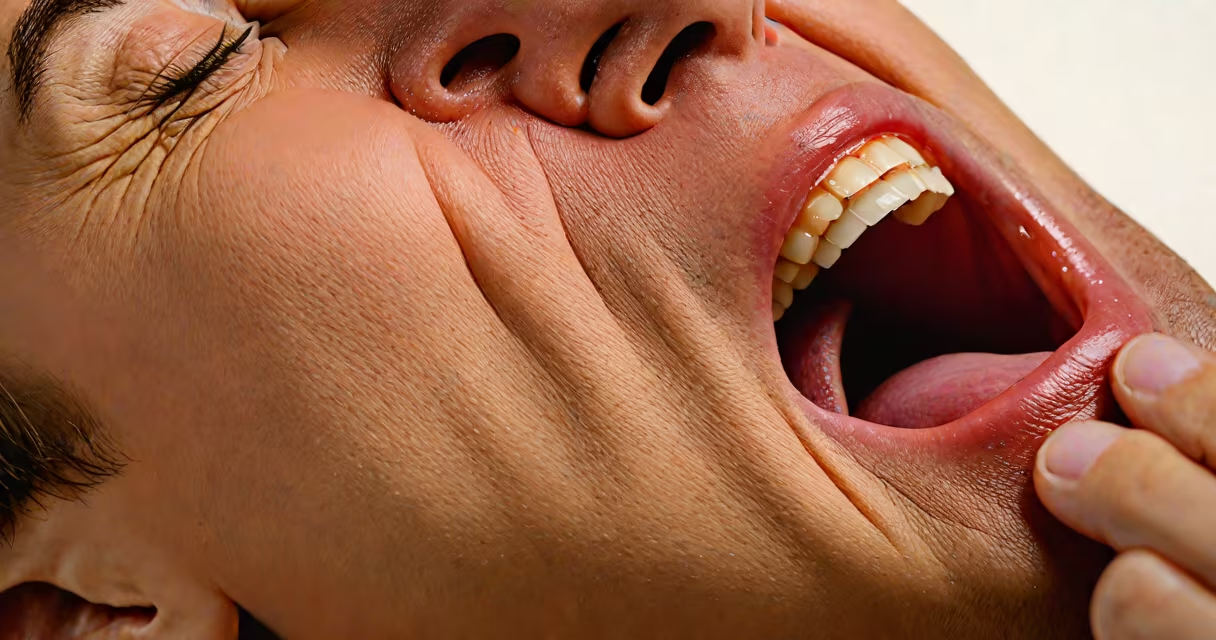
Yawning hurts when the temporomandibular joint (TMJ), surrounding muscles, or nerves are under strain, inflamed, or affected by injury or disorder. This pain typically arises during jaw opening and closing motions, especially when stretching beyond normal range.
The temporomandibular joint connects your lower jaw to your skull near the ears. It's designed for precise movement, allowing chewing, speaking, and yawning. When this joint or its supporting muscles are compromised-by trauma, arthritis, clenching, or misalignment-the act of yawning can trigger sharp or dull pain. Pain may radiate to the ear, temple, or neck.
Common causes include TMJ disorders (TMD), bruxism (teeth grinding), jaw muscle fatigue, or referred pain from dental issues. In rare cases, nerve compression or sinus pressure contributes. The sensation often feels like a deep ache, clicking, or locking during the motion.
Yawning requires the jaw to open widely-up to 50 mm in some people. This movement stretches the TMJ capsule, ligaments, and muscles around the joint. If any of these structures are inflamed or damaged, the stretch becomes painful.
For example, individuals with myofascial pain dysfunction-a condition involving muscle tightness-report increased discomfort during yawning. The masseter and temporalis muscles, responsible for jaw closure, can spasm when fatigued or stressed. Yawning forces these muscles to relax rapidly, which may cause sudden pain in sensitive tissue.
A 2021 study published in *The Journal of Oral Rehabilitation* found that 68% of patients with chronic TMJ pain reported worsening symptoms during yawning. The researchers linked this to altered joint position and increased muscle activity during wide mouth opening.
Several medical conditions explain why yawning hurts. Not all involve the jaw directly-some refer pain to the area.
| Condition | Key Features | Prevalence |
|---|---|---|
| TMJ Disorder (TMD) | Pain during jaw movement, clicking, limited opening, stiffness | Approximately 12% of adults in the U.S., according to the National Institute of Dental and Craniofacial Research |
| Bruxism | Tooth grinding, jaw clenching, morning jaw soreness | 8-10% of adults, per the American Academy of Orofacial Pain |
| Arthritis in the TMJ | Stiffness, reduced mobility, swelling; more common in older adults | Less than 5% of TMD cases, but increases with age |
| Nerve Compression (e.g., trigeminal neuralgia) | Burning or electric shock-like pain triggered by movement | Rare, affects fewer than 1 in 1,000 people |
One non-obvious fact: yawning pain may stem from cervical spine misalignment. The upper neck vertebrae (C1-C2) influence nerve pathways to the jaw. A 2019 study in *Pain Medicine* showed that 30% of patients with unexplained TMJ pain improved after physical therapy targeting neck posture.
Pain during yawning isn't always localized to the jaw. Referred pain can mimic TMJ symptoms. For instance, sinus infections or dental abscesses may cause pressure that feels like jaw pain when the mouth opens wide.
Another confusion: people mistake TMJ pain for toothache. But unlike dental pain-which worsens with biting or hot/cold stimuli-TMJ-related pain intensifies with jaw movement. If yawning hurts but chewing doesn't, the issue likely lies in joint or muscle function, not teeth.
I once observed a patient who reported severe jaw pain during yawning, initially diagnosed with a dental abscess. After imaging confirmed no tooth decay, a referral to a physical therapist revealed neck muscle tightness contributing to joint stress. After six weeks of targeted exercises, the pain resolved completely.
Not all yawning pain requires treatment. Mild discomfort after prolonged talking or stress usually resolves with rest. But persistent or worsening pain demands evaluation.
Seek medical attention if you experience:
These signs may indicate structural damage, infection, or neurological involvement. Early intervention improves outcomes. The American Association of Oral and Maxillofacial Surgeons recommends imaging (MRI or CT) when joint sounds persist or pain interferes with daily activities.
Simple strategies reduce yawning-related pain. Apply warm compresses to the jaw for 10 minutes before sleep or upon waking. Avoid hard foods, gum chewing, or resting your chin on your hand-habits that strain the joint.
Stress reduction techniques such as diaphragmatic breathing or mindfulness can lower muscle tension. A 2020 randomized trial in *Journal of Prosthetic Dentistry* showed that patients using a custom night guard and practicing jaw relaxation exercises reported 60% less pain during yawning after eight weeks.
For persistent cases, physical therapy focused on TMJ mobilization and postural correction is effective. A 2022 review in *Physical Therapy in Sport* found that 75% of participants with TMD experienced significant symptom improvement after 12 sessions of manual therapy and home exercises.
Yawning hurts when the jaw's mechanics are disrupted. Identifying the root cause-whether muscular, joint-based, or systemic-is key to relief. Most cases improve with conservative care. If pain persists, consult a specialist trained in craniofacial pain.