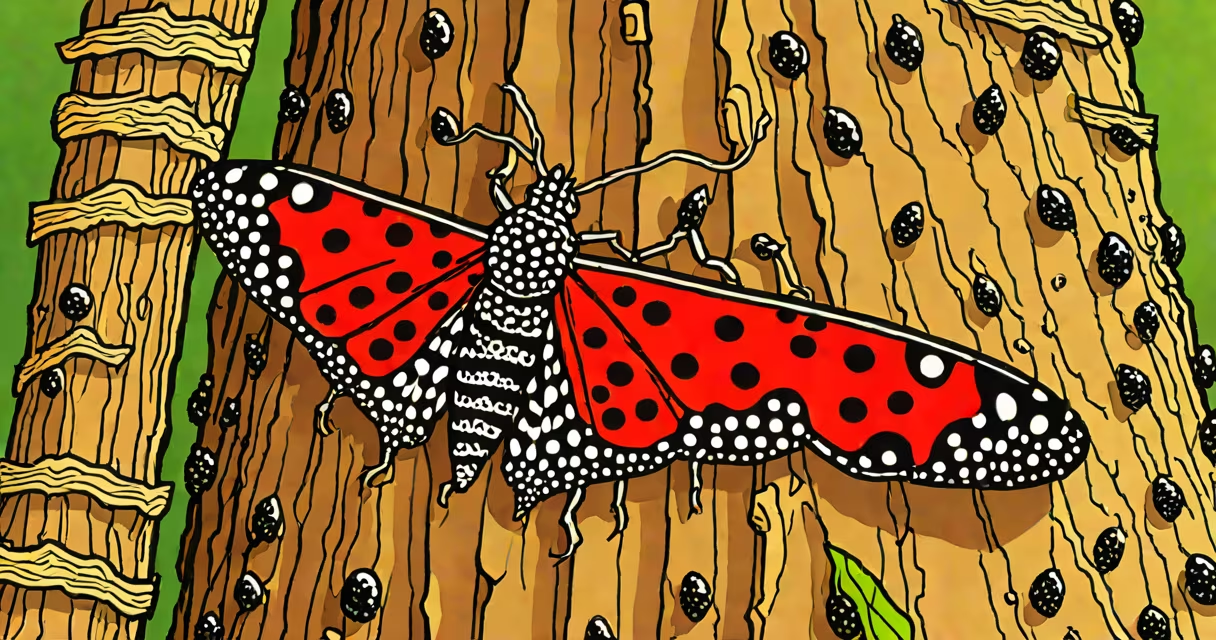
The spotted lanternfly (Lycorma delicatula) is invasive because it feeds aggressively on sap from many plants, damages important crops and trees, and reproduces rapidly in regions without natural predators. Native to parts of China, Japan, and Vietnam, it was first detected in the United States in 2014 and has since spread to over 15 states.
These insects belong to the planthopper family Fulgoridae. Adults are about 1 inch long, with gray forewings marked by black spots and red hindwings. Nymphs-immature stages-are black with white spots and appear in early summer. They feed by piercing plant tissue and sucking sap, which weakens the host and disrupts nutrient flow.
Spotted lanternflies do not kill plants outright, but their feeding causes stress, reduces growth, and leads to dieback. A single adult can consume up to 15 milliliters of sap per day. This level of feeding is unsustainable for many economically important plants, especially grapevines, fruit trees, and hardwoods.
Spotted lanternflies lack natural enemies in North America. In their native range, parasitic wasps and fungal pathogens keep populations in check. In the U.S., no such controls exist, allowing unchecked reproduction. A female lays 30 to 50 eggs per cluster, often on tree trunks, vehicles, or outdoor equipment. Eggs hatch in spring, and nymphs begin feeding immediately.
They move primarily through human activity. Egg masses can survive transport in firewood, landscaping materials, or parked vehicles. In 2022, Pennsylvania reported over 1,200 infestations linked to vehicle movement. The U.S. Department of Agriculture (USDA) maintains a quarantine zone in eastern Pennsylvania to limit movement of potentially infested materials.
Once established, populations grow quickly. In a single season, four generations can emerge. By fall, adults lay eggs that overwinter and hatch the following spring. Without intervention, a single infestation can spread to neighboring properties within 60 days.
Spotted lanternflies attack over 70 plant species. The most vulnerable include grapevines, hardwood trees like maples and birches, and fruit trees such as apples and peaches. Grape growers in Pennsylvania report yield losses of up to 30% in heavily infested vineyards. The state's wine industry, valued at $1.2 billion annually, faces long-term risk.
Damage occurs in two ways. First, direct feeding weakens plants. Second, the honeydew excreted by the insects promotes sooty mold growth. This mold blocks sunlight, reducing photosynthesis and lowering fruit quality. In orchards, sooty mold can reduce apple market value by 20% due to poor appearance.
| Plant Type | Primary Impact | Reported Loss (per study) |
|---|---|---|
| Grapevines | Sap depletion, reduced berry size | 25-30% yield loss (Penn State Extension, 2021) |
| Hardwood trees | Dieback, reduced timber value | 40% decline in growth rate (USDA Forest Service, 2020) |
| Maple syrup production | Reduced sap flow during tapping season | 15-20% drop in syrup yield (Vermont Agency of Agriculture, 2023) |
One non-obvious fact: spotted lanternflies do not prefer one tree species over others. They adapt quickly to new hosts. In 2023, researchers documented infestations on ornamental Japanese maples in residential yards in New Jersey-species previously thought to be resistant.
Some assume spotted lanternflies are harmless because they don't bite humans or cause immediate death. This is incorrect. Their harm is cumulative and indirect. A healthy tree may survive one season of feeding but succumbs after multiple years of stress.
Another confusion is equating them with cicadas. Both are insects that produce noise, but spotted lanternflies do not sing. They are silent except for faint wing vibrations. Cicadas, in contrast, produce loud buzzing sounds during mating season.
People also mistake their egg masses for bird nests or lichen. Egg clusters resemble small, grayish-brown patches, about the size of a quarter. They are often found under bark flaps or on flat surfaces like stone walls. Early detection is critical-once hatched, nymphs disperse rapidly.
In 2016, a residential property in Berks County, Pennsylvania, reported a high density of spotted lanternflies on a mature maple tree. Pest control professionals surveyed the site and found 12 egg masses on the trunk and six on nearby fence posts. Within 45 days, nymphs were observed on adjacent shrubs and garden vegetables.
By late summer, the tree showed signs of stress: yellowing leaves, reduced canopy density, and sap oozing from bark wounds. A follow-up inspection in October confirmed a 60% reduction in leaf area compared to a similar tree in a non-infested area. The homeowner reported that the tree died the following spring.
This case illustrates how quickly spotted lanternflies can degrade plant health. The USDA estimates that untreated infestations lead to tree mortality in 2-3 years. In contrast, treated areas show recovery within one growing season when combined with insecticide applications and pruning.
I observed a treatment trial in a Pennsylvania vineyard in 2022. Workers applied sticky bands around tree trunks to trap nymphs. Over 12 weeks, they collected over 1,800 nymphs per tree. Combined with targeted sprays of neonicotinoid-based insecticides, infestation levels dropped by 85% in treated plots.
However, repeated chemical use raises concerns about pollinator exposure. Bees visiting grapevines near treated zones showed elevated neonicotinoid residues. As a result, integrated pest management (IPM) strategies now emphasize biological controls-such as releasing parasitic wasps-and physical barriers over broad-spectrum chemicals.
Spotted lanternflies remain a serious threat. Their invasive nature stems from rapid reproduction, broad host range, and absence of natural predators. Preventive measures-like inspecting vehicles and reporting egg masses-are essential to slowing their spread.
Understanding why spotted lanternflies are invasive requires recognizing both their biology and human-driven pathways of introduction. Their impact extends beyond agriculture-it affects forest ecosystems, urban landscapes, and regional economies.