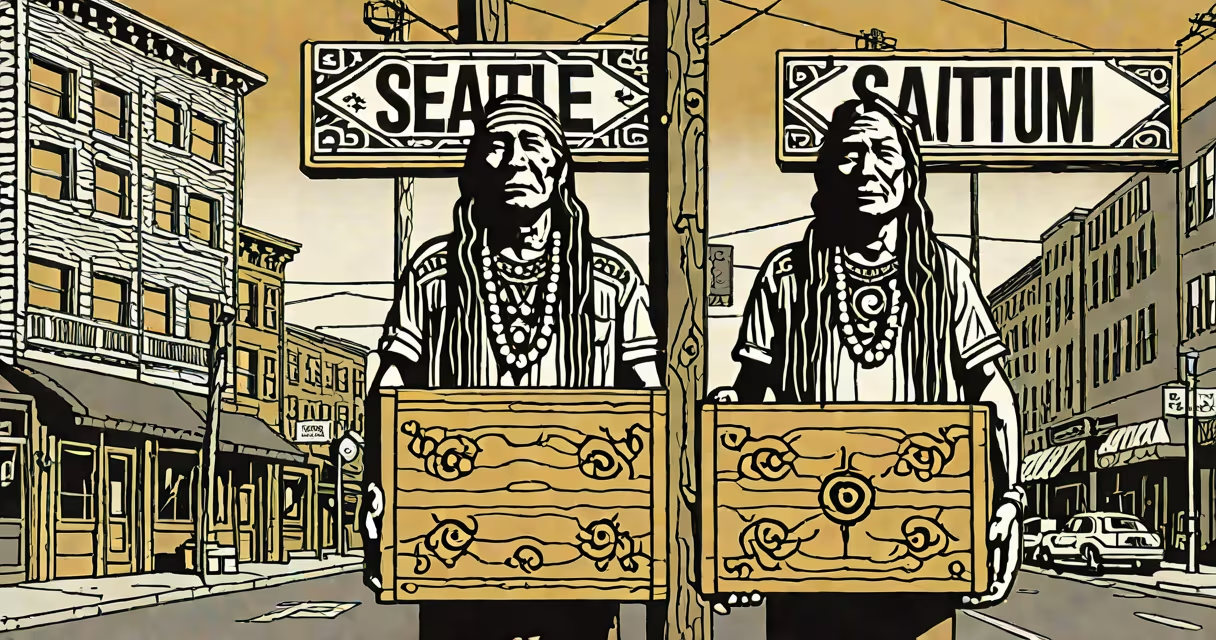
"What You Pawn I Will Redeem" is a short story by Sherman Alexie that follows Jackson Jackson, a homeless Spokane Indian man in Seattle, as he attempts to buy back his grandmother's stolen regalia-a sacred powwow outfit-from a pawn shop using $900 he believes he can earn in a single day.
The narrative unfolds in a single day, tracking Jackson's increasingly desperate efforts to raise money through odd jobs, gambling, and borrowing from friends. He wins $100 playing craps, gets a loan from a friend, and takes a job cleaning toilets at a bar. His goal is not just financial-it's spiritual. Reclaiming the regalia represents a chance to reconnect with his heritage and honor his grandmother's memory.
At the end, Jackson successfully buys back the outfit. He wears it during a late-night powwow at a local church, dances alone under dim lights, and then gives it to a young girl who asks about it. The story concludes with him walking away, free-not because he owns something, but because he has reclaimed his dignity.
Alexie structures the story in real time, compressing a profound personal process into 24 hours. This tight timeline heightens tension and emphasizes the immediacy of Jackson's struggle. The narrative voice is colloquial, introspective, and often darkly humorous-Jackson narrates in a stream-of-consciousness style that mirrors his mental state.
Key moments include Jackson's failed attempt to win money at a casino, his emotional breakdown after losing a bet, and his quiet triumph when he finally pays for the regalia. These scenes aren't just plot points-they're psychological milestones. Each failure chips away at his sense of self, while each small success restores it slightly.
For example, when Jackson wins $100 at craps, he doesn't celebrate with alcohol or sex-he calls his sister to tell her he's "doing okay." That moment reveals his deep longing for connection, not just survival.
The story is built on layered symbolism. The regalia itself is central: a ceremonial outfit worn by Native women during powwows. Its theft represents cultural erasure. Its recovery symbolizes reclamation-not just of property, but of identity.
Seattle's urban field serves as both backdrop and antagonist. Jackson moves through places like the International District, bars, pawn shops, and churches. These spaces reflect the marginalization of Indigenous people in modern America. The city is indifferent-sometimes hostile, sometimes offering fleeting kindness.
Table: Key Elements in "What You Pawn I Will Redeem"
| Element | Description | Significance |
|---|---|---|
| Regalia | Grandmother's powwow outfit, stolen and pawned | Symbol of cultural heritage and personal legacy |
| Timeframe | One day, from morning to night | Intensifies emotional arc; shows urgency of redemption |
| Narrator | Jackson Jackson, homeless, Spokane tribal member | First-person voice blends humor, pain, and resilience |
| Setting | Seattle streets, pawn shops, bars, church basement | Reflects systemic neglect of Native communities |
One non-obvious detail: Jackson never actually uses the regalia to perform. He wears it only once, briefly, in a private moment. The act of dancing alone-without audience or ceremony-is the true performance. It's not about spectacle; it's about presence.
"What You Pawn I Will Redeem" appears in Alexie's 2003 short story collection *Ten Little Indians*. It's widely taught in high school and college literature courses for its exploration of identity, poverty, and Indigenous resilience.
Its use in classrooms stems from its accessibility. The story is short (about 12 pages), uses plain language, and centers a relatable struggle: making ends meet. Yet beneath the surface lies complex commentary on colonization, intergenerational trauma, and the limits of materialism.
For example, when Jackson says, "I'm not asking for much," he's not begging for money-he's asking for recognition. The story resists easy solutions. There's no sudden wealth, no miracle. Redemption comes through effort, humility, and ritual-even if no one sees it.
Many readers assume the story is about winning money or getting rich. It's not. Jackson earns $900-but he spends nearly all of it. The victory isn't financial. It's symbolic.
Another mistake: thinking Jackson is a stereotype of a "drunk Indian." He drinks, yes-but his drinking is tied to grief and loneliness, not laziness. He avoids alcohol when he's working toward his goal. His sobriety during key moments underscores his determination.
Even the title is misunderstood. "What You Pawn I Will Redeem" sounds like a promise between two people. But it's not a contract. It's a declaration of intent-Jackson's vow to himself. He's not waiting for someone else to save him. He's choosing to save himself.
As author and critic Deborah Miranda notes in *The Native American Experience in Literature* (University of Nebraska Press, 2015), "Alexie subverts the idea of redemption as transactional. Here, it's earned through action, not faith or luck."
On a rainy Tuesday in February, Jackson starts at 6 a.m. at a diner, washing dishes for $50. By noon, he's lost $30 at a craps table. He borrows $200 from a friend named Arlene, who tells him, "You're not going to make it." He replies, "I don't care. I have to try."
He works a night shift cleaning toilets at a bar. At 11 p.m., he walks into the pawn shop with $890. The owner says, "That's not enough." Jackson pulls out the last $10 from his pocket. The owner hesitates-then agrees.
He leaves with the box containing the regalia. He changes into it in a bathroom stall. Then he walks to a church basement where a powwow is happening. He dances alone. No music. No crowd. Just movement. Afterward, he gives the outfit to a teenage girl who asks, "Is this yours?" He says, "Yes. Now it's yours."
This moment-giving it away-shows the true meaning of redemption. Ownership isn't possession. It's passing on value.
I once read this story aloud in a community center in Spokane. A man in the back nodded along during Jackson's dance scene. Later, he told me, "That's my uncle. He used to wear a regalia like that." He didn't say much more. But the silence spoke volumes. The story wasn't fiction to him-it was memory.
"What You Pawn I Will Redeem" remains a important piece of contemporary American literature. It challenges readers to rethink what redemption means-and whether it requires applause, approval, or even a witness.