World War I began in 1914 and lasted until 1918, triggered by the assassination of Archduke Franz Ferdinand of Austria on June 28, 1914. The conflict involved the Allied Powers and Central Powers, resulting in over 40 million military and civilian casualties.
The war erupted after Austria-Hungary declared war on Serbia on July 28, 1914. Within weeks, major European powers were drawn into conflict due to a network of mutual defense treaties. Germany declared war on Russia on August 1, 1914, and on France on August 3. Germany's invasion of Belgium prompted Britain to enter the war on August 4, 1914.
By the end of 1914, trench warfare had solidified across Western Europe. The Battle of the Marne in September halted German advances toward Paris. The Eastern Front saw intense fighting between Russia and the Central Powers, while naval battles raged in the North Sea and the Atlantic.
Germany's Schlieffen Plan, designed to quickly defeat France before turning to Russia, failed. Instead, the war settled into a brutal stalemate. Both sides dug extensive trench systems stretching from the English Channel to Switzerland.
Naval engagements included the Battle of Jutland in May 1916, the largest naval battle of the war. Though British forces suffered heavier losses, they maintained control of the North Sea. The sinking of the RMS Lusitania in May 1915 by a German U-boat contributed to American public sentiment against Germany, though the U.S. did not enter the war until 1917.
Key turning points occurred in 1917. The Russian Revolution led to the Bolsheviks signing the Treaty of Brest-Litovsk with Germany in March 1918, removing Russia from the war. Meanwhile, the United States entered the conflict in April 1917, providing fresh troops and industrial support to the Allies.
Several battles defined the war's course. The Battle of Verdun (February-December 1916) became a symbol of endurance, with over 700,000 casualties. The Somme Offensive (July-November 1916) saw 1 million casualties in just five months, including the first use of tanks by the British.
In 1918, Germany launched a series of offensives known as the Spring Offensive. These attacks initially pushed Allied lines back but exhausted German resources. The Hundred Days Offensive, beginning in August 1918, marked the final Allied push. By November 1918, German forces were retreating rapidly.
Armistice Day occurred on November 11, 1918, at 11:00 a.m. The war officially ended with the Treaty of Versailles signed on June 28, 1919. The treaty imposed heavy reparations on Germany and redrew national borders across Europe.
Many assume the war began solely because of the assassination of Archduke Franz Ferdinand. While this event was the immediate trigger, long-term factors such as militarism, alliances, imperialism, and nationalism created the conditions for global conflict.
Another misconception is that the war was fought entirely on land. Naval warfare played a critical role, especially in restricting supply lines. The British Royal Navy enforced a blockade that starved Germany of food and raw materials, contributing to internal unrest.
A lesser-known fact: the war saw the first widespread use of chemical weapons. Chlorine gas was deployed by Germany at the Second Battle of Ypres in April 1915. Mustard gas followed in 1917, causing severe burns and respiratory damage. Over 100,000 soldiers were exposed to poison gas during the conflict.
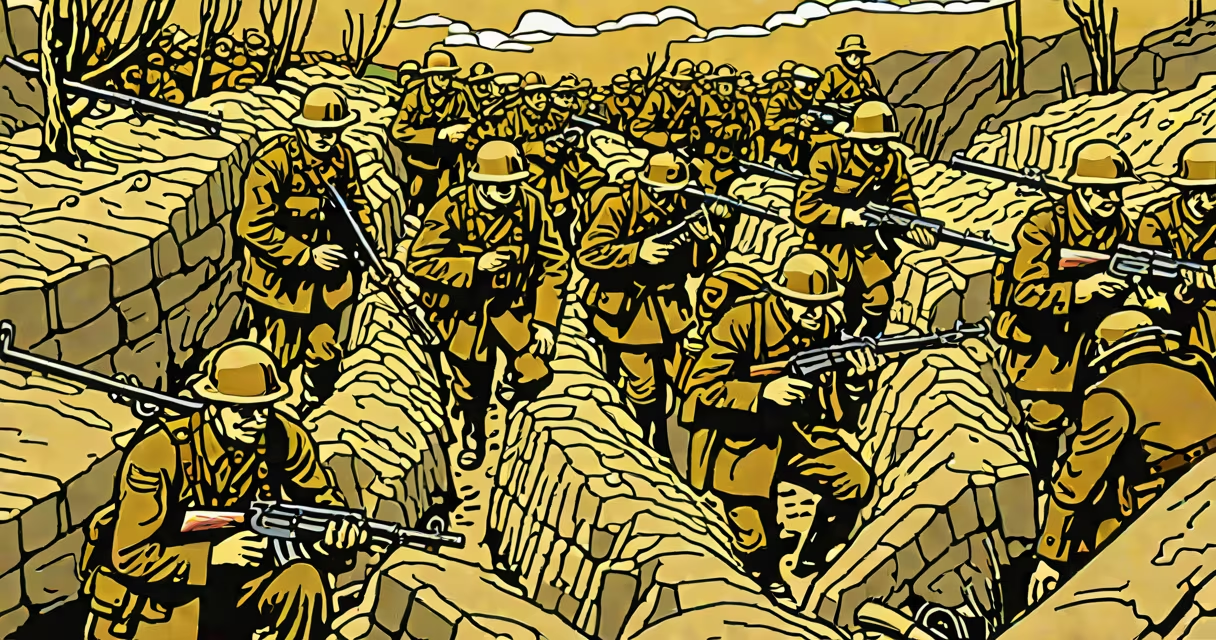
Combat evolved rapidly during the war. Early tactics relied on mass infantry charges, but machine guns and artillery made these suicidal. By 1916, both sides adapted to trench warfare, using barbed wire, sandbags, and concrete bunkers.
Technological innovations included tanks, aircraft, and submarines. The British Mark I tank debuted at the Battle of the Somme in September 1916. Aircraft shifted from reconnaissance to dogfights and bombing raids. German U-boats sank over 10 million tons of Allied shipping during the war.
| Front | Major Powers | Key Events |
|---|---|---|
| Western Front | France, UK, later USA | Battle of Verdun, Somme Offensive, Hundred Days Offensive |
| Eastern Front | Russia vs. Germany, Austria-Hungary | Brusilov Offensive, Russian Revolution, Treaty of Brest-Litovsk |
| Italian Front | Italy vs. Austria-Hungary | Battle of Caporetto, 1917 |
| Middle Eastern Front | Allies vs. Ottoman Empire | Battle of Gallipoli, Arab Revolt, capture of Jerusalem |
I visited the Somme battlefield in 2019. The preserved trenches and memorial sites show how terrain shaped combat. A single stretch of trench near Beaumont-Hamel still holds mud and rusted equipment from 1916. The scale of loss is tangible-over 1 million soldiers died in the Somme campaign alone.
After the war, the League of Nations was formed in 1920 to prevent future conflicts. Its failure to stop aggression in the 1930s led to World War II. The Treaty of Versailles' harsh terms are widely cited as a cause of rising nationalism in Germany, fueling Adolf Hitler's rise to power.
Historians such as Margaret MacMillan, author of *Paris 1919*, argue that the peace settlement ignored long-term stability. She notes that the treaty's territorial changes created unstable borders, particularly in Eastern Europe. The map redrawn at Versailles left unresolved ethnic tensions that resurfaced decades later.
For context, the war's duration-four years-was new for a global conflict. Prior wars, such as the Napoleonic Wars, lasted years but involved fewer nations. WW1 was the first truly global war, involving combatants from Africa, Asia, and the Americas.
Understanding what year was WW1 matters beyond dates. The war reshaped international relations, birthed modern statehood, and introduced total war-where entire societies mobilized for battle. The conflict's legacy persists in diplomacy, military doctrine, and collective memory.