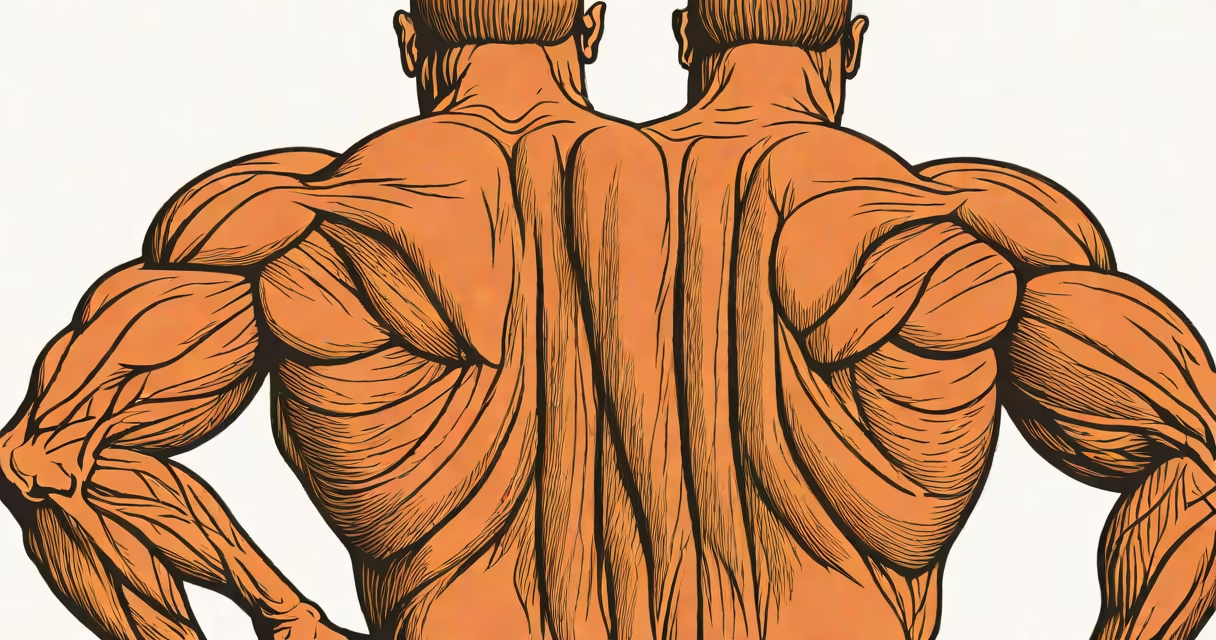
The upper back contains four primary muscles: the trapezius, rhomboid major and minor, levator scapulae, and the upper fibers of the latissimus dorsi. These muscles work together to stabilize the scapula, support upright posture, and enable movements like reaching, pulling, and rotating the torso.
These muscles coordinate to control the position of the scapula-the flat, triangular bone on the upper back. When you sit at a desk, raise your arm overhead, or carry a heavy bag, these muscles contract to keep the shoulder blade stable and prevent strain on the shoulder joint.
The trapezius spans from the base of the skull to the lower spine and divides into upper, middle, and lower fibers. The upper fibers improve the scapula, helping you shrug your shoulders. The middle fibers retract the scapula, drawing it toward the spine. The lower fibers depress and stabilize the scapula during downward movements.
The rhomboids lie deep beneath the trapezius and pull the scapula inward and downward. They activate when you pull your shoulders back, such as during rowing or maintaining good posture while walking.
Each muscle in the upper back performs distinct actions:
Many people mistake the upper back muscles for a single structure. In reality, they are layered and function independently. For example, the trapezius is often misidentified as the sole muscle responsible for shoulder stability, but it's only one component of a complex system.
Another frequent error is assuming that upper back pain stems solely from the trapezius. While tension in the upper trapezius contributes to stiffness and headaches, pain originating from the rhomboids or levator scapulae may feel similar but require different treatment approaches.
A lesser-known fact: the levator scapulae is frequently overlooked in rehabilitation programs despite being a common source of neck and upper back discomfort. Research from the Journal of Orthopaedic & Sports Physical Therapy confirms that tightness in this muscle correlates strongly with forward head posture and chronic neck pain.
Consider a person who sits at a computer for eight hours daily. Over time, the levator scapulae becomes shortened due to constant neck flexion. This leads to aching on one side of the upper back and stiffness when turning the head. Stretching the levator scapulae improves range of motion and reduces discomfort.
Another example: a weightlifter performing seated rows. The rhomboids and middle trapezius contract to retract the scapula. Without proper activation, the upper trapezius overcompensates, leading to muscle imbalances and increased risk of injury.
According to the American Council on Exercise, poor scapular control affects 68% of individuals who perform resistance training without proper form. Strengthening the rhomboids and middle trapezius helps correct rounded shoulders and improves performance in compound lifts.
Pain or tightness in the upper back often signals muscular fatigue, poor posture, or overuse. Symptoms like spasms, localized tenderness, or restricted shoulder movement may indicate strain. A spasm in the upper trapezius can last minutes to hours and feels like a sudden, sharp knot under the skin.
Back spasm symptoms in the upper back typically involve sudden onset of pain, muscle rigidity, and limited motion. If the pain radiates down the arm or is accompanied by numbness, it may signal nerve involvement rather than muscle strain. In such cases, medical evaluation is necessary.
The upper back muscles connect to the cervical spine, thoracic vertebrae, and the humerus. The trapezius attaches to the occipital bone and clavicle, allowing it to influence both neck and shoulder mechanics. The rhomboids originate from the spinous processes of T2-T5 and insert into the medial border of the scapula.
Understanding these attachments explains why upper back pain sometimes feels like it's coming from the neck or shoulder. The levator scapulae runs from C1-C4 to the scapula's superior angle. Its proximity to the cervical nerves means tightness can mimic nerve-related pain.
For reference, the muscles in the upper arm-including the biceps brachii and triceps brachii-work in tandem with the upper back during pushing and pulling. The biceps assist in elbow flexion and supination, while the triceps extend the elbow. When combined with scapular stability, these muscles enable efficient movement patterns.
The upper back muscles-trapezius, rhomboids, levator scapulae, and upper latissimus dorsi-are essential for posture, movement, and joint protection. They do not act alone; their coordinated function prevents injury and supports everyday activities.
Recognizing which muscle is involved in discomfort allows for accurate self-assessment and effective intervention. Ignoring tightness in the levator scapulae or rhomboids can lead to long-term postural issues. Addressing these early prevents progression to chronic pain.
Understanding what muscles are in the upper back enables better movement habits, injury prevention, and informed decisions about physical therapy or fitness routines.