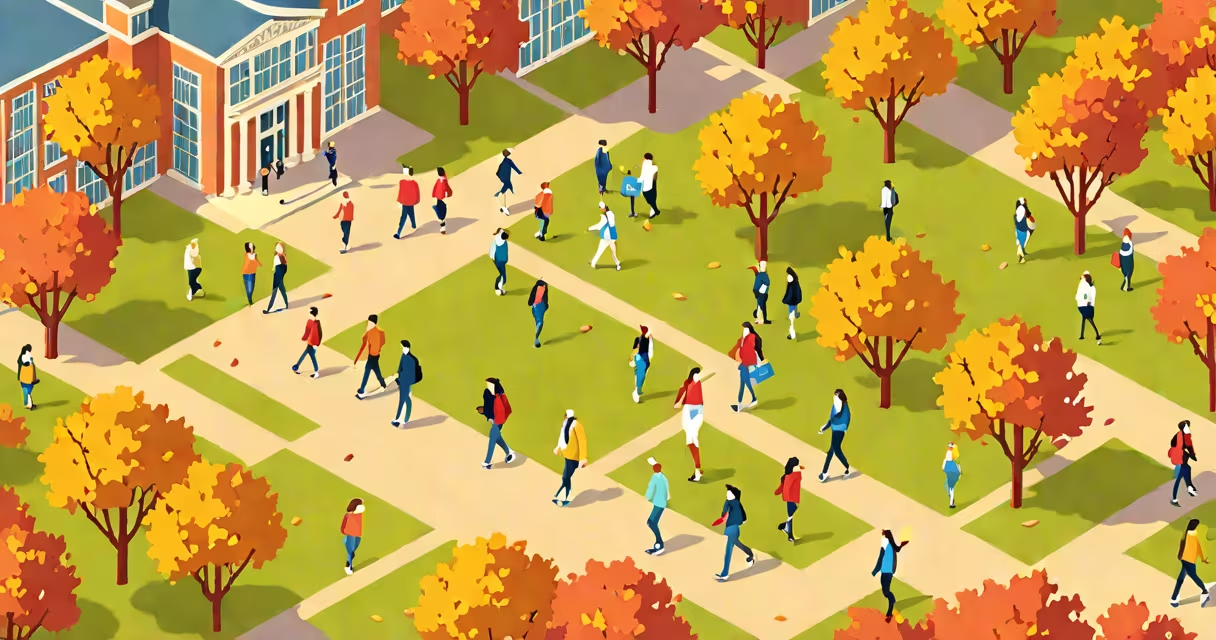
A college undergraduate is a student enrolled in a bachelor's degree program at a university or college, typically lasting four years. This stage follows high school and precedes graduate or professional study. Undergraduate education focuses on broad foundational knowledge across disciplines.
Undergraduates take courses in general education, major-specific subjects, and electives. They earn credits toward a degree such as a Bachelor of Arts (BA), Bachelor of Science (BS), or Bachelor of Fine Arts (BFA). Most programs require 120 credit hours, completed over eight semesters.
The term "undergraduate" distinguishes this level from graduate studies, which include master's and doctoral degrees. A student who earns a bachelor's degree becomes eligible for entry-level jobs or further education. According to the National Center for Education Statistics, 68% of U.S. undergraduates attend public institutions, while 32% attend private colleges.
Students begin as freshmen, then progress through sophomore, junior, and senior years. Each year builds on prior coursework. For example, a biology major takes introductory chemistry in their first year, organic chemistry in the second, and advanced topics like biochemistry in later years.
Courses are structured around credit hours. One credit equals one hour of class per week over a 15-week semester. A typical course is three credits, requiring 45 contact hours. Students usually take 12-18 credits per semester to stay on track for graduation in four years.
Academic advisors help students plan schedules. They ensure requirements are met, including general education courses in math, science, humanities, and social sciences. These courses provide breadth beyond a student's major field.
Undergraduate degrees fall into several categories based on focus and structure:
| Type | Duration | Common Majors | Examples |
|---|---|---|---|
| Bachelor of Arts (BA) | 4 years | English, history, psychology, sociology | Harvard University BA in History |
| Bachelor of Science (BS) | 4 years | Computer science, engineering, biology | MIT BS in Electrical Engineering |
| Bachelor of Fine Arts (BFA) | 4 years | Visual arts, dance, theater | Yale BFA in Acting |
| Bachelor of Business Administration (BBA) | 4 years | Accounting, marketing, finance | University of Michigan BBA in Finance |
Some schools offer accelerated programs. For example, the University of California, Berkeley offers a three-year BA program for high-achieving students who complete summer courses. Others allow dual-degree tracks, such as a BS in Computer Science and a BA in Economics at Stanford.
Colleges and universities host undergraduate programs. Institutions range from large public state schools to small private liberal arts colleges. Community colleges offer two-year associate degrees, which can transfer to four-year programs.
Students pursue undergraduate study for career preparation, personal growth, or access to graduate education. A 2022 report from the U.S. Bureau of Labor Statistics shows that workers with bachelor's degrees earn 67% more on average than those with only a high school diploma.
Many employers require a bachelor's degree for roles in healthcare, engineering, education, and business. For example, becoming a registered nurse requires a BSN (Bachelor of Science in Nursing), not just a certificate.
"Undergraduate" does not mean "freshman." While many undergraduates start as freshmen, the term includes all students working toward a bachelor's degree, regardless of year. A senior in their final year is still an undergraduate.
Some assume that online degrees are less valid. That's false. Regionally accredited online bachelor's programs, such as those offered by Arizona State University, carry the same academic weight as on-campus programs. The U.S. Department of Education confirms that online degrees from accredited institutions meet federal standards.
Another misconception is that majors are set in stone. Students often change majors. The National Student Clearinghouse reports that 30% of undergraduates switch majors at least once. A student entering with a goal of studying computer science may switch to economics after taking a compelling course in behavioral finance.
Sarah entered community college as a first-generation student. She completed 60 credits in two years, focusing on math, English, and introductory science. She transferred to a public university with a 3.5 GPA, meeting the minimum requirement for admission.
At her new school, she declared a major in environmental science. Her first year included General Chemistry I (4 credits), Introduction to Environmental Studies (3 credits), and Calculus I (4 credits). She maintained a 3.2 GPA and joined a sustainability club.
By her junior year, she took Advanced Ecology (4 credits), Environmental Policy (3 credits), and a research internship. She earned 90 credits by the end of her third year. In her final semester, she completed a capstone project analyzing urban green space distribution in her city.
Sarah graduated with honors, earning a Bachelor of Science in Environmental Science. She applied to graduate school in urban planning and was accepted into a program at the University of Washington.
Her process reflects the standard path: transfer, declare a major, complete required credits, and graduate. It also shows how support systems-academic advising, tutoring centers, and student organizations-help students succeed.