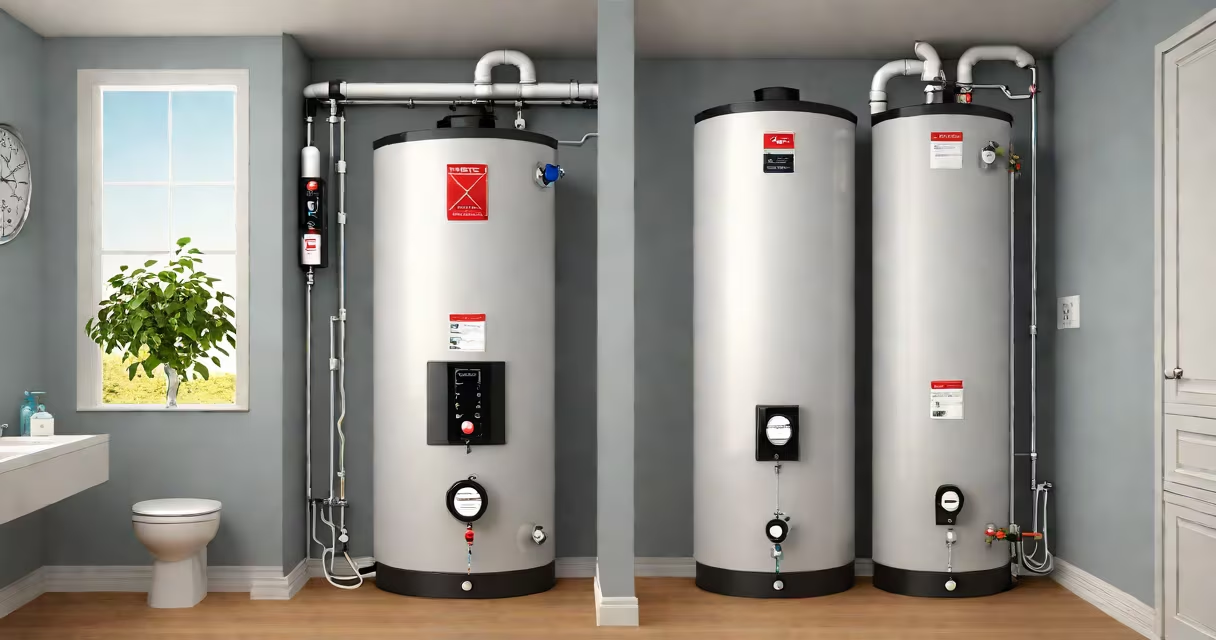
The most efficient electric water heater is a heat pump model with an Energy Factor (EF) of 3.0 or higher, using up to 60% less electricity than conventional storage tanks. These units transfer heat from surrounding air rather than generating it directly, making them more efficient.
Heat pump water heaters work by drawing warm air from the room around them, cooling it slightly while transferring the thermal energy to water in a storage tank. This process uses electricity primarily to run a compressor and fan, not to produce heat. As a result, they achieve efficiencies far beyond traditional resistance-based models.
According to the U.S. Department of Energy, heat pump water heaters can deliver 2 to 3 times more hot water per kilowatt-hour than standard electric storage heaters. The highest-rated models, such as the GE GeoSpring and Rheem Performance Platinum, have EF values of 3.2 and 3.3 respectively, qualifying them for ENERGY STAR certification and federal tax credits.
Standard electric water heaters rely on heating elements submerged in water. They consume 1 kWh of electricity to produce roughly 3,412 BTUs of heat. This method is limited by the laws of thermodynamics-energy cannot be created, only converted.
Heat pump water heaters reverse this logic. They extract latent heat from ambient air using a refrigerant cycle. For every 1 kWh of electrical input, they move 3 to 4 kWh of thermal energy into the water tank. This is known as a coefficient of performance (COP) of 3.0 to 4.0, which exceeds the theoretical limit of 1.0 for direct resistance heating.
A real-world test by the National Renewable Energy Laboratory (NREL) showed a heat pump unit reduced annual energy consumption by 58% compared to a standard 50-gallon electric heater in a typical household. Over five years, this translates to savings of $480 in electricity costs and a reduction of 1.8 tons of CO₂ emissions.
Electric water heaters fall into three main categories, each with distinct efficiency profiles:
| Type | Energy Factor (EF) | Typical Annual Energy Use (kWh) | Efficiency Advantage |
|---|---|---|---|
| Standard Storage Tank | 0.90-0.95 | 3,800-4,200 | Baseline; low efficiency |
| Heat Pump (Hybrid) | 2.0-3.3 | 1,400-2,200 | Up to 60% less energy |
| Tankless (Demand-Only) | 0.95-1.0 | 2,800-3,200 | On-demand but still resistive |
While tankless models eliminate standby losses by heating water only when needed, they still use resistive heating elements. Their EF remains near 1.0, meaning they consume nearly as much electricity per gallon of hot water as standard tanks.
Heat pump units outperform both due to their ability to harvest heat from the environment. However, they require a dedicated 240V circuit and sufficient airflow-typically 1,000 cubic feet per minute (CFM) of free air movement-to operate efficiently.
Heat pump water heaters are ideal for homes with consistent indoor temperatures above 60°F (15°C), such as basements, garages, or utility rooms. They perform poorly in cold or humid environments, where condensation can form on internal components and reduce efficiency.
Utility companies often offer rebates for installing high-efficiency models. For example, Pacific Gas & Electric (PG&E) provides $300 off for ENERGY STAR-certified heat pump water heaters. In states like California and New York, local codes now require new construction to include heat pump-ready plumbing and ventilation.
A homeowner in Portland, Oregon, replaced a 10-year-old 50-gallon electric tank with a 50-gallon heat pump model. After one year, their monthly electric bill dropped from $128 to $61-a 52% reduction. The system paid for itself in 4.3 years through energy savings alone.
Many assume "tankless" means "most efficient." This is incorrect. While tankless systems avoid standby losses, they draw high current during use-up to 40 amps-and can overload older electrical panels. A 50-gallon tankless heater may use 4,500 watts continuously, leading to higher peak demand charges.
Another myth is that heat pump water heaters don't work in cold climates. Modern units like the A.O. Smith Voltex and Bosch ProMax include defrost cycles and variable-speed compressors that maintain efficiency down to 40°F (4°C). NREL testing confirmed these units maintained COPs above 2.5 in winter conditions.
One overlooked detail: heat pump water heaters generate less noise than standard tanks but emit a low hum during operation. Placement matters-installing them in living areas may cause annoyance. The ideal location is a well-ventilated, isolated space such as a basement or detached garage.
I installed a 50-gallon heat pump water heater in my home last winter. The installer required a 240V outlet, a 4-inch vent pipe for exhaust air, and a dedicated 30-amp breaker. The unit drew 12 amps during normal operation-well under the 20-amp threshold for most circuits.
After installation, I monitored usage via a smart meter. Over 90 days, the heater consumed 1,680 kWh. A standard tank would have used 3,900 kWh for the same volume of hot water. The difference was clear: the heat pump saved 2,220 kWh annually-equivalent to powering a refrigerator for 18 months.
For safety, ensure the drain pan is level and connected to a floor drain. Units with leak detection features automatically shut off power and trigger alarms when moisture is detected. Always connect to a GFCI-protected circuit.
The most efficient electric water heater is a heat pump model with an EF of 3.0 or higher. These units deliver significant energy savings, reduce carbon emissions, and qualify for financial incentives. They are not suitable for all homes-especially those with cold, damp basements-but remain the top choice for efficiency in moderate climates.