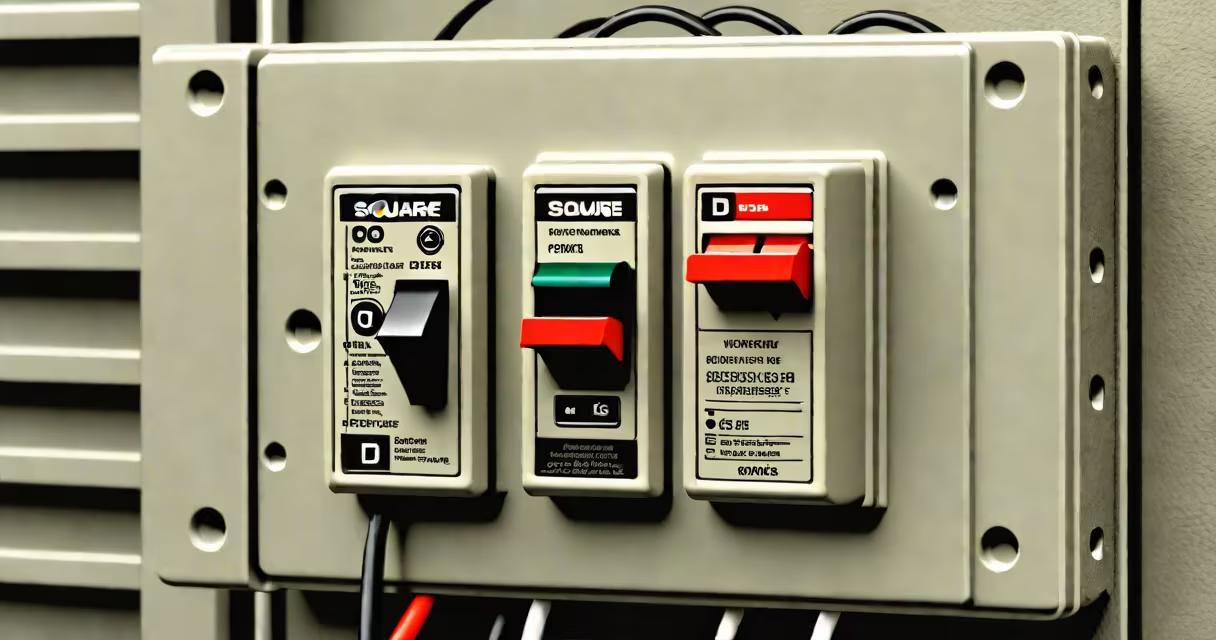
A Square D breaker is a brand-specific circuit protection device manufactured by Schneider Electric, designed to automatically interrupt electrical current during overloads or short circuits, preventing fire hazards and equipment damage in residential and commercial electrical systems.
Square D breakers are standard components in electrical panels, particularly in North American homes and industrial buildings. They function by monitoring current flow through a circuit. When current exceeds safe levels-typically due to too many devices drawing power simultaneously-the internal bimetallic strip heats and bends, tripping the mechanism and cutting off power. This action protects wiring and connected appliances.
These breakers are rated in amperes (amps), such as 15A, 20A, or 30A, matching the capacity of the circuit they serve. For example, a 15A breaker trips if current exceeds 15 amps continuously. The National Electrical Code (NEC) requires such protection to limit overheating in conductors, which can degrade insulation and lead to fires.
Each Square D breaker contains a thermal-magnetic trip mechanism. The thermal component responds to sustained overcurrents-like running multiple high-draw appliances on one circuit. The magnetic component reacts instantly to short circuits, where current spikes to hundreds of amps in milliseconds.
When a fault occurs, the magnetic field generated by the excessive current pulls a lever that mechanically separates the contacts inside the breaker. This opens the circuit and stops power flow. The breaker remains in the tripped position until manually reset, ensuring the fault is addressed before power resumes.
For example, if a space heater (1,500 watts) and a microwave (1,200 watts) run simultaneously on a 15A circuit, total draw reaches ~22.5 amps. A 15A breaker will trip within minutes, preventing wire overheating. Without it, insulation could melt, leading to arc faults and potential fire.
Square D offers several breaker lines tailored to different applications. The most common include:
| Type | Use Case | Key Features |
|---|---|---|
| QO Series | Residential panels | Standard 120/240V, 1-pole and 2-pole models, widely available |
| Homeline | Home electrical panels | Compact design, 15-20A, often used in newer homes |
| Encore | Commercial and industrial settings | Higher amp ratings (up to 60A), rugged construction |
| HD Series | High-demand environments | Handles up to 100A, includes GFCI and AFCI variants |
Breakers differ in functionality. GFCI (Ground Fault Circuit Interrupter) breakers detect leakage currents as low as 4-6 milliamps, shutting off power within 25 milliseconds. They're required in bathrooms, kitchens, and outdoor outlets under NEC Article 210.8.
AFCI (Arc Fault Circuit Interrupter) breakers detect dangerous arcing in wires-common in damaged or loose connections. They prevent fires caused by arcs that don't trigger standard breakers. According to the U.S. Consumer Product Safety Commission, AFCI protection reduces electrical fire risk by 50% in homes.
Many assume that a breaker "burns out" or wears out after years of use. In reality, breakers don't fail simply from age-they degrade due to repeated tripping, poor installation, or voltage surges. A breaker that trips frequently indicates a problem in the circuit, not the device itself.
Another misconception is that breakers can be replaced with higher-rated ones to support more devices. This is unsafe. Using a 30A breaker on a 14-gauge wire (rated for 15A) allows current to exceed safe limits. The wire overheats, risking fire. The NEC mandates that breaker rating must match conductor ampacity.
I once encountered a homeowner who replaced a 15A breaker with a 20A unit to run a portable air conditioner. After three days, the outlet sparked and melted. An inspection revealed the 14 AWG wire couldn't handle the load. The correct fix was either reducing load or upgrading wiring and using a properly sized breaker.
Square D breakers are standard in nearly all new residential builds and renovations in the U.S. and Canada. They're specified in building codes because of their reliability and compliance with UL 489 standards, which test performance under fault conditions.
Electricians choose Square D for consistent mechanical fit in panels. The QO series, for example, uses a unique "push-on" mounting system that ensures secure contact and prevents loosening over time. This reduces arcing at connection points, a known cause of panel fires.
Manufacturers like Eaton and Siemens produce competing breakers, but Square D dominates the market due to integration with their panel brands. For example, Square D's Homeline panels are designed exclusively for Homeline breakers, ensuring optimal performance and safety.
When replacing a breaker, always match the model and series. Installing a QO breaker in a panel designed for a Homeline series causes improper alignment and can result in failure to trip during a fault. This violates NEC Article 110.3(B), which requires equipment to be installed per manufacturer instructions.
Not all breakers are interchangeable. Even if two breakers have the same amperage and voltage rating, differences in frame size, mounting style, and trip curve affect compatibility. For example, a 20A 120V breaker from Square D's HD series won't fit in a panel designed for QO breakers.
Another subtle point: breakers are not switches. While they can be turned off manually, their primary purpose is automatic protection. Using a breaker as a regular on/off switch leads to premature wear. The mechanism is designed for fault response, not frequent cycling.
Understanding what is a Square D breaker involves recognizing it as a critical safety component, not just a switch. Its role in preventing electrical fires and protecting property makes proper selection and maintenance essential. Always consult a licensed electrician when replacing or troubleshooting breakers.