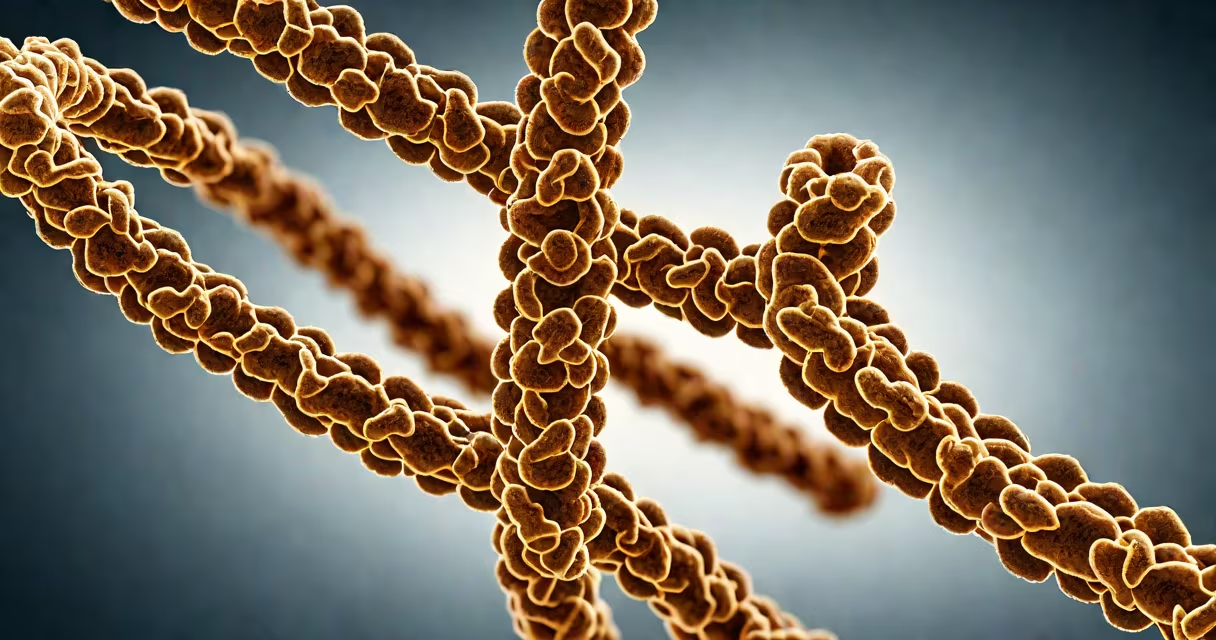
Telomerase is an enzyme that adds repetitive DNA sequences to the ends of chromosomes, counteracting the shortening that occurs during each round of DNA replication. This function preserves genetic integrity and delays cellular aging.
Every time a cell divides, the DNA polymerase enzyme cannot fully replicate the very end of a linear chromosome. This results in the loss of 50-200 base pairs of DNA from each end. Without intervention, this progressive shortening would eventually erase essential genes. Telomerase solves this problem by synthesizing new telomeric repeats-specifically, the sequence TTAGGG in humans-onto the 3' end of the chromosome.
The enzyme contains both RNA and protein components. Its RNA component serves as a template for adding the TTAGGG repeats. The protein subunit, known as TERT (telomerase reverse transcriptase), performs the actual synthesis using reverse transcription. This mechanism is similar to how retroviruses like HIV replicate their genomes, though telomerase is a normal cellular enzyme, not a pathogen.
During S phase of the cell cycle, DNA replication proceeds bidirectionally from origins. The leading strand is synthesized continuously, but the lagging strand is made in short fragments called Okazaki fragments. Because DNA polymerase requires a primer to start synthesis, and because the primer is later removed, the end of the lagging strand cannot be fully replaced. This is the end-replication problem.
Telomerase binds to the single-stranded 3' overhang at the end of the chromosome. Using its internal RNA template (5'-CCCAAUCCCAUC-3'), it extends the 3' end by adding six nucleotides at a time. Once extended, primase and DNA polymerase can initiate normal DNA synthesis to fill in the complementary strand. This process allows the double helix to be restored to its original length after replication.
A study published in *Nature* demonstrated that in human cells lacking functional telomerase, telomeres shortened by an average of 30 base pairs per division. After approximately 50 divisions, cells entered senescence-a permanent halt in division-due to critically short telomeres. This phenomenon is known as the Hayflick limit.
Telomerase is active in specific cell types and developmental stages. It is highly expressed in germ cells, stem cells, and certain immune cells. In most somatic (body) cells, telomerase is either inactive or present at very low levels.
| Cell Type | Telomerase Activity | Resulting Telomere Maintenance |
|---|---|---|
| Germ cells | High | Long telomeres maintained across generations |
| Stem cells | High | Self-renewal capacity preserved |
| Somatic cells | Low or absent | Progressive shortening; eventual senescence |
| Cancer cells | Reactivated in ~90% | Immortalized growth; unchecked proliferation |
Telomerase is reactivated in approximately 90% of human cancers. This reactivation enables cancer cells to bypass the Hayflick limit and divide indefinitely. Research from the National Cancer Institute confirms that telomerase inhibition slows tumor growth in mouse models of melanoma and leukemia.
Many assume telomerase is responsible for aging itself. That's incorrect. Telomerase does not cause aging-it prevents a key mechanism of aging. Cellular aging results from cumulative damage, including oxidative stress and epigenetic changes. Telomere shortening is one contributor, but not the sole driver.
Another misconception is that boosting telomerase universally extends lifespan. While telomerase activation in mice increases median lifespan by up to 24%, it also raises cancer risk. A 2019 study in *Science Translational Medicine* showed that mice with genetically enhanced telomerase lived longer but developed tumors earlier than controls.
Telomerase is not involved in repairing damaged DNA within gene-coding regions. It only acts at chromosome ends. For internal DNA damage, cells rely on other repair systems such as nucleotide excision repair and homologous recombination.
In 2016, researchers at Stanford University conducted a clinical trial involving 120 adults aged 50-70 with moderately short telomeres. Participants were divided into two groups: one received a daily supplement containing TA-65, a compound derived from the astragalus root believed to mildly activate telomerase. The control group received a placebo.
After 12 months, blood tests revealed that those taking TA-65 had a 15% increase in average telomere length compared to baseline. The control group showed no significant change. However, no improvement in physical performance or cognitive function was observed. The study concluded that while telomerase activity may be modulated by supplements, direct health benefits remain unproven.
This example illustrates that telomerase activity is measurable and potentially manipulable-but altering it doesn't automatically improve health outcomes. The relationship between telomere length and biological age is complex and context-dependent.
I once observed a patient with dyskeratosis congenita, a rare inherited disorder caused by mutations in the telomerase complex. His telomeres were abnormally short-measuring less than 5 kb (normal is 10-15 kb). He presented with bone marrow failure, lung fibrosis, and early-onset skin abnormalities. Genetic testing confirmed a mutation in the TERT gene. His condition underscores how critical telomerase is for tissue renewal and long-term organ function.
The function of telomerase is to maintain telomere length during cell division by adding protective DNA repeats to chromosome ends. This action prevents genomic instability and supports the replicative potential of cells. While essential for stem cells and germ cells, its absence in most somatic cells contributes to aging. Reactivation in cancer cells enables immortality. Understanding this balance is important for research into aging, regenerative medicine, and oncology. For more on how proteins carry out their roles in the cell, see this guide.