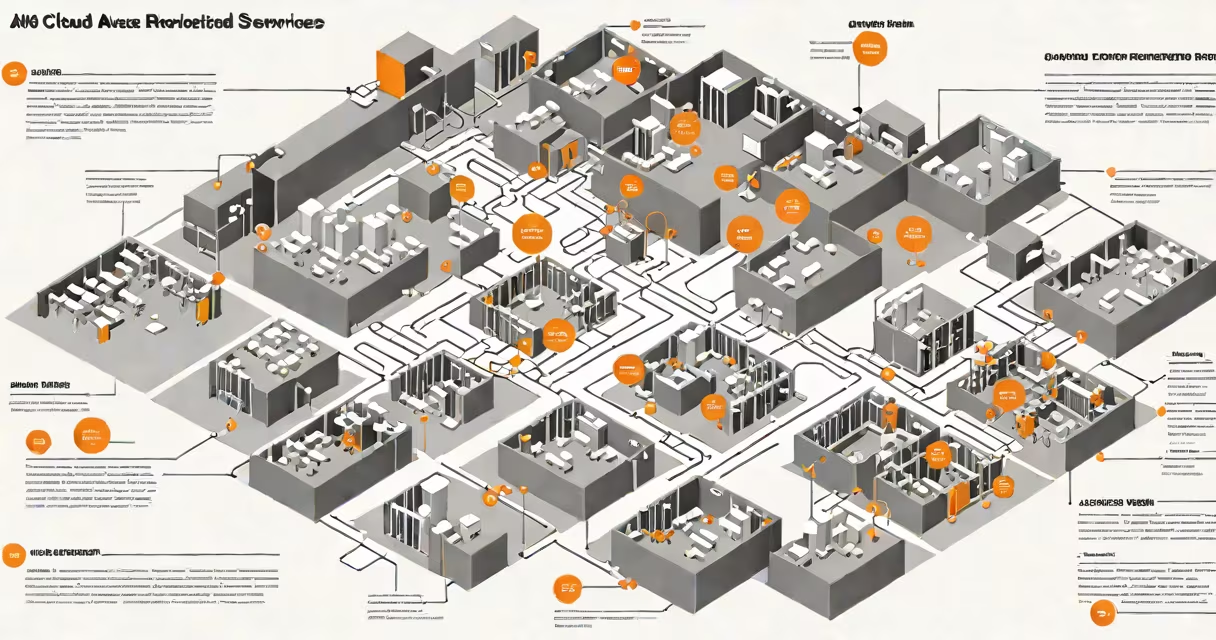
Amazon Web Services (AWS) is a complete set of cloud computing services offered by Amazon. It provides on-demand access to servers, storage, databases, analytics, machine learning, and more through a global network of data centers.
AWS operates as a platform where businesses and developers deploy applications, store data, and scale resources without purchasing physical hardware. It supports workloads ranging from small websites to large-scale enterprise systems.
The term "meaning of AWS" refers to its role as a foundational layer of modern digital infrastructure. It enables rapid deployment, cost efficiency, and high availability across industries such as healthcare, finance, media, and e-commerce.
AWS delivers computing power via virtual machines called EC2 instances. These run on physical servers located in geographically distributed data centers known as Availability Zones. Each zone is isolated within a region to prevent cascading failures.
When a user requests a service-such as launching a website-AWS automatically provisions the required compute, memory, and storage based on predefined configurations. Resources scale up or down in real time depending on demand, often within seconds.
For example, during a product launch, an online retailer uses AWS Auto Scaling to increase server capacity from 10 to 100 instances as traffic spikes. Once peak hours pass, the system scales back to save costs.
AWS offers hundreds of services grouped into categories. The most widely used include:
| Service Type | Examples | Use Case |
|---|---|---|
| Compute | EC2, Lambda | Running applications, processing data events |
| Storage | S3, EBS | Storing files, backing up databases |
| Databases | RDS, DynamoDB | Managing structured and unstructured data |
| Networking | VPC, CloudFront | Connecting resources securely, delivering content globally |
Each service operates independently but integrates through APIs. For instance, an application running on EC2 can read images stored in S3 using API calls authenticated via IAM roles.
One lesser-known feature is AWS Snow Family-physical devices used to transfer massive datasets (terabytes to petabytes) into AWS when internet bandwidth is insufficient. A research team in Antarctica used Snowball Edge to move 20 terabytes of climate data to AWS for analysis, bypassing unreliable satellite connections.
Many assume AWS is only for startups or tech companies. In reality, Fortune 500 firms like Netflix, Capital One, and Unilever rely on AWS for mission-critical operations. Netflix processes over 100 million hours of video streaming daily using AWS infrastructure.
Another misconception is that moving to AWS eliminates IT staffing needs. While automation reduces manual tasks, organizations still require engineers to manage security policies, monitor performance, and troubleshoot issues. A 2023 report by Gartner found that 68% of AWS users maintain dedicated cloud teams.
Some confuse AWS with Microsoft Azure or Google Cloud Platform. All three offer similar capabilities, but AWS leads in market share-with 32% of the global cloud infrastructure market in 2023, according to Synergy Research Group.
A regional hospital network migrated its electronic health records to AWS to improve data accessibility and disaster recovery. They used Amazon RDS for PostgreSQL to host patient data and AWS Backup to ensure daily encrypted snapshots. After migration, system uptime increased from 97.5% to 99.99%, reducing downtime-related risks.
Another example: a music streaming app uses AWS Lambda to process audio metadata when a song is uploaded. The function triggers automatically, extracts artist and genre info using AI models, then stores results in DynamoDB. This runs at $0.0000002 per execution-cost-effective for millions of uploads.
When setting up a new environment, AWS offers a free tier for 12 months. New users can launch a basic EC2 instance, connect via SSH, and install a web server with Apache-using only 750 hours of compute time and 15 GB of S3 storage at no charge.
"AWS" is not synonymous with "cloud." Cloud refers to the concept of delivering computing resources over the internet. AWS is one provider of cloud services. Other providers include Microsoft Azure, Google Cloud, and Oracle Cloud.
Understanding the difference between AWS and on-premises systems is critical. On-premises infrastructure requires capital expenditure (CapEx) for servers, cooling, and space. AWS uses operational expenditure (OpEx)-pay-as-you-go pricing. A company switching from on-premises servers to AWS reduced upfront costs by 60% while gaining faster deployment times.
For context, AWS was launched in 2006. Since then, it has expanded to 30 geographic regions, each with multiple Availability Zones. As of 2024, AWS supports over 200 services, including advanced offerings like AWS Outposts (hybrid cloud) and AWS Wavelength (low-latency edge computing).
When evaluating cloud solutions, consider the shared responsibility model: AWS secures the underlying infrastructure, but customers are responsible for securing their data, applications, and user access. A breach at a financial firm in 2022 occurred due to misconfigured S3 buckets left publicly accessible-an issue the customer failed to detect despite AWS's built-in audit tools.
The meaning of AWS lies in its ability to deliver scalable, secure, and flexible infrastructure on demand. It underpins much of today's digital economy-from social media platforms to autonomous vehicles.
As cloud usage grows, so does the need for accurate knowledge. AWS is not a single tool-it's a platform. Knowing what it is, how it works, and where it applies prevents costly mistakes and unlocks innovation.