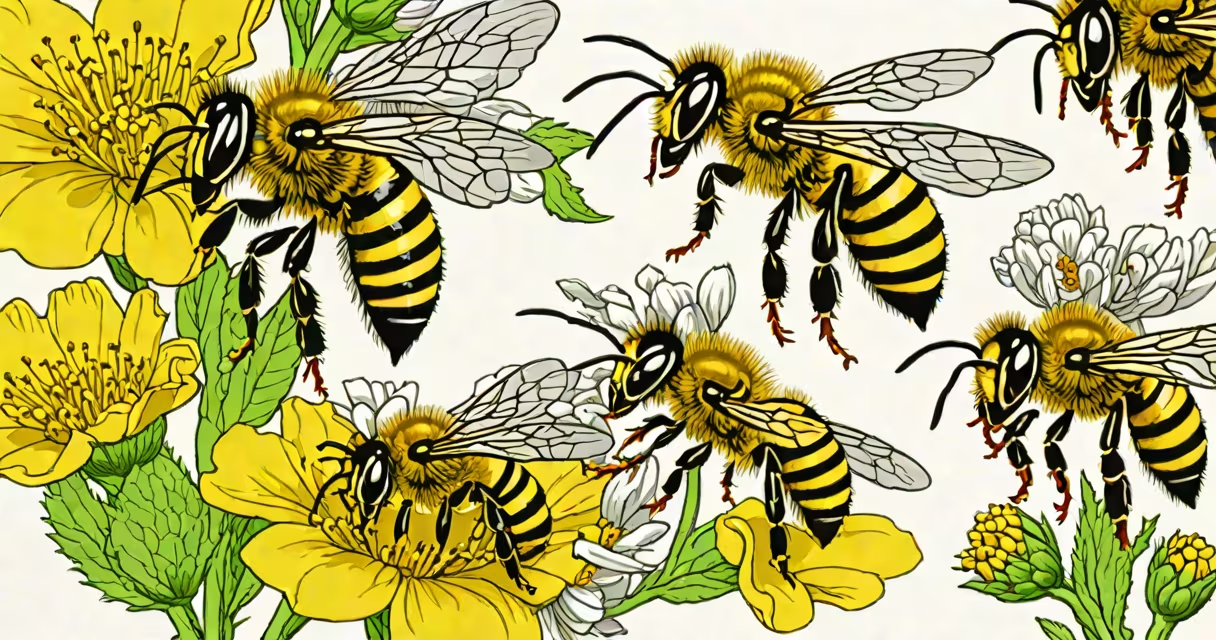
Bees and wasps are both flying insects in the order Hymenoptera, but they differ in body shape, diet, nesting habits, and stinging behavior. Bees are typically hairy, feed on nectar and pollen, and play a key role in pollination. Wasps are smoother, often predatory, and primarily consume protein-rich prey or sugary substances.
Bees evolved to collect pollen as a food source for their young. Their bodies are covered in fine, branched hairs that trap pollen grains. This adaptation makes bees effective pollinators. Wasps, by contrast, lack these specialized hairs and do not actively gather pollen. They are more likely to hunt insects or scavenge meat and sweets.
Both insects can sting, but their stingers differ in function. A bee's barbed stinger detaches during a defensive strike, killing the bee. Wasps have smooth stingers that allow multiple stings without self-harm. This difference shapes how each responds to threats.
Bees tend to be rounder and more densely furred than wasps. Their bodies appear fuzzy due to dense hair, especially on the legs and abdomen. Wasps have slender, segmented bodies with smooth, shiny exoskeletons. Their waists are narrow and sharply defined, giving them a "wasp-waist" look.
Coloration varies, but common bees include honeybees (yellow and black bands) and bumblebees (thick, dark bands). Wasps like yellowjackets and paper wasps display bold yellow and black patterns. The color pattern alone is not enough to distinguish them-some wasps mimic bees, and some bees resemble wasps.
A clear visual cue is wing position at rest. Bees hold their wings folded vertically along their backs. Wasps keep their wings flat and extended sideways. Observing this detail in the field helps avoid confusion.
Bees rely on floral resources. Honeybees (Apis mellifera) travel up to 3 miles from their hive to collect nectar and pollen. They store nectar as honey and use pollen to feed larvae. A single worker bee may visit 50-100 flowers per trip.
Wasps are opportunistic feeders. Yellowjackets (Vespula spp.) hunt flies, caterpillars, and other small insects to feed their young. Adults drink nectar, fruit juice, and sugary drinks-often seen around outdoor events. This scavenging behavior increases human encounters.
One study from the University of California, Davis, found that wasps contribute less to plant pollination than bees. While they do transfer pollen, their smooth bodies shed it quickly, reducing efficiency. Bees, with their hairy bodies, retain pollen for longer distances.
Bees build nests from wax. Honeybees construct hexagonal combs in hollow trees or man-made hives. Solitary bees like mason bees dig tunnels in wood or soil. Colonies range from a few dozen to tens of thousands of individuals.
Wasps build paper nests from chewed wood pulp. These nests hang from eaves, shrubs, or tree branches. The structure resembles a papery brown ball or dome. Paper wasps (Polistes spp.) live in smaller colonies of 10-20 individuals. Yellowjackets form larger colonies-up to 5,000 workers in a season.
Bees are generally non-aggressive unless defending their nest. A honeybee will sting only once and die afterward. Wasps, however, can sting repeatedly and are more likely to attack in groups. A 2021 report from the Centers for Disease Control and Prevention noted that wasp stings cause more emergency room visits than bee stings annually in the U.S., despite fewer total stings.
Many people assume all stinging insects are aggressive. In reality, most bees and wasps avoid humans. A honeybee will only sting if stepped on or threatened. Wasps are more likely to investigate food or drink, leading to accidental stings.
Another misconception is that all bees are beneficial and all wasps are pests. While bees are important pollinators, some wasp species control pest populations. For example, parasitic wasps lay eggs in aphids, killing them. This natural biological control reduces crop damage without pesticides.
There is also confusion between hornets and large wasps. Hornets are a type of wasp, not a separate category. The European hornet (Vespa crabro) is a large, slow-moving wasp that builds large paper nests. It is not more dangerous than other wasps but is often feared due to size and reputation.
| Feature | Bees | Wasps |
|---|---|---|
| Body Shape | Furry, rounded | Smooth, slender, narrow waist |
| Hair Coverage | Dense, branched hairs trap pollen | Minimal, smooth cuticle |
| Diet | Nectar and pollen | Protein (insects), sugar (fruit, nectar) |
| Nest Material | Wax | Paper (chewed wood pulp) |
| Sting Type | Barbed; detaches after use | Smooth; can sting multiple times |
| Social Level | Highly social (e.g., honeybees), solitary (e.g., carpenter bees) | Often social (e.g., yellowjackets), some solitary |
I once observed a bumblebee hovering near a lavender patch in my garden. Its thick, fuzzy body was dusted with golden pollen. A nearby paper wasp, sleek and black with yellow stripes, darted toward a dead fly on the ground. The bee continued feeding peacefully. The wasp caught the insect, carried it back to its nest under the porch, and returned for more. This moment highlighted the ecological divide: one gathering pollen, the other hunting prey.
Understanding the difference between bees and wasps helps reduce fear and supports conservation. Bees are essential for agriculture-about 75% of global crops depend on animal pollination, according to the Food and Agriculture Organization. Wasps serve as natural pest controllers. Mistaking one for the other leads to unnecessary extermination.
When you see a stinging insect, pause. Observe its shape, color, and movement. A fuzzy, slow-flying insect near flowers is likely a bee. A sleek, fast-moving one around food is probably a wasp. Knowing this helps protect pollinators and prevents unnecessary stings.