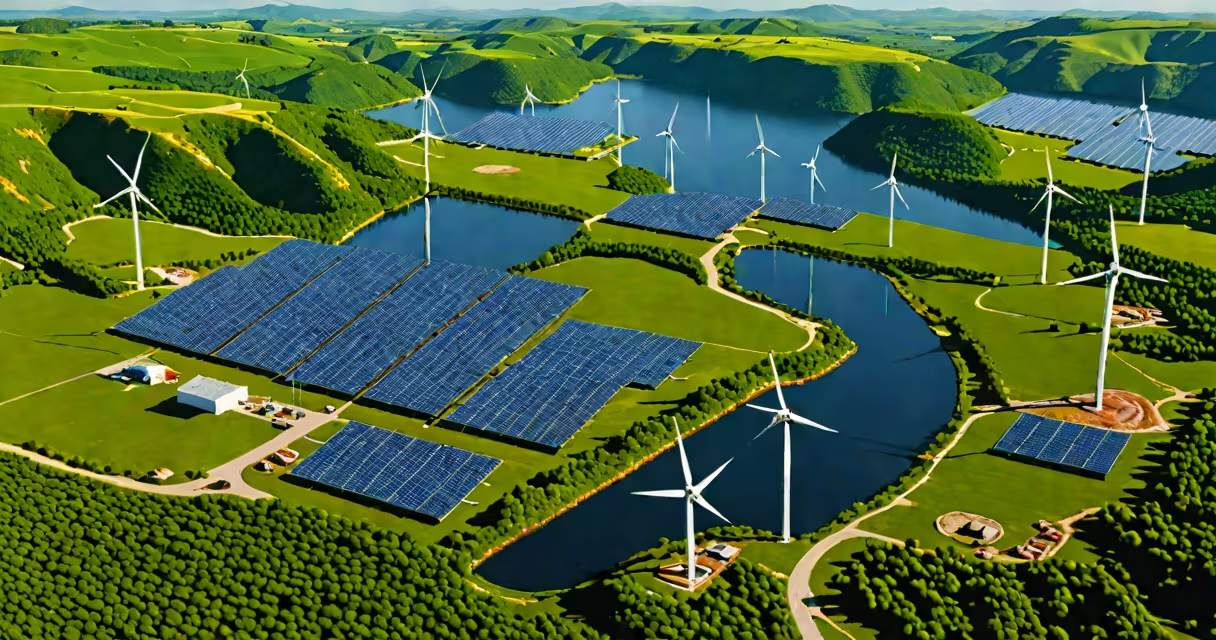
Solar, wind, and hydropower are three renewable resources-naturally replenishing energy sources that do not deplete when used. They derive from ongoing natural processes and play a central role in lowering greenhouse gas emissions compared to fossil fuels.
Solar energy captures sunlight using photovoltaic panels or concentrated solar plants. These systems convert photons into electricity without combustion. The United States installed 39 gigawatts of utility-scale solar capacity between 2010 and 2023, according to the U.S. Energy Information Administration (EIA).
Wind power uses turbines to convert kinetic energy from moving air into electrical current. Modern wind farms deploy large horizontal-axis turbines, often in coastal or high-altitude regions with consistent wind patterns. In 2023, wind accounted for 10% of U.S. electricity generation, per the EIA.
Hydropower generates electricity by channeling flowing water through turbines in dams or run-of-river systems. The largest hydroelectric facility globally is China's Three Gorges Dam, which produces 22.5 gigawatts of power. The International Energy Agency (IEA) reports hydropower supplies 16% of global electricity annually.
Solar panels rely on semiconductor materials like silicon. When sunlight strikes the panel, electrons move, creating direct current (DC). An inverter converts DC to alternating current (AC) for grid use. A typical residential system with 20 panels produces around 6 kilowatts under peak conditions.
Wind turbines operate on aerodynamic principles. Blades rotate when wind flows past them, turning a shaft connected to a generator. A single 2-megawatt turbine can power approximately 1,500 homes annually. Offshore installations benefit from stronger, steadier winds than land-based sites.
Hydropower systems use the gravitational potential of elevated water. Water released from a reservoir passes through a turbine, spinning it to generate electricity. After passing through, water returns to the river downstream. Run-of-river projects avoid large reservoirs, minimizing ecological disruption.
The following table outlines the primary forms of each resource:
| Resource | Type | Key Feature |
|---|---|---|
| Solar | Photovoltaic (PV) | Direct conversion of light to electricity; used in rooftops and utility farms |
| Solar | Concentrated Solar Power (CSP) | Uses mirrors to focus heat and produce steam; enables thermal storage for night-time generation |
| Wind | Onshore | Installed on land; lower costs but limited by terrain and zoning laws |
| Wind | Offshore | Located in oceans; higher wind speeds and less visual impact, but more expensive to build and maintain |
| Hydropower | Dam-based | Creates large reservoirs; provides grid stability but affects fish migration and local ecosystems |
| Hydropower | Run-of-river | Minimal water storage; reduces environmental impact but depends on seasonal flow |
A common misconception is that all renewables are equally low-impact. For example, while solar panels produce no emissions during operation, manufacturing them requires rare earth elements and consumes significant energy. The IEA estimates that producing a standard solar panel emits roughly 40 grams of CO₂ per kilowatt-hour over its lifetime-far below coal's 1,000 grams.
Renewable resources are sometimes conflated with clean energy. While all three major types emit little to no carbon during operation, not all clean energy sources are renewable. Nuclear power, for instance, produces minimal emissions but relies on uranium-fossil-fuel-like extraction and long-lived waste.
Another error is assuming that renewable energy is inherently cheap. Initial installation costs remain high. A 2022 study by the National Renewable Energy Laboratory (NREL) found that the average levelized cost of electricity (LCOE) for utility-scale solar was $36 per megawatt-hour, while onshore wind was $26. These are competitive with fossil fuels but require upfront investment and grid upgrades.
I once observed a community solar project in Vermont where residents collectively funded a 50-kilowatt range. Despite favorable state incentives, the group faced delays due to permitting and interconnection rules. This highlighted that policy and infrastructure-not just technology-are essential for deployment.
These three resources form the core of decarbonization strategies. The Intergovernmental Panel on Climate Change (IPCC) states that limiting global warming to 1.5°C requires tripling renewable capacity by 2030. Solar and wind together are projected to supply 60% of global electricity by 2050 under a net-zero scenario.
Hydropower remains important for grid balancing. Unlike solar and wind, which fluctuate with weather, hydropower can ramp up quickly to meet demand spikes. Countries like Norway and Brazil use hydropower for over 50% of their electricity mix.