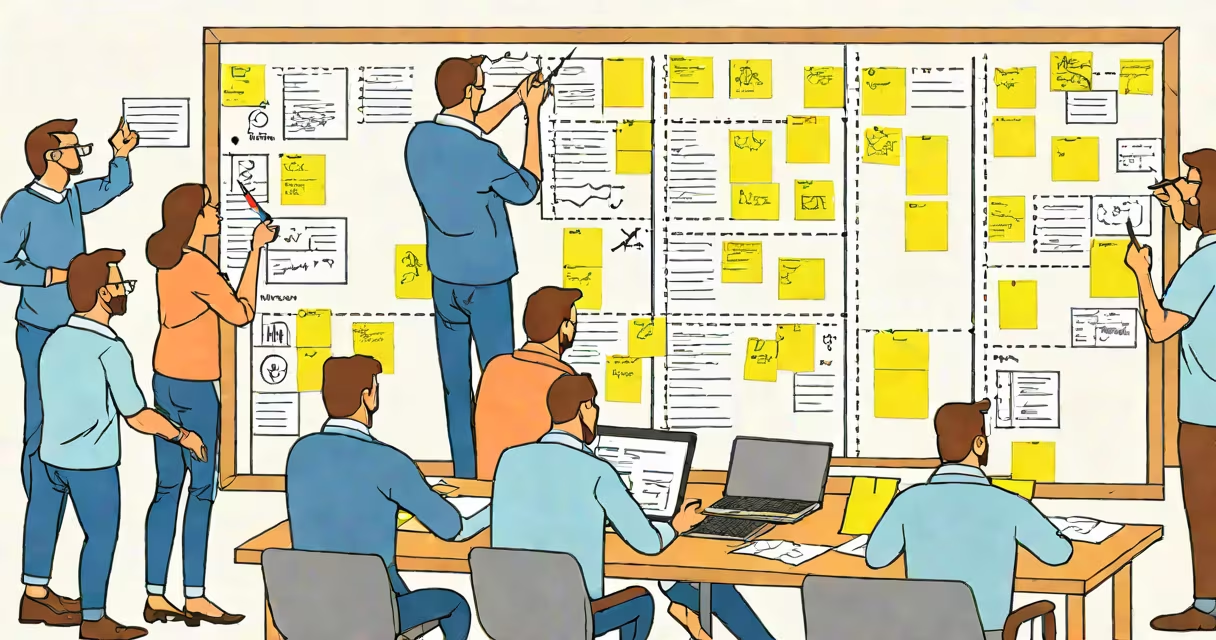
Scrum in software development is an agile structure that structures work into time-boxed iterations called sprints, typically lasting two to four weeks. It emphasizes teamwork, regular feedback, and incremental delivery of functional software. Scrum defines specific roles-Product Owner, Scrum Master, and Development Team-and prescribes ceremonies like Sprint Planning, Daily Stand-ups, Sprint Review, and Sprint Retrospective.
Scrum operates on the principle that complex problems require adaptive solutions. Instead of attempting to define every requirement upfront, teams build small, testable pieces of software each sprint and adjust based on feedback. This reduces risk, increases transparency, and aligns development with business goals. According to the Scrum Guide, the structure was created by Ken Schwaber and Jeff Sutherland in the early 1990s and has since become one of the most widely adopted methods for software delivery.
Each sprint produces a potentially shippable product increment. Teams plan work in a prioritized list called the Product Backlog, which the Product Owner maintains. During Sprint Planning, the team selects items from the backlog to commit to completing in the upcoming sprint. The Scrum Master ensures the process runs smoothly and removes impediments. The Development Team-a cross-functional group of engineers, testers, and designers-executes the work.
Scrum's structure creates predictable rhythm and accountability. A typical sprint begins with Sprint Planning, where the team agrees on the goal and selects backlog items they believe they can complete. These items are broken into tasks and estimated using story points or hours. The team then commits to delivering a set of features by the end of the sprint.
Throughout the sprint, the team holds a 15-minute Daily Stand-up. Each member answers three questions: What did I do yesterday? What will I do today? Are there blockers? This keeps communication efficient and surfaces issues early. The Scrum Master facilitates the meeting and ensures it stays focused.
At the end of the sprint, the team demonstrates the completed work in a Sprint Review. Stakeholders attend, provide feedback, and decide whether to accept the increment. The team then holds a Sprint Retrospective to reflect on what went well, what didn't, and how to improve. These meetings are essential for continuous improvement and team cohesion.
Scrum relies on three distinct roles, each with clear responsibilities:
| Role | Responsibilities | Example Action |
|---|---|---|
| Product Owner | Manages the Product Backlog, prioritizes work, and represents stakeholder interests. | Reorders backlog items based on market feedback after a demo. |
| Scrum Master | Facilitates ceremonies, removes obstacles, and enforces Scrum rules. | Intervenes when a team member dominates stand-ups. |
| Development Team | Delivers working software each sprint; self-organizing and cross-functional. | Breaks a feature into tasks and assigns them during planning. |
The Development Team must be small-ideally 5 to 9 members-to maintain agility. Larger groups slow decision-making and increase coordination overhead. The team owns the definition of "done," ensuring quality standards are met before shipping.
A common misconception is that Scrum is a process or a tool. It is not. Scrum is a structure-a skeleton for organizing work. Teams fill in the details with their own practices, tools, and workflows. For example, one team may use Jira for backlog management, while another uses Trello. The structure remains consistent regardless of tool choice.
Scrum is used across industries, but it's most prevalent in software development. Companies like Spotify, Amazon, and Google apply Scrum to manage large-scale product development. Spotify's engineering model, known as the "Squad Model," is built around Scrum principles, with autonomous teams operating in two-week sprints.
Scrum is effective because it balances flexibility with structure. It allows teams to respond quickly to changing requirements while maintaining focus. A study by VersionOne found that 88% of organizations using Agile methods reported improved project visibility and faster delivery times. Scrum contributes to those results.
Teams adopt Scrum to reduce waste, improve predictability, and increase customer satisfaction. By delivering working software every few weeks, stakeholders see progress early and can adjust direction. This contrasts with traditional waterfall models, where feedback only occurs after months of development.
Many people mistake Scrum for a methodology or a checklist. It is neither. Scrum is a lightweight structure grounded in empirical process control-inspect, adapt, and learn. It doesn't prescribe how to code, design, or test. It only defines who does what, when, and how often.
Another error is assuming that Scrum requires daily stand-ups to be held in person. While face-to-face meetings are ideal, remote teams use video calls. The key is consistency and brevity-not physical location. The Scrum Guide states that the Daily Stand-up must be time-boxed to 15 minutes and occur at the same time every day.
There's also confusion between Scrum and Kanban. Both are Agile approaches, but they differ in structure. Kanban visualizes workflow on a board and limits work-in-progress. Scrum uses fixed-length sprints and predefined events. A team can combine both-using Kanban to track tasks within a sprint-but they are not interchangeable.
Consider a team building a login system for a mobile app. The Product Owner adds "User can log in with email and password" to the Product Backlog, prioritizing it high due to user demand.
In Sprint Planning, the team selects this item and breaks it into tasks: design authentication flow (2 days), implement backend API (3 days), build frontend form (2 days), write unit tests (1 day), and perform integration testing (1 day). They estimate 9 story points and commit to finishing within the two-week sprint.
During the sprint, the team holds daily stand-ups. On Day 5, a developer reports a dependency issue with the identity service. The Scrum Master helps resolve it by contacting the infrastructure team.
At the Sprint Review, the team demonstrates the login screen. The Product Owner approves it, but requests adding a "forgot password" link. That becomes a new backlog item for the next sprint.
After the review, the team holds a retrospective. They identify that testing took longer than expected due to missing test data. They agree to create a mock database for future sprints.
This cycle shows how Scrum enables rapid iteration, learning, and adaptation-all without sacrificing quality.