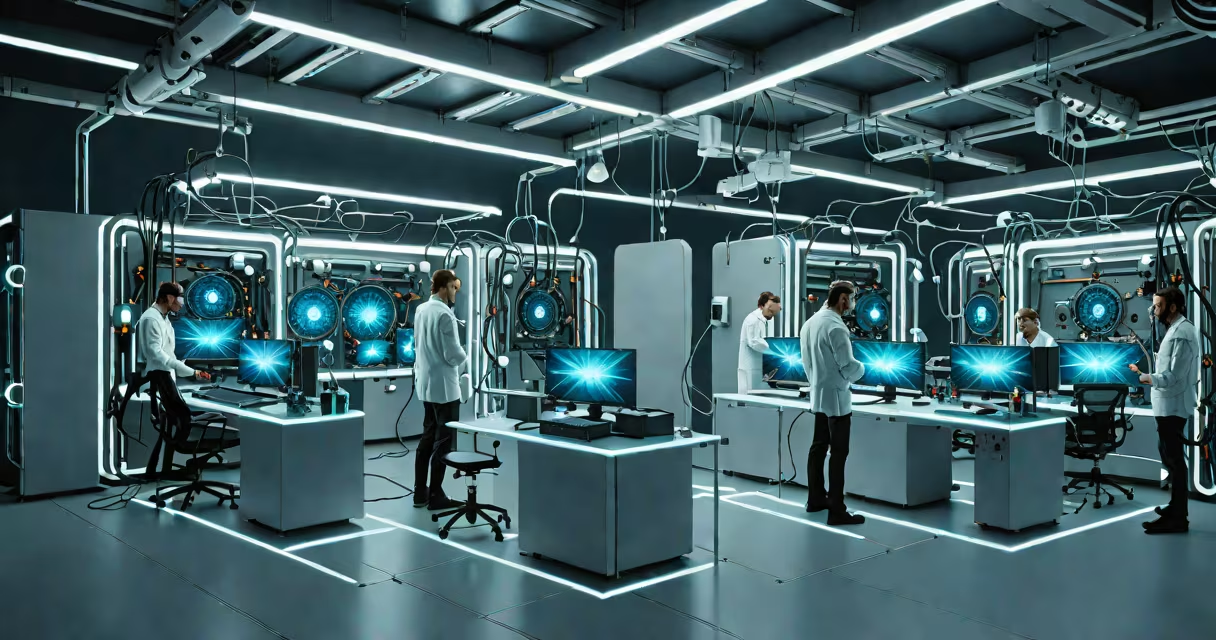
Deep tech refers to technologies rooted in substantial scientific or engineering advances, requiring years of research and development before commercialization. These innovations solve complex problems in fields like AI, quantum computing, biotech, and clean energy, often emerging from academic labs or national research programs.
Unlike consumer-focused software or apps, deep tech products are built on fundamental discoveries rather than incremental improvements. They typically involve high upfront costs, long timelines, and significant technical risk. Examples include gene-editing tools, fusion energy reactors, and autonomous systems using real-time neural processing.
The term originated in venture capital circles in the early 2010s to distinguish projects grounded in physical science from those based on business model innovation. According to MIT's Industrial Performance Center, deep tech ventures take an average of 7.3 years to reach market readiness-nearly twice the time of typical software startups.
Deep tech begins with a breakthrough in physics, biology, materials science, or computational theory. Researchers validate hypotheses through controlled experiments, simulations, or prototype testing. Only after demonstrating feasibility do teams pursue scaling and regulatory approval.
For example, CRISPR-Cas9 gene editing emerged from basic research into bacterial immune systems. Scientists at the University of California, Berkeley, and École Polytechnique Fédérale de Lausanne (EPFL) independently showed that the system could precisely alter DNA sequences in living cells. This foundational work led to therapies for sickle cell disease and certain cancers, now undergoing clinical trials.
Development proceeds through phases: proof-of-concept, prototype, pilot deployment, and commercial rollout. Each stage demands specialized infrastructure-clean rooms for semiconductor fabrication, biosafety level 3 labs for viral vector production, or cryogenic systems for quantum processors.
Deep tech spans several domains, each defined by its underlying science and application timeline. The table below outlines major categories, their typical development duration, and notable real-world applications.
| Type | Typical Development Time | Example Application | Source of Innovation |
|---|---|---|---|
| Quantum Computing | 10-15 years | Drug discovery simulations | Quantum mechanics, superconducting circuits |
| Advanced Materials | 8-12 years | Graphene-based batteries | Condensed matter physics |
| Biotechnology | 6-10 years | Gene therapy for inherited blindness | Molecular biology, synthetic genomics |
| AI-Driven Robotics | 5-8 years | Autonomous surgical assistants | Neural networks, real-time control systems |
| Fusion Energy | 15-20 years | Commercial power generation | Plasma physics, magnetic confinement |
Each category requires domain-specific expertise and infrastructure. For instance, fusion energy projects like those at the ITER facility in France rely on tokamak reactors cooled to near absolute zero using liquid helium. These systems demand multi-billion-dollar investments and international collaboration.
Not all deep tech leads to immediate consumer products. Some remain in the research phase for decades. The Human Genome Project, completed in 2003, took 13 years and $3 billion. Its data now underpins thousands of diagnostics and targeted cancer treatments.
Deep tech addresses systemic challenges that existing technologies cannot solve. Climate change mitigation, pandemic preparedness, and space exploration depend on deep tech breakthroughs. For example, carbon capture systems using metal-organic frameworks (MOFs) can filter CO₂ from industrial emissions with 90% efficiency-far surpassing traditional amine scrubbing methods.
Healthcare relies heavily on deep tech. Modern mRNA vaccines, developed during the COVID-19 pandemic, were built on decades of research into lipid nanoparticles and RNA stability. The Pfizer-BioNTech vaccine used a lipid delivery system designed at the University of Pennsylvania, which protected the fragile mRNA until it reached human cells.
Despite high failure rates, deep tech attracts significant investment. In 2022, global deep tech funding reached $112 billion, according to the World Economic Forum. Investors prioritize projects with clear scientific validation and patent protection. A 2023 report from the National Science Foundation found that 68% of deep tech startups secured patents within five years of founding.
Many confuse deep tech with artificial intelligence or fintech. While AI is a component of some deep tech systems, not all AI projects qualify. A chatbot built with off-the-shelf models is not deep tech. But an AI system trained to predict protein folding-like AlphaFold2 from DeepMind-is deep tech because it solves a 50-year-old problem in structural biology.
Another misconception is that deep tech is inherently slow-moving. While many projects take years to mature, rapid progress occurs in well-funded areas. For example, CRISPR-based therapies have moved from lab concept to FDA-approved treatment in under a decade. In 2023, Vertex Pharmaceuticals launched exa-cel, a one-time gene therapy for beta-thalassemia, after 15 years of research.
A less obvious distinction: deep tech is not synonymous with "high-tech." A smartphone uses advanced components but operates on established principles. Deep tech introduces new laws of nature or material behaviors. The difference lies in novelty of mechanism, not complexity of interface.
I visited a deep tech startup in Boston developing solid-state lithium-ion batteries using sulfide electrolytes. The team had spent four years refining crystal structures to prevent dendrite formation-a known cause of battery fires. During a test run, one prototype sustained 1,200 charge cycles without degradation. That performance exceeded commercial lithium iron phosphate cells by 40%. The project was backed by ARPA-E, a U.S. Department of Energy program focused on high-risk energy innovations.
What is deep tech? It is technology driven by fundamental scientific insight, not incremental design. It includes quantum computing, synthetic biology, fusion energy, and advanced materials. These fields require long-term investment, rigorous experimentation, and cross-disciplinary collaboration. Unlike consumer-facing apps, deep tech aims to change what's possible in medicine, energy, and computing. The impact may take years-but when realized, it changes entire industries.