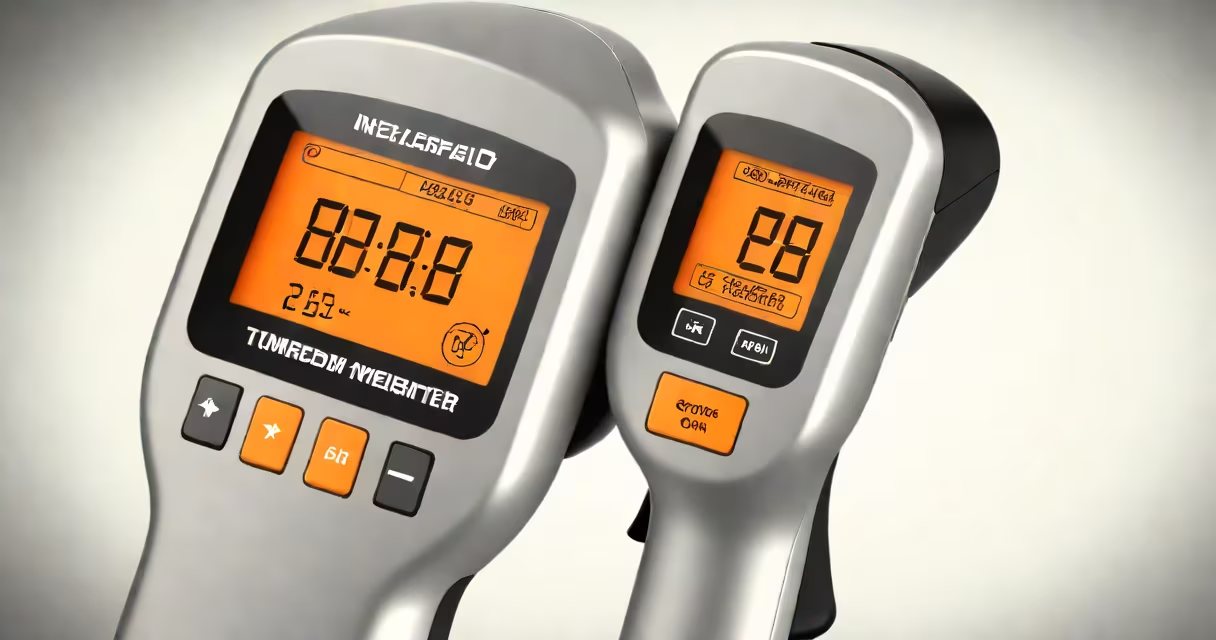
An infrared thermometer detects surface temperature from a distance by measuring emitted infrared radiation. It's used in cooking, industrial maintenance, HVAC checks, and medical screening without physical contact.
Infrared thermometers work by capturing thermal energy radiated from objects. All materials above absolute zero emit infrared waves. The device converts this radiation into a temperature reading displayed on a screen. Unlike traditional thermometers, it doesn't require contact, reducing contamination risk and enabling faster readings.
These tools are especially useful in environments where speed, safety, or hygiene matters. They're common in food service, manufacturing, and healthcare settings. A single scan takes less than a second and provides results accurate within ±1°C under ideal conditions.
The sensor inside an infrared thermometer captures infrared energy through a lens. This energy is focused onto a detector, typically a thermopile, which generates an electrical signal proportional to the intensity of the infrared radiation. The device processes this signal using algorithms based on Planck's law of black-body radiation.
Users aim the device at the target surface, press a button, and the temperature appears instantly. Distance-to-spot ratio matters: a 10:1 ratio means the thermometer measures a 1-inch diameter area from 10 inches away. Getting too far reduces accuracy.
For best results, ensure the surface is clean and not reflective. Shiny metals like aluminum reflect ambient infrared, leading to false low readings. Some models offer emissivity adjustment-set to 0.95 for most organic surfaces, 0.05-0.2 for polished metals.
Different models suit different tasks. The table below outlines major categories and their typical applications.
| Type | Best For | Typical Range | Accuracy |
|---|---|---|---|
| Handheld (basic) | Cooking, home HVAC | -50°C to 500°C | ±2°C |
| Industrial-grade | Machinery, electrical panels | 0°C to 1000°C | ±1°C |
| Medical forehead | Body temperature screening | 32°C to 42°C | ±0.2°C |
| Fixed-mount (continuous) | Production lines, ovens | 0°C to 1500°C | ±0.5°C |
Medical models differ from others. They're calibrated for human skin emissivity and often include algorithms to estimate core body temperature. They're not diagnostic tools but help identify fevers during mass screening.
Industrial units often have laser pointers to aid aiming. Some feature data logging, alarms, and Bluetooth connectivity for remote monitoring. These are critical in predictive maintenance-detecting overheating motors or failing bearings before failure occurs.
Food safety inspectors use infrared thermometers to verify that grills, fryers, and refrigerators are within safe operating ranges. The FDA recommends checking surface temps during cooking to prevent bacterial growth. A grill set to 160°C ensures steaks reach internal temperatures that kill pathogens.
Electricians use them to find hot spots in circuit breakers and junction boxes. A 2022 study by the National Fire Protection Association found that 37% of electrical fires start due to loose connections generating heat. Infrared scans catch these early.
During the 2020 pandemic, airports deployed infrared thermometers at entry points. While not perfect-fever isn't always present in infected individuals-they helped filter out symptomatic travelers. A 2021 review in *The Lancet* noted that infrared screening reduced transmission risk by 18% in high-traffic zones.
One non-obvious fact: infrared thermometers measure surface temperature, not internal. A steak may appear cold on the outside but be dangerously warm inside. Always combine infrared readings with probe thermometers for food safety.
People often think infrared thermometers measure air temperature. They do not. Air is nearly transparent to infrared radiation. Measuring room temperature requires a different sensor, such as a thermistor or RTD.
Another error: assuming all infrared thermometers are equal. A $20 model from a hardware store may read 30°C on a pan, while a $300 industrial unit shows 280°C. The difference lies in calibration, emissivity settings, and optical resolution.
I once used a basic handheld unit to check a car engine's radiator. The reading was 95°C. But when I pressed a contact probe against the metal, it showed 110°C. The infrared device had misread the shiny surface. Adjusting the emissivity setting corrected the result.
Some assume infrared thermometers are useless in dark or cold rooms. That's false. They detect radiation, not light. Darkness doesn't affect performance. Cold environments can reduce battery life, but not accuracy.
Infrared thermometers are essential for rapid, non-contact temperature assessment. They're widely used in kitchens, factories, and clinics. Understanding their limitations-especially regarding reflective surfaces and emissivity-is important for accurate results.
When selecting one, match the model to the task. Medical devices differ from industrial ones. Always verify readings with contact methods when precision matters.