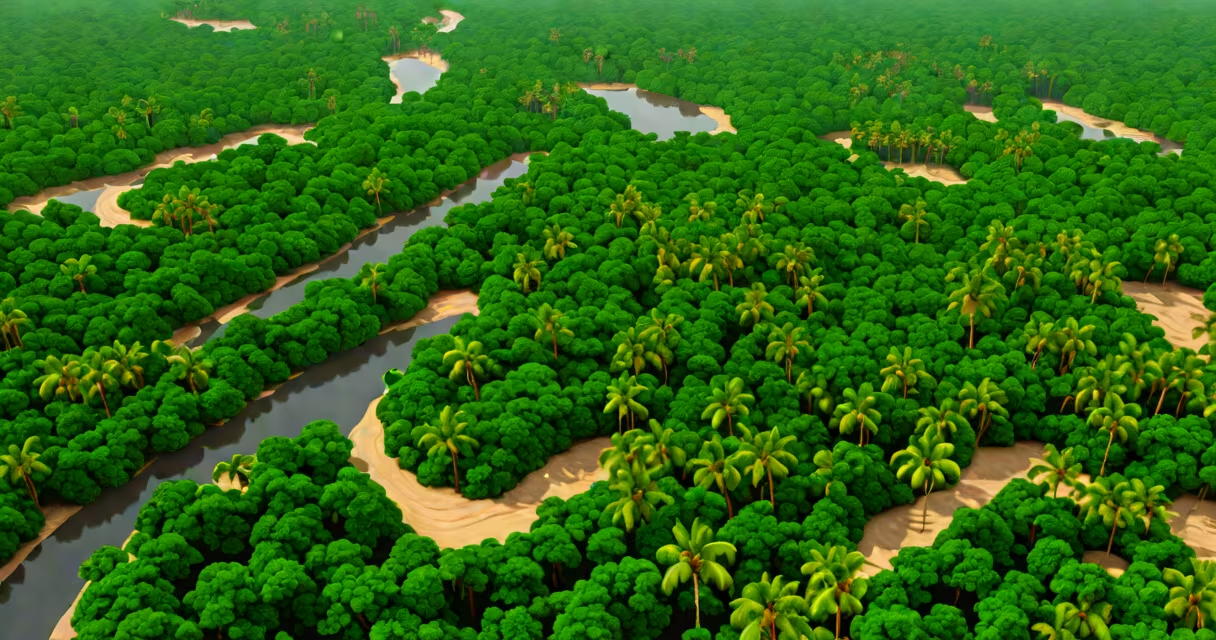
A threat to the rainforest is any human or environmental activity that degrades, fragments, or destroys tropical forest ecosystems, leading to biodiversity loss, carbon release, and disruption of water cycles. These pressures are accelerating due to industrial-scale land conversion and climate feedback loops.
Threats operate through direct destruction and indirect stress. Direct threats include clearing forests for agriculture, logging, mining, and infrastructure projects. Indirect threats involve climate change, invasive species, and altered fire regimes. Together, they reduce forest cover, fragment habitats, and weaken ecological resilience.
The Amazon rainforest lost 13,235 square kilometers of tree cover between 2001 and 2023, according to Global Forest Watch. That's equivalent to losing 18,000 football fields per year. This rate exceeds natural regeneration and pushes ecosystems toward tipping points.
Deforestation begins when roads cut into remote areas, enabling access for farmers, loggers, and miners. Once roads exist, land becomes valuable. Smallholders clear trees for cattle pasture or soy fields. Large agribusinesses follow, often using satellite imagery to identify high-yield zones.
Logging operations remove high-value timber such as mahogany and teak. Selective logging may leave canopy intact, but it damages root systems and increases vulnerability to windthrow and fire. A study in Indonesia found that logged forests had 40% higher fire risk due to increased dryness and fuel accumulation.
Climate change compounds these effects. Warmer temperatures increase evaporation, reducing rainfall. Droughts weaken trees, making them susceptible to pests. In 2015, a drought in the Amazon caused widespread tree mortality, with 10% of trees dying in some regions. This reduced carbon sequestration capacity and released stored CO₂.
Threats fall into four categories: land-use change, resource extraction, climate-related stress, and invasive pressures. Each has distinct drivers and spatial patterns.
| Type | Primary Driver | Example Location | Impact Scale |
|---|---|---|---|
| Industrial Agriculture | Cattle ranching, palm oil, soy | Eastern Amazon, Sumatra | 60% of recent deforestation |
| Illegal Logging | Unregulated timber trade | Central African Republic, Papua New Guinea | 20% of global tropical timber supply |
| Open-Pit Mining | Gold, coltan, bauxite | Madre de Dios, Peru; Democratic Republic of Congo | Mercury contamination in rivers |
| Infrastructure Expansion | Highway construction, dams | Brazil's BR-319 highway corridor | Fragmentation of 1.2 million hectares |
One non-obvious fact: small-scale farming accounts for less than 10% of total deforestation in the Amazon, despite media focus. The majority stems from large agribusinesses operating under weak enforcement. In Brazil, 70% of deforestation in the Amazon occurred on properties with legal titles, indicating institutional failure rather than individual action.
Threats cluster in tropical zones with high biodiversity and low governance capacity. The Amazon, Congo Basin, and Southeast Asian forests face disproportionate pressure due to their rich mineral deposits, fertile soils, and proximity to growing markets.
In the Congo Basin, mining for cobalt and copper has surged since 2010. Artisanal and small-scale mining now occupies over 15,000 hectares of primary forest. Mercury runoff from gold processing contaminates fish and threatens indigenous communities downstream.
On Borneo, palm oil plantations replaced 4 million hectares of rainforest between 1990 and 2020. This conversion eliminated habitat for orangutans, whose population dropped from 100,000 to fewer than 50,000 in the same period. The International Union for Conservation of Nature (IUCN) lists the Bornean orangutan as critically endangered.
Many assume that rainforests are "wild" and untouched. In reality, Indigenous peoples have managed these ecosystems for millennia. Their stewardship reduces fire risk and maintains biodiversity. When their land rights are ignored, deforestation rates rise sharply.
A 2021 study published in Science found that Indigenous-managed lands in the Amazon had 20% lower deforestation rates than surrounding areas. This effect persisted even after controlling for geography and economic development. The data contradicts the myth that conservation requires exclusion of local people.
Another misconception is that climate change is a distant threat. It's already altering rainforest dynamics. In the Amazon, prolonged dry seasons have shifted the balance from carbon sink to carbon source. Since 2005, the region has emitted more CO₂ than it absorbs during drought years.
In August 2019, over 70,000 fires burned across the Brazilian Amazon. Satellite data showed 80% were linked to land clearing for cattle pasture. The fires released 200 million tons of CO₂-equivalent to Spain's annual emissions.
Local residents reported smoke inhalation, respiratory illness, and crop failures. Indigenous leaders documented illegal incursions onto protected territories. The Brazilian government's response included deploying military forces, but enforcement remained inconsistent.
This event illustrates how multiple threats interact: land speculation drove clearing, dry conditions enabled rapid fire spread, and weak law enforcement allowed violations to persist. The cumulative impact exceeded regional recovery capacity.
When I visited the Juruá River region in 2022, I saw a riverbank where 90% of trees had been felled. The soil was compacted, and native fish populations had vanished. A local fisherman told me, "The forest doesn't just disappear-it dies slowly." His words captured the irreversible nature of degraded rainforest ecosystems.
Understanding what is a threat to the rainforest requires recognizing both visible destruction and hidden processes like soil erosion, species displacement, and carbon loss. These changes accumulate over decades and often go unnoticed until collapse occurs.