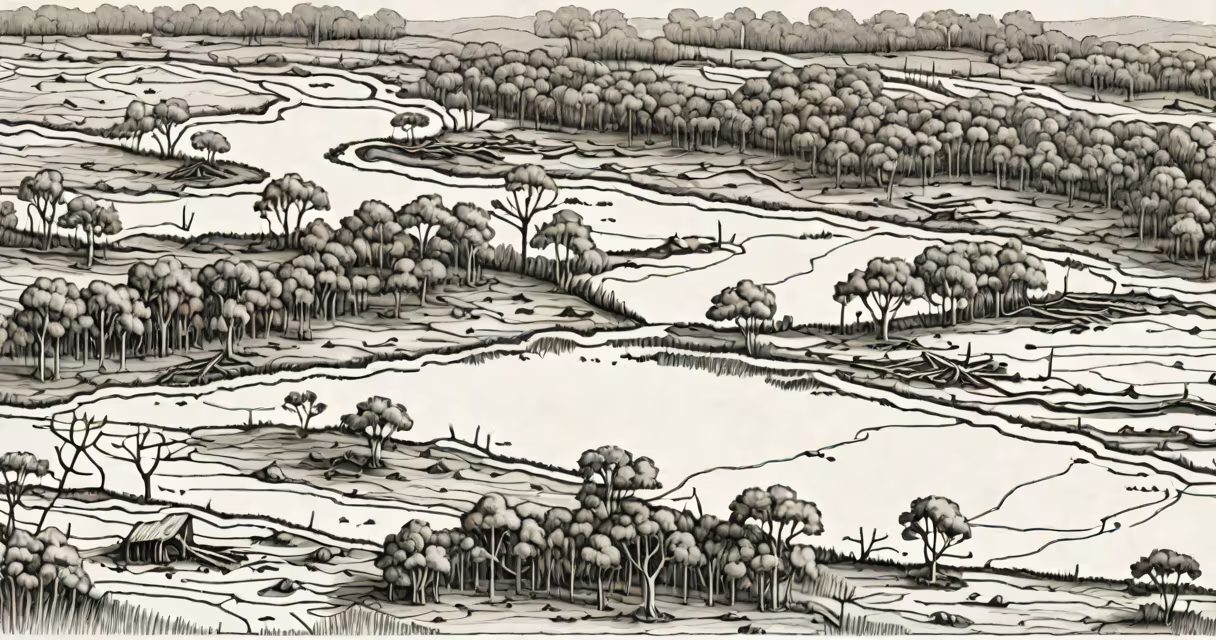
A result of deforestation is the release of stored carbon into the atmosphere, leading to higher greenhouse gas concentrations and contributing to global climate change. This occurs when forests are removed through logging, agriculture, or urban expansion, disrupting the carbon cycle and reducing Earth's capacity to absorb CO₂.
Forests act as carbon sinks. Trees absorb carbon dioxide during photosynthesis and store it in biomass and soil. When trees are cut down and burned or left to decompose, that carbon is released back into the atmosphere. According to the Intergovernmental Panel on Climate Change (IPCC), land-use changes-including deforestation-account for approximately 13% of global anthropogenic CO₂ emissions annually.
Deforestation also triggers cascading ecological disruptions. The removal of tree cover leads to immediate habitat loss for millions of species, alters local weather patterns, and increases surface runoff. In the Amazon rainforest, for example, deforestation has reduced regional rainfall by up to 20% in some areas, according to research published in *Nature Communications*.
When forests are cleared, the complex web of life they support collapses. Tree roots stabilize soil; their removal causes erosion, which degrades farmland and clogs rivers. In Indonesia, deforestation for palm oil plantations has led to severe sedimentation in rivers, damaging fisheries and increasing flood risk downstream.
Animals lose shelter, food sources, and migration routes. The Sumatran orangutan, for instance, has seen its population decline by over 80% since 1990 due to habitat loss from deforestation. The International Union for Conservation of Nature (IUCN) lists the species as critically endangered, citing forest clearance as the primary threat.
Deforestation also reduces evapotranspiration-the process by which trees release water vapor into the air. This weakens cloud formation and reduces rainfall. A 2021 study in *Science Advances* found that large-scale deforestation in the tropics can reduce precipitation by 10-30% in surrounding regions, affecting agriculture and water supplies.
The consequences of deforestation fall into several categories, each with measurable impacts:
| Result Type | Primary Cause | Concrete Example | Source |
|---|---|---|---|
| Carbon emissions | Burning or decomposition of trees | Indonesia's 2015 fires released 1.6 billion tons of CO₂-more than the UK's annual emissions. | Global Carbon Project (2016) |
| Habitat destruction | Clearing for farming or development | Amazon deforestation reached 11,088 km² in 2022-equivalent to 1.5 million football fields. | INPE (Brazil's space agency, 2023) |
| Soil erosion | Loss of root systems | In Haiti, deforestation has contributed to 80% of topsoil loss, worsening drought vulnerability. | FAO, 2020 report on land degradation |
| Water cycle disruption | Reduced transpiration | Central African forests now experience longer dry seasons due to reduced moisture recycling. | Nature, 2022 study on tropical hydrology |
These results are not isolated-they interact. For example, soil erosion from deforested slopes increases sediment load in rivers, which harms aquatic life and reduces reservoir capacity. This creates feedback loops that amplify environmental damage.
Many assume deforestation only affects remote rainforests. In reality, temperate forests-like those in the eastern United States and parts of Europe-also face significant clearing for infrastructure and agriculture. Between 1990 and 2020, Europe lost 1.3 million hectares of forest, primarily due to urban sprawl and road construction.
Another misconception is that replanting trees fully reverses deforestation. While reforestation helps, it takes decades for a newly planted forest to sequester carbon at the rate of a mature one. A 2020 study in *Ecological Applications* showed that even after 50 years, regrown forests capture only 60% of the carbon stored in old-growth stands.
Some confuse deforestation with forest degradation. Degradation involves partial loss-logging, fire, or invasive species-but leaves some canopy intact. This still reduces biodiversity and carbon storage, yet is often overlooked in policy and reporting. The UN Food and Agriculture Organization (FAO) estimates that 40% of global forest loss stems from degradation rather than outright clearing.
In 2022, Brazil recorded 11,088 square kilometers of deforestation in the Amazon-up 22% from the previous year. Satellite data from INPE shows that most of this occurred in protected Indigenous territories, where illegal mining and cattle ranching drive forest clearance.
One documented case involved a 300-hectare plot in the state of Pará. Local communities reported increased flooding and falling crop yields after nearby forest was cleared. Soil samples taken from the area revealed a 45% drop in organic matter and a 60% increase in surface runoff compared to adjacent forested zones.
Scientists linked these changes directly to the loss of tree cover. Without roots to hold soil and leaves to intercept rainfall, the land became unstable. Water now flows faster across the surface, carrying nutrients away and leaving behind compacted, infertile ground.
This illustrates how deforestation doesn't just harm wildlife-it undermines human livelihoods. Small farmers depend on stable soils and predictable rainfall. When forests vanish, so do food security and economic resilience.
Deforestation is not a single event-it's a chain reaction. The removal of one tree may seem minor, but when multiplied across thousands of hectares, the cumulative effect is irreversible for many ecosystems. What is a result of deforestation is not just environmental damage, but a systemic failure to maintain planetary balance.