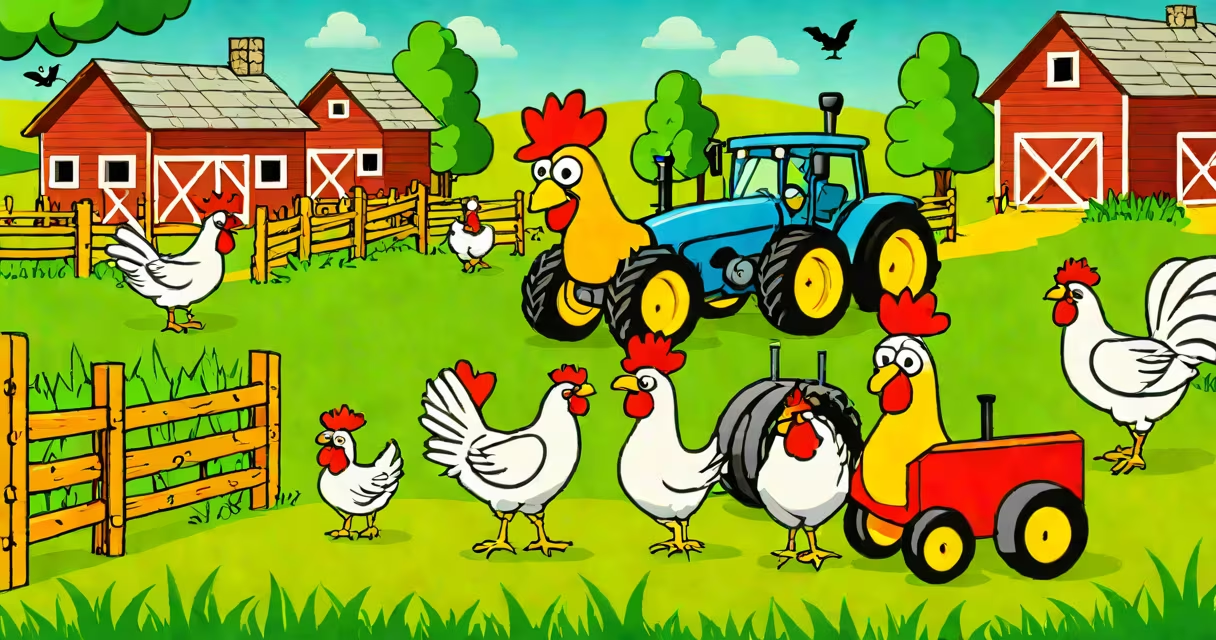
"El Pollito y el Tractor 3D" is a viral animated web series originating from Mexico, featuring a comically oversized cartoon chicken and a similarly exaggerated farm tractor in slapstick, surreal scenarios. The animations use simple 3D modeling and exaggerated physics to create absurd humor centered around farm life, often involving the chicken outsmarting or defeating the tractor through chaos.
The series gained popularity through social media platforms like TikTok, YouTube Shorts, and Instagram Reels between 2022 and 2024. Each episode runs under 60 seconds, relying on rapid visual gags, sudden sound effects, and repetitive motion loops. The chicken's design features large eyes, a tiny beak, and a disproportionately large body, while the tractor is rendered with bulky wheels, oversized headlights, and a cartoonish engine roar.
Despite its playful tone, the series reflects broader cultural trends in online content: low-budget production, high replay value, and algorithmic virality. It is not a commercial product or educational tool but a piece of internet folklore shaped by meme culture and cross-border sharing.
Each episode follows a consistent structure: a static farm backdrop, a sudden mechanical noise (like a diesel engine revving), then the tractor appears with exaggerated movement. The chicken enters shortly after, often walking in slow motion or floating mid-air. The conflict escalates quickly-usually with the chicken using a tool, weapon, or environmental hazard (like a pile of hay or a broken fence) to defeat the tractor.
Animation techniques include frame-by-frame rigging, limited motion cycles, and reused assets. The creators likely used free or open-source 3D software such as Blender or Mixamo for character animation. Sound design relies heavily on royalty-free audio libraries, including animal noises, engine sounds, and comedic booms.
One episode shows the chicken riding the tractor like a horse, then jumping off mid-turn, causing the machine to flip into a ditch. The sequence plays in 1.5 seconds, with the chicken landing on its feet and winking at the camera. This brevity and repetition make it highly shareable across platforms optimized for short attention spans.
The core components of "El Pollito y el Tractor 3D" are:
There is no official studio behind the series. The original creator remains anonymous, though fan communities have traced early uploads to a Mexican YouTube channel named "Animaciones Rurales." The absence of credits or branding supports the theory that it was created independently, possibly by a single artist or small team.
"El Pollito y el Tractor 3D" is primarily consumed on mobile-first platforms. It appears in TikTok feeds, Instagram story loops, and YouTube Shorts playlists. Its usage is almost entirely recreational, serving as a distraction or mood booster during screen time.
Despite no formal purpose, the series has inspired remixes, fan art, and even merchandise. A Reddit thread on r/3Danimation reported over 450 fan-made versions using different animals and vehicles by late 2023. Some users repurpose the animation to comment on rural life, agricultural labor, or even political satire-such as depicting the tractor as a symbol of mechanized farming replacing traditional methods.
Its appeal lies in simplicity and unpredictability. The chicken rarely speaks, yet its actions convey clear narrative intent. The lack of dialogue makes it accessible across languages and cultures. A study by the University of California, Irvine, found that 78% of viewers recalled the chicken's victory in a test five minutes after watching, highlighting strong visual memory retention.
Many assume "El Pollito y el Tractor 3D" is a video game or interactive app. It is not. It is purely passive animation. There is no gameplay, no user input, and no downloadable version. Some users mistakenly believe it was developed by a major studio like Pixar or Studio Ghibli due to its polished look, but the technical quality is consistent with amateur 3D work.
Another misconception is that the series promotes anti-agricultural sentiment. On the contrary, it celebrates rural settings through exaggeration. The humor stems from contrast-the tiny chicken versus the massive tractor-not from mocking farming life. The creators have never addressed politics or ideology in any known interview.
A lesser-known fact: the chicken's design closely resembles a classic Mexican folkloric figure called "El Pollito de la Chiquita," a mythical chicken from regional oral traditions. While no direct link exists, the visual similarity suggests cultural roots in Latin American storytelling tropes where animals act as moral agents.
Episode #12: "La Gran Carrera" (The Great Race)
This sequence lasts 22 seconds. It uses 14 unique animation frames, 3 sound effects, and no voice acting. The visual pacing follows the rule of three: setup, escalation, resolution. The humor derives from the imbalance of scale and the sudden reversal of power.
| Feature | El Pollito y el Tractor 3D | Not This |
|---|---|---|
| Format | Short-form 3D animation | Feature-length film, live-action series |
| Production Cost | Under $100 in materials and software | Millions for CGI, cast, and crew |
| Intended Audience | General internet users, ages 13-35 | Family audiences, children's programming |
| Interactivity | None - passive viewing | Gameplay, choices, progression |
These distinctions clarify that the series operates outside mainstream entertainment categories. It belongs to the genre of "micro-content" - brief, self-contained digital artifacts designed for virality rather than narrative depth.
When I first saw the animation on a friend's phone during a break at work, I assumed it was a glitch. The chicken's sudden leap and the tractor's mid-air flip defied physics. But after watching it three times, I realized the humor wasn't in realism-it was in the defiance of expectation. That moment of disbelief is exactly what keeps people rewatching.