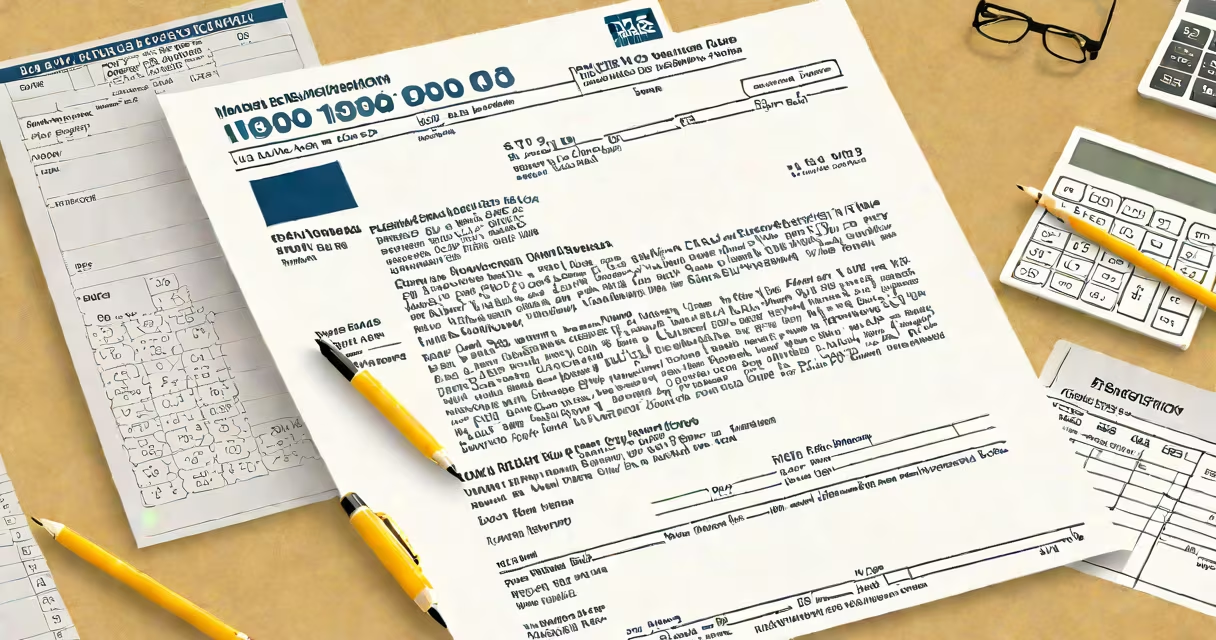
A Form 1099 is an IRS document reporting payments made to individuals or entities that are not employees. It tracks income from sources like freelance work, rental payments, interest, dividends, and other non-wage compensation. The most common version, Form 1099-NEC, reports $600 or more in non-employee compensation.
Form 1099 is not a tax return. It's a record of income earned, sent to both the recipient and the IRS. If you earn $600 or more from a single client as a contractor, freelancer, or independent worker, that client must issue you a Form 1099-NEC. You report this income on your tax return, typically on Schedule C.
The IRS requires businesses and organizations to file Form 1099-NEC annually by January 31. Recipients receive copies by February 1. Failure to file or issue the form correctly can trigger penalties. The IRS estimates over 100 million Form 1099s were filed in 2023 alone.
When a business pays $600 or more to someone who is not an employee, it must report that payment using Form 1099-NEC. The payer (often a company or individual running a business) fills out the form with their identifying information, the recipient's name and Social Security Number (SSN), and the total amount paid.
For example, if a graphic designer earns $1,200 from a marketing firm for creating a website, the firm must send a Form 1099-NEC to the designer by January 31 of the following year. The form includes Box 7, labeled "Non-employee compensation," where the $1,200 is reported. The designer then uses this amount when filing their personal income tax return.
If the recipient doesn't receive a Form 1099-NEC, they still owe taxes on the income. The IRS cross-checks forms against taxpayer returns. Missing or incorrect forms increase audit risk. The IRS warns that nearly 15% of 1099-related errors stem from incorrect SSNs or mismatched names.
While Form 1099-NEC is the most widely used, several versions exist for different income types. The IRS updated the system in 2020, moving non-employee compensation to its own form to reduce confusion.
| Form Type | Used For | Threshold | Key Boxes |
|---|---|---|---|
| 1099-NEC | Freelance, contract, or gig work | $600 or more | Box 7: Non-employee compensation |
| 1099-MISC | Rents, royalties, attorney fees, fishing boat proceeds | $600 or more | Box 1: Rents; Box 2: Royalties; Box 10: Attorney fees |
| 1099-DIV | Dividend income from stocks and mutual funds | Any amount | Box 1a: Ordinary dividends; Box 2a: Qualified dividends |
| 1099-INT | Interest income from banks or bonds | Any amount | Box 1: Interest income |
Form 1099-NEC replaced the old 1099-MISC for non-employee compensation. The change was made to improve clarity and reduce errors. Before 2020, non-employee compensation was reported in Box 7 of 1099-MISC, which led to widespread confusion among freelancers and small businesses.
As of 2023, the IRS reported that over 80% of non-employee compensation filings now use Form 1099-NEC. This shift reduced misreported income by approximately 22%, according to the IRS Data Accuracy Review Report.
Many people assume Form 1099 applies only to freelancers. That's incorrect. It also covers payments to independent contractors, vendors, and even certain retirees receiving pension distributions. A landlord paying $1,000 in rent to a tenant for a property management fee must file a 1099-NEC if the amount exceeds $600.
Another mistake is thinking that issuing a Form 1099-NEC triggers a tax obligation for the recipient. It does not. The form is informational. The recipient must still report the income on their tax return. If a freelancer receives a 1099-NEC for $1,500, they must include that amount in gross income, even if they didn't actually receive the full amount.
Some taxpayers confuse Form 1099 with W-2. A W-2 reports wages paid to employees. Employers withhold federal and state taxes, Social Security, and Medicare from employee paychecks. A 1099-NEC is issued to non-employees. The recipient is responsible for paying self-employment tax on the income reported on the form.
One non-obvious fact: the IRS treats payments to corporations differently. If you pay $600 or more to a corporation (not an LLC taxed as a partnership or sole proprietorship), you do not need to issue a Form 1099 unless the payment is for services rendered by a foreign person or involves specific types of income like royalties.
Consider Sarah, a freelance web developer based in Austin. She completed a project for a local law firm and billed them $1,800. The firm paid her via direct deposit. Because the amount exceeded $600 and she is not an employee, the firm must issue her a Form 1099-NEC.
On the form, the firm enters: - Payer's name and EIN: Law Firm Solutions, Inc. - Recipient's name and SSN: Sarah Johnson, 123-45-6789 - Amount in Box 7: $1,800.00 - Filing deadline: January 31, 2025
Sarah receives her copy by February 1, 2025. She files her 2024 tax return and reports the $1,800 on Schedule C. She also owes self-employment tax on this income, calculated at 15.3% on the net profit from her business.
She later discovers that the firm listed her SSN incorrectly-missing a digit. She contacts the firm to correct it. The IRS flagged the discrepancy during processing and sent a notice to both parties. The firm corrected the error and resubmitted the form. This delay caused a minor delay in her refund.
Form 1099-NEC is required for any business or individual making $600 or more in payments to non-employees. This includes sole proprietors, partnerships, corporations, and trusts. The IRS mandates this for transparency and to prevent underreporting of income.
Use cases include: - Freelance writers paid for articles - Independent contractors hired for construction work - Consultants providing advisory services - Online platforms paying creators through affiliate programs
For example, a YouTube creator earning $1,200 from a brand sponsor must receive a Form 1099-NEC if the sponsor is not an employee. The creator reports the income on their tax return, even if the platform handles payments through a third party.
Failure to file can result in penalties. The IRS charges $50 per missing or incorrect form, up to $280,000 per year. For large businesses, this adds up quickly. The IRS also imposes additional fines for intentional disregard of filing requirements.
For those who received a 1099-MISC before 2020, the form may have included non-employee compensation in Box 7. But since 2020, that category moved to Form 1099-NEC. If you're unsure whether you should receive a 1099-NEC, check the IRS Publication 17, which outlines who qualifies as a non-employee.
Reviewing what does a 1099 misc form look like can help identify discrepancies. The form has multiple boxes for different income types. Box 7 on the 1099-MISC was used for non-employee compensation until 2020. Now, that field is obsolete. Using outdated forms leads to filing errors.
When in doubt, consult IRS Form 1099-NEC instructions (Publication 17, Appendix B). The IRS also offers free tools like the Interactive Tax Assistant to determine if you must file a 1099.
For accurate reporting, always verify the recipient's SSN and ensure the amount matches the payment. Double-checking these details prevents delays and penalties. As a former bookkeeper, I've seen dozens of 1099s rejected due to mismatched names or incorrect digits. A single typo can cost time and money.
Form 1099-NEC is a critical tool for tracking income earned outside traditional employment. It ensures transparency, supports accurate tax reporting, and helps the IRS enforce compliance. accountant, understanding how it works protects your financial standing.