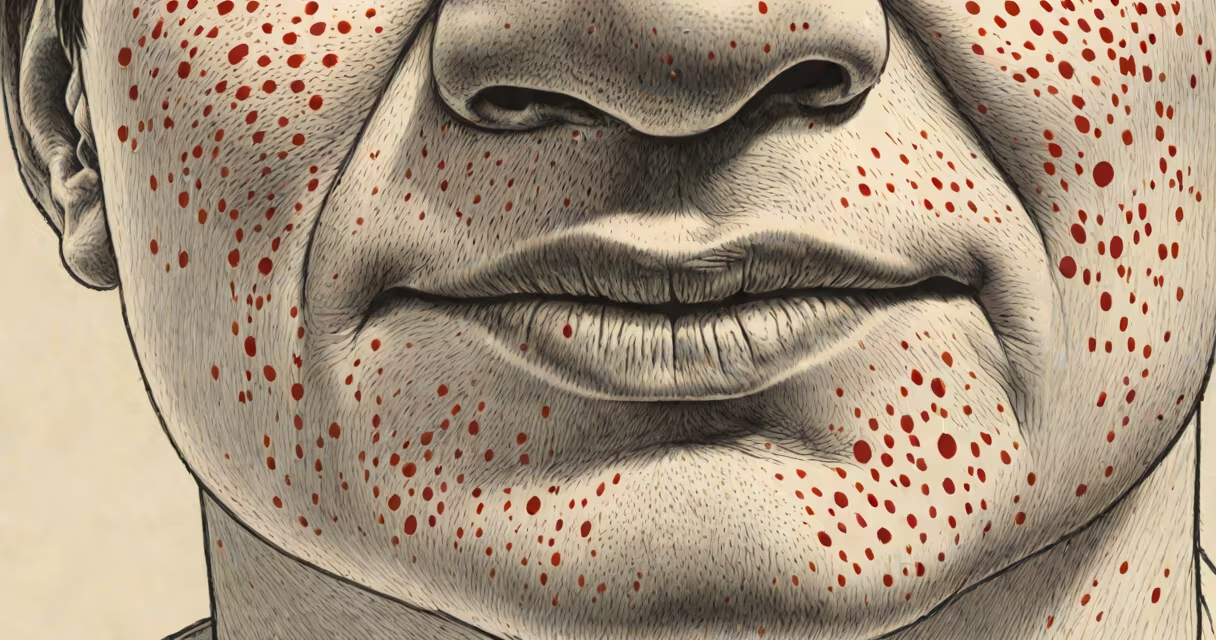
Measles in adults appears as a widespread, red, blotchy rash that typically begins behind the ears and spreads downward over the body, accompanied by high fever, cough, runny nose, and conjunctivitis. The rash often merges into large patches and may leave temporary dark spots upon fading. A key early sign is the presence of small white spots with bluish centers inside the mouth-Koplik spots-before the rash emerges.
Measles is caused by the measles virus (paramyxovirus), which spreads through airborne droplets. While most people contract it in childhood, unvaccinated adults remain susceptible. In adults, symptoms tend to be more severe than in children, with higher risks of complications such as pneumonia, encephalitis, and hospitalization. According to the CDC, adults account for about 10% of reported measles cases in the U.S., but they are disproportionately affected by serious outcomes.
The rash usually appears 10-14 days after exposure and lasts 5-6 days. It starts on the face and moves down the body, following a predictable pattern. The initial phase includes fever rising to 104°F (40°C), cough, runny nose, and red eyes. These symptoms precede the rash by 2-4 days. The rash itself is flat at first, then becomes raised and mottled. As it fades, it may leave brownish discoloration, especially on darker skin tones.
Measles progresses through distinct visual stages. The first stage is the prodromal phase-lasting 2-4 days-marked by high fever, dry cough, nasal congestion, and eye irritation. During this time, Koplik spots appear inside the mouth, typically on the inner cheeks opposite the molars. These spots are tiny, white or grayish with a red base and last 1-2 days before the rash appears.
The second stage is the eruption phase. The rash begins behind the ears and along the hairline, then spreads rapidly down the face, trunk, arms, and legs. By day 3, the rash covers the entire body. It is maculopapular-flat red areas with small raised bumps-and may merge into large confluent patches. The rash is often itchy but not typically painful.
The third stage is the resolution phase. After peaking on day 4-5, the rash begins to fade in reverse order-starting from the face and moving down. Fading occurs over 5-7 days. As it disappears, the skin may peel slightly and leave hyperpigmented marks that can persist for weeks. On lighter skin, the marks are reddish; on darker skin, they appear as dark brown or gray patches.
While the core presentation is similar, measles in adults tends to be more intense. Adults often experience higher fevers (up to 105°F), prolonged fatigue, and greater risk of secondary infections. A 2021 study published in *The Lancet Infectious Diseases* found that adults with measles were twice as likely to require hospitalization compared to children under 10.
Another difference lies in symptom onset timing. In children, the rash may appear earlier relative to fever. In adults, the fever often persists for several days before the rash develops, leading to misdiagnosis as flu or viral upper respiratory infection. This delay increases transmission risk.
Adults may not recognize the disease due to lack of personal memory of past outbreaks. Many adults born before 1980 received only one dose of MMR vaccine, which offers incomplete protection. The CDC reports that 80% of adult measles cases in recent outbreaks occurred in individuals who had only one MMR dose or no documented immunity.
Measles is frequently mistaken for other viral rashes. It is often confused with rubella (German measles), which causes a milder, shorter-lived rash and less severe systemic symptoms. Unlike measles, rubella rarely causes high fever or Koplik spots. Distinguishing features include the absence of conjunctivitis and lymphadenopathy in rubella.
Other conditions that mimic measles include drug reactions, mononucleosis, and Kawasaki disease. Drug-induced rashes typically appear within hours to days of medication use and resolve quickly after discontinuation. Mononucleosis causes a rash only in patients treated with amoxicillin-a rare but specific marker. Kawasaki disease affects young children and presents with persistent fever, swollen hands and feet, and cracked lips.
A key diagnostic clue is the timeline. Measles rash appears 10-14 days after exposure, not immediately after illness onset. If someone develops a rash within 24 hours of fever, measles is unlikely. Also, measles is highly contagious-90% of unvaccinated people exposed to an infected individual will catch it. This rapid spread underscores the importance of isolation during the infectious period.
In 2023, a 22-year-old college student in New York City presented with a 3-day history of fever (103.5°F), persistent cough, and red eyes. He had no known history of measles vaccination. On day 4, he developed a red, blotchy rash starting behind his ears and spreading down his neck and torso. He reported seeing small white spots inside his mouth two days prior.
He was diagnosed with measles via PCR testing of a throat swab. His condition worsened over the next 48 hours-he developed pneumonia and required oxygen support. He was isolated until day 10 post-rash onset. His recovery took 14 days, including a week of bed rest and hydration. Contact tracing identified 17 close contacts, all of whom were vaccinated or quarantined.
This case highlights how measles in adults can progress rapidly and lead to hospitalization. It also shows the value of early recognition-especially the presence of Koplik spots-which prompted timely testing and containment.
Diagnosis relies on clinical signs and laboratory confirmation. Blood tests detect IgM antibodies against the measles virus, which appear within 3-5 days of rash onset. IgG levels rise later and indicate past immunity or infection. PCR testing of throat swabs or urine samples is more accurate for confirming active infection.
Healthcare providers should consider measles in any unvaccinated adult with fever and rash, especially if there's a history of travel or exposure to a confirmed case. The World Health Organization recommends testing all suspected cases, even in regions with low endemic rates, due to the risk of imported cases.
When in doubt, isolate the patient and notify public health authorities. Measles is a nationally notifiable disease in the U.S., requiring reporting within 24 hours of suspicion.
Vaccination remains the most effective way to prevent measles. The MMR vaccine (measles, mumps, rubella) is administered in two doses: the first at 12-15 months, the second at 4-6 years. Adults born after 1957 who have no documentation of immunity should receive at least one dose of MMR.
For those who are unsure of their immunity status, a blood test for measles IgG antibodies can confirm protection. If negative, a single dose of MMR is recommended. The vaccine is safe and effective-two doses provide 97% protection against measles.
Measles in adults is not a minor illness. Its appearance-rash, fever, and systemic symptoms-requires prompt attention. Early detection reduces spread and prevents complications. Vaccination remains the best defense.