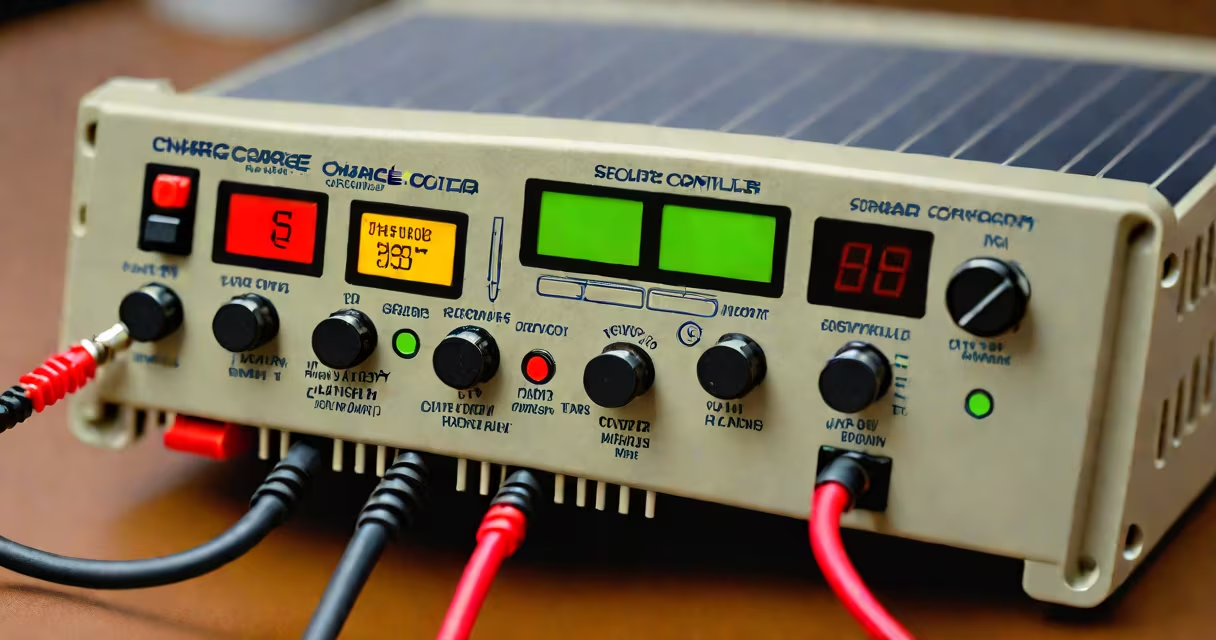
A charge controller manages the flow of electricity from solar panels to batteries, preventing overcharging and ensuring efficient energy storage. It acts as a traffic director between solar arrays and battery banks, maintaining safe voltage levels and extending battery life.
Solar panels generate variable voltage based on sunlight intensity. Without regulation, this fluctuating output could damage batteries through overvoltage or excessive current. A charge controller stabilizes the input, adapting to changing conditions throughout the day.
According to the National Renewable Energy Laboratory (NREL), improper charging reduces lead-acid battery lifespan by up to 50%. Charge controllers mitigate this risk by monitoring battery state and adjusting charge rates accordingly. They are essential components in off-grid and grid-tied solar installations.
The charge controller receives direct current (DC) from photovoltaic panels and channels it to a battery bank. It continuously measures both panel voltage and battery voltage, comparing them to determine the optimal charge profile.
When sunlight increases, panel voltage rises. The controller detects this and increases current delivery until the battery reaches full charge. At that point, it switches to float mode-maintaining a stable voltage to prevent gassing and water loss in flooded lead-acid batteries.
For example, a 12V battery typically charges at 14.4V during bulk phase, drops to 13.6V in absorption, and settles at 13.2V in float. A controller enforces these stages automatically. NREL testing shows that proper stage control improves battery cycle life by 30% compared to unregulated charging.
Two primary technologies dominate: Pulse Width Modulation (PWM) and Maximum Power Point Tracking (MPPT). Each suits different system sizes and efficiency needs.
| Type | Efficiency Range | Best For | Cost |
|---|---|---|---|
| PWM | 70-85% | Small systems under 300W, budget setups | Low ($20-$50) |
| MPPT | 90-98% | Larger systems, high-voltage arrays, cold climates | High ($80-$250) |
PWM controllers match panel voltage to battery voltage. If a 12V panel produces 18V under sunlight, the controller drops it to 12V, wasting excess energy as heat. This limits usable power to roughly 70% of available solar output.
MPPT controllers track the maximum power point-the voltage at which the panel delivers peak wattage. They convert surplus voltage into additional amperage, increasing usable energy. In winter or low-light conditions, MPPT systems can harvest 20-30% more energy than PWM units.
For instance, a 300W solar range operating at 18V produces 16.7A. With a PWM controller, output drops to ~12V, reducing effective power to ~120W. An MPPT controller maintains near-peak performance, delivering close to 300W. Over a year, this difference translates to 15-20% higher annual yield.
Many assume that any solar charge controller works universally. That's incorrect. Using a 12V-rated controller with a 24V battery bank causes immediate failure due to mismatched voltage thresholds.
Another mistake is oversizing the controller. A 100A controller on a 100W panel wastes money and space. The controller must handle the maximum current from the range-typically 1.25× the panel's short-circuit current (Isc).
For example, a 200W panel with Isc = 10.5A requires a controller rated for at least 13.1A (10.5 × 1.25). Choosing a 15A model meets minimum specs. Oversizing beyond 20A adds cost without benefit.
Some users believe charge controllers eliminate the need for fuses. This is false. Fuses protect against reverse current and short circuits. A controller may fail safely, but wiring faults still pose fire risks. NEC Article 690.9 mandates overcurrent protection between panels and controllers.
In remote cabins, charge controllers maintain battery health over months of variable weather. One off-grid home in Montana reported a 40% longer battery life after switching from a basic PWM unit to an MPPT controller with temperature compensation.
I installed a 60A MPPT controller on a 1.2kW solar range in Arizona. During summer, panel output peaked at 18V. The controller adjusted charge rate dynamically, preventing overheating and maintaining consistent battery voltage. After 18 months, battery capacity remained above 90% of original rating-well above the industry average of 75% for unregulated systems.
For marine applications, charge controllers prevent sulfation in batteries left idle during long voyages. A sailboat in Maine used a smart controller with automatic equalization cycles. Battery resistance dropped from 25mΩ to 8mΩ over six months, indicating reduced internal degradation.
Understanding what a charge controller does ensures system longevity and safety. It doesn't just "turn on" solar power-it actively manages energy flow, protects batteries, and maximizes return on investment. Choose the right type based on range size, climate, and budget. Always verify compatibility with your battery and panel specifications.